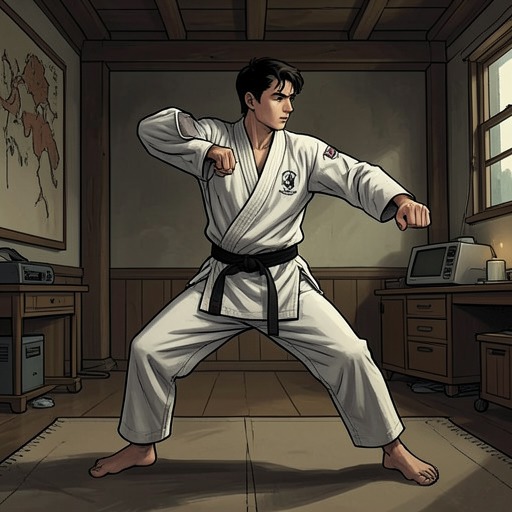
Yin Yang Zu
The Book of Five RingsYin-Yang Foot is a rule of Niten Ichi-ryū footwork: movement must alternate between the left and right feet rather than rely on one foot alone. Its importance lies in making combat movement continuous and adaptable, while grounding specialized sword practice in the manner of ordinary walking.
Definition and Movement
The rule’s name describes a reciprocal pattern: move left-right and right-left, not with one foot preferentially. The pattern applies when cutting, withdrawing, and warding off a cut, so it governs both advance and response rather than a single maneuver. Footwork becomes a continuing alternation suited to changing actions, not a fixed lead-leg arrangement.
This principle belongs to a broader instruction about how the feet meet the ground. The toes should feel somewhat light while the heels tread firmly; whether the steps are fast or slow, large or small, they should move as in normal walking. The familiar gait is not discarded for combat, but trained into a form that can carry varied speeds and distances without losing its grounded quality.
Rejected Steps and Everyday Practice
The teaching rejects three named walking methods: jumping-foot, floating-foot, and fixed-steps. These are contrasted with the steadier, walking-like movement that allows the feet to keep alternating. The emphasis is not simply on avoiding one conspicuous error: neither a springing or ungrounded step nor a locked sequence should replace responsive, balanced motion.
The rule also accords with the instruction that a combat stance should be maintained in everyday life and that an everyday stance should become a combat stance. Yin-Yang Foot makes that continuity practical: ordinary walking supplies the movement pattern, while training makes the alternation deliberate and available when cutting, retreating, or parrying. Combat readiness is thus presented as a cultivated way of moving, not a posture reserved for the instant of engagement.
Relation to the Whole Body
Footwork is one part of a coordinated bodily discipline. The stance instruction calls for an erect head, composed features, a straight neck, lowered shoulders, strength extending through the legs to the toes, and an abdomen braced against bending at the hips. In that context, alternating the feet supports movement without abandoning the alignment and steadiness required of the whole body.
The same connection between bodily preparation and action appears in instructions for close engagement. To stick to an enemy, the practitioner is told to bring head, body, and legs together without leaving a gap; in the Body Strike, the practitioner closes through an opening in the guard and drives the left shoulder into the enemy’s breast, coordinating the impact with breathing. These techniques are not definitions of Yin-Yang Foot, but they show why the rule matters within the larger method: movement must carry the whole body into action rather than leave the legs, trunk, or arms working apart.
Significance
Yin-Yang Foot turns alternating steps into a principle of adaptability. Because the same pattern is prescribed for cutting, withdrawal, and parrying, it resists a narrow division between attack and defense. Its simple basis in everyday walking also fits the broader claim that strategy must be practiced as a continuous discipline: the familiar motion of the feet becomes part of combat method without becoming a rigid, specialized gait.