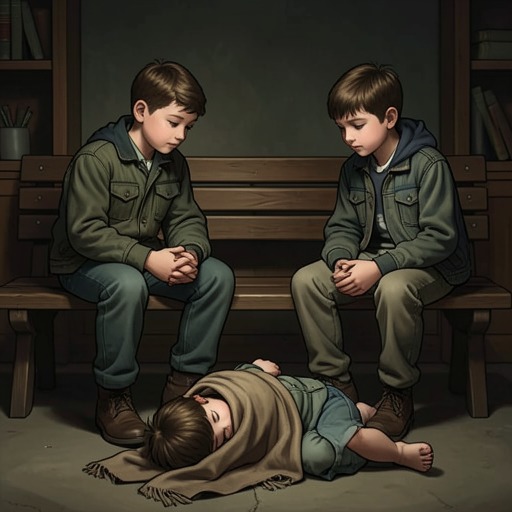
Alyosha Karamazov and Kolya Krassotkin: friendship and mutual respect
The Brothers KaramazovAlyosha Karamazov and Kolya Krassotkin: friendship and mutual respect is a meeting of two young people in which esteem becomes reciprocal and emotionally open. Alyosha does not patronize Kolya or reduce him to a child; he speaks with him as an equal. Kolya, who arrives hoping to learn from Alyosha, discovers that he too is regarded with attention and respect. Their exchange moves from intellectual admiration to bashful affection, and finally to Kolya’s explicit willingness to obey Alyosha when Alyosha draws a firm boundary.
Recognition Between Equals
Kolya asks whether Alyosha’s observation about young people acting for themselves in their games is really his own idea, and listens intently to the answer. The question is not merely a challenge: Kolya finds the thought interesting and says he will consider it when he gets home. He admits that he had hoped to learn something from Alyosha, whom he had sought out after hearing about him. Alyosha answers that he, too, has learned from Kolya, smiling and pressing his hand. The gesture makes their regard mutual rather than a one-sided lesson delivered by an older or wiser figure.
What most pleases Kolya is precisely Alyosha’s manner toward him. Alyosha treats him as an equal and speaks as though Kolya were fully grown. That recognition matters to the shape of the friendship: Kolya’s confidence and intellectual independence are not mocked, but neither does Alyosha need to flatter or imitate him. Their conversation allows Kolya to be taken seriously without requiring him to pretend he is already beyond embarrassment or uncertainty.
From Admiration to Affection
Later, Alyosha tells Kolya not to be like everyone else, even if he is the only one. Kolya responds with relief and excitement, saying that Alyosha knows how to console him and that he has long wanted to meet him. He asks whether Alyosha had thought about him as well. Alyosha answers that he had heard of Kolya and had thought of him, adding gently that vanity would not matter if it partly prompted the question. The exchange acknowledges Kolya’s desire to be noticed without turning that desire into a rebuke.
Kolya describes their conversation as having been like a declaration of love and anxiously asks whether that sounds ridiculous. Alyosha assures him that it does not, and that even if it did, it would not matter. Their language is openly affectionate, but the scene keeps the emotional force grounded in friendship: Kolya is voicing the intensity of being understood and welcomed, while Alyosha accepts that intensity without embarrassment or ridicule.
Alyosha’s own bashfulness briefly makes that welcome reciprocal in bodily terms. He laughs that Kolya has made him blush, and admits that he feels a little embarrassed without quite knowing why. Kolya is delighted by this response. He says that he loves and admires Alyosha at that moment because Alyosha is ashamed, and because in this he is like Kolya himself. Kolya’s ecstatic reaction turns a small sign of vulnerability into their point of likeness: admiration does not depend on Alyosha appearing invulnerable or superior.
Trust, Authority, and a Boundary
The friendship is not simply agreement or mutual praise. When Kolya speaks of Perezvon as a possible threat, Alyosha sharply tells him that if he says another word, Alyosha will have nothing more to do with him. The rebuke interrupts Kolya’s performance and makes the limit of Alyosha’s acceptance clear. His affection does not mean that he will indulge every provocation.
Kolya immediately recognizes Alyosha’s authority. He declares that Alyosha is the only man in the world who can command Nikolay Krassotkin, points to him, and says he will obey. He then steps forward, opens the door, and quickly goes into the inner room. The quick departure gives the declaration practical force: Kolya does not merely praise Alyosha’s influence but responds to it by withdrawing as Alyosha has ordered.
The Meaning of Their Mutual Respect
The relationship is marked by a productive contrast between Kolya’s self-conscious performance and Alyosha’s steady, non-condescending attention. Kolya can test an idea, seek consolation, confess vanity, and express affection without being dismissed as childish. Alyosha, in turn, is able to correct him without withdrawing the respect that makes the correction meaningful. Their bond therefore joins intimacy to moral seriousness: being treated as an equal gives Kolya room to speak freely, while trusting Alyosha gives his command weight.
The exchange also changes the direction of admiration. Kolya initially approaches expecting to learn from Alyosha, but Alyosha tells him that the learning has gone both ways. That reciprocity does not erase their differences in temperament; Kolya is more demonstrative, while Alyosha’s warmth appears in his attentive replies, smile, handclasp, and moment of embarrassment. Instead, it lets each recognize the other without requiring sameness. Kolya’s final obedience is not a surrender of the independence he brings to their conversation; it shows that his respect for Alyosha can guide his actions even when Alyosha contradicts him.
The friendship’s decisive significance lies in this combination of equality and influence. Alyosha does not win Kolya’s trust by claiming authority over him, but by first taking him seriously. Once that respect is established, Alyosha can set a boundary and Kolya can accept it. Their relationship presents affection not as mere praise or comfort, but as a connection capable of honest disagreement, vulnerability, and restraint.