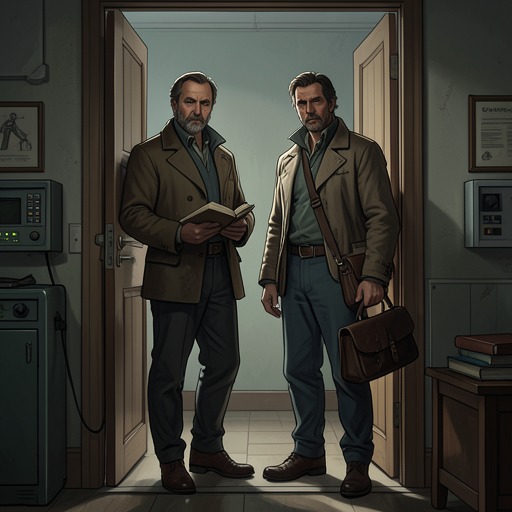
Alyosha tells Ivan, “It wasn’t you”
The Brothers KaramazovAlyosha tells Ivan, “It was not you killed father,” confronting his brother’s private conviction that he is responsible for their father’s murder. The exchange is decisive not because it resolves the crime, but because Alyosha distinguishes Ivan’s moral self-accusation from the act of killing and makes that distinction impossible for Ivan to ignore.
The denial and its immediate stakes
The conversation begins with Alyosha insisting that a document cannot incriminate Dmitri because Dmitri did not murder their father. Ivan stops and asks who Alyosha believes the murderer is. Alyosha answers that Ivan already knows. When Ivan dismissively frames the alternative as a story about the epileptic Smerdyakov, Alyosha does not turn the exchange into an argument over evidence; he holds to the knowledge he believes Ivan already possesses.
Alyosha then says plainly that Ivan did not kill their father. Ivan is thunderstruck, asking what Alyosha means by “not you.” The exchange shifts from the question of who physically committed the murder to the burden Ivan has taken upon himself. Alyosha’s repeated denial is therefore both a claim about the crime and a response to his brother’s inward accusation.
Naming Ivan’s private guilt
Ivan falters, asking when he ever said this, and recalls that he was in Moscow. Alyosha replies that Ivan has said it to himself many times, alone during the two dreadful months. He describes Ivan as having accused himself and confessed inwardly that he was the murderer, while insisting that Ivan is mistaken and is not the murderer.
This is the scene’s central revelation: Alyosha understands Ivan’s guilt not as a public confession but as a private, repeated judgment. The distinction between having committed the murder and believing oneself responsible is the point on which the conversation turns. Alyosha does not dismiss Ivan’s anguish; he addresses it directly, denying the conclusion Ivan has reached about himself.
A reassurance that unsettles
The words do not produce immediate relief. After a long silence, the brothers stand facing one another, both pale. Ivan begins to tremble and clutches Alyosha’s shoulder. The physical change follows the accusation and denial, making visible how sharply Alyosha’s words have affected him without explaining away the guilt that preceded them.
Ivan then whispers that Alyosha has been in his room at night, when “he came.” He demands that Alyosha confess whether he has seen him. Alyosha, bewildered, asks whether Ivan means Mitya. This unanswered question leaves the exchange suspended between Alyosha’s effort to reassure his brother and Ivan’s troubled reference to a nighttime visitor. The scene does not identify that visitor here or establish what Ivan means; its force lies in showing that Alyosha’s words have reached a private experience Ivan cannot readily explain.
Significance in the brothers’ exchange
Alyosha’s statement is an act of intimate moral address: he speaks as though compelled to tell Ivan that self-accusation does not make him the murderer. Its effect is not a clean absolution. Ivan’s shock, trembling, and abrupt question open another uncertainty even as Alyosha offers reassurance. The scene thus separates legal or factual guilt from Ivan’s inward sense of responsibility, while leaving the source and meaning of his nighttime experience unresolved.