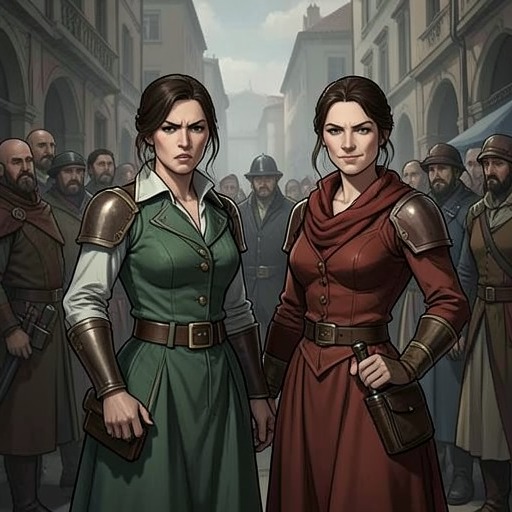
Alyosha’s intervention in Ivan and Katerina’s confrontation
The Brothers KaramazovAlyosha’s intervention in Ivan and Katerina’s confrontation turns an emotionally tortured triangle into an explicit rupture. Seeing that Katerina Ivanovna’s attachment to Dmitri and Ivan’s love for her have been concealed beneath pride, obligation, and mutual injury, Alyosha tries to make the truth speakable and to bring the three together. Instead, Ivan openly declares the one-sidedness of his love, tells Katerina that he is leaving forever, and refuses her hand. Alyosha is left calling after him and reproaching himself for having started the painful disclosure.
The Confrontation and Alyosha’s Recognition
The scene reaches its crisis when Madame Hohlakov sharply asks about Alyosha’s opinion, which Katerina Ivanovna had been so anxious to hear. Alyosha responds not with the reassurance expected of him but with sudden distress: he cannot understand what has happened. His reaction marks a break in the room’s strained performance of ordinary conversation. Katerina’s request for his decision had given his judgment unusual weight, but the answer he arrives at is not a verdict about what she should do. It is a claim that the relationships themselves have been misnamed.
Alyosha says that perhaps Katerina Ivanovna has never loved Dmitri, and that Dmitri, in turn, has never loved her but only esteemed her. He adds that someone must tell the truth, because no one else in the room will. The recognition cuts through the formal arrangement of an engagement and the emotions organized around it: esteem is not love, and a relationship sustained by suffering does not thereby become a reciprocal romance. The claim is Alyosha’s perception, not a neutral ruling. Its force in the scene comes from his willingness to say aloud what its participants have left unspoken.
The Attempt to Join the Three
Alyosha’s response to what he sees is an attempted reconciliation. He proposes fetching Dmitri so that he can take Katerina Ivanovna’s hand and Ivan’s, and join their hands together. In his haste, the plan gives physical form to his hope that truth might end the torment and make a more honest arrangement possible. He does not merely identify the concealed emotional pattern; he tries to intervene in it, imagining a gesture that would bring the three people into a single acknowledged relation.
The proposal also shows the limits of Alyosha’s understanding of the moment. Naming the truth does not make it bearable, nor can a symbolic joining of hands settle feelings that have been shaped by pride and hurt. His intervention instead forces Ivan to answer publicly. The scene’s turn is therefore both recognition and reversal: Alyosha exposes the emotional structure, but his effort to resolve it helps bring about the separation he wanted to prevent.
Ivan’s Declaration and Farewell
Ivan laughs, rises, and takes his hat. His manner changes into what Alyosha has not seen from him before: youthful sincerity and strong, unreserved feeling. Ivan corrects Alyosha’s account in a crucial respect. Katerina Ivanovna has never cared for him, he says; she has always known that he loved her, although he never told her, and she did not return that love. He also denies that he has ever truly been her friend, describing her as too proud to need his friendship. His words confirm the central asymmetry Alyosha has sensed, while making plain that Ivan’s own attachment has been hidden in silence.
Ivan’s farewell gives that disclosure its cost. He says that he is too young and has loved Katerina Ivanovna too much; although it would be more dignified simply to leave, and less offensive to her, he is going far away and will never return. He refuses to sit beside a “laceration,” a word that makes their continuing proximity sound like an open wound rather than a consolation. He says she cannot be angry with him because he is more severely punished by never seeing her again, but then refuses to take her hand. He also says that she has tortured him too deliberately for him to forgive her at that moment. The departure is thus not a gentle release: love, grievance, and the decision to leave are spoken together, without being reconciled.
Consequences and Narrative Significance
As Ivan goes, Alyosha calls after him, begging him to come back. Almost immediately he recognizes that Ivan will not return and turns his distress against himself: it is his fault, he says, because he began it. He condemns Ivan’s words as angry and unjust, yet continues to insist that Ivan must come back. The contradiction captures Alyosha’s predicament: he believes that truth had to be spoken, but he is horrified by the injury its disclosure has made visible and intensified.
The intervention exposes rather than resolves the conflict among Katerina Ivanovna, Ivan, and Dmitri. Alyosha’s proposal would have joined their hands; Ivan’s refusal and departure leave the scene organized around separation instead. The episode’s decisive action is not a change in anyone’s declared past, but the movement of a private, unreturned love into open speech. Ivan’s departure makes that revelation consequential, while Alyosha’s self-blame shows that compassion cannot guarantee control over what truth will do once spoken.