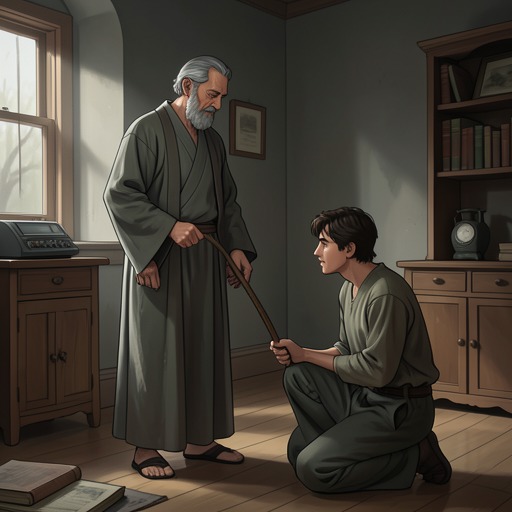
Alyosha’s spiritual crisis and renewal after Zossima’s death
The Brothers KaramazovAlyosha’s spiritual crisis and renewal after Zossima’s death is a decisive passage in his development: the young monk’s faith survives not because his anguish is small, but because it is profound enough to force him beyond the expectation that holiness must be vindicated by an unmistakable miracle. The death of his elder and the apparent dishonour that follows bring him to a painful confrontation with divine silence; his renewal comes through human companionship, the Gospel story of Cana, and an unpremeditated embrace of the earth.
The Crisis of Faith
Alyosha’s distress is explicitly not a loss of faith. The narrator insists that his trouble arose because he possessed great faith, not because he belonged among those of little faith. Even long afterward, Alyosha remembered that day as one of the bitterest and most fateful of his life. His suffering therefore grows from the distance between what he believes ought to happen and what he sees happening, rather than from indifference to belief.
He had expected justice, not merely a display of supernatural power. The man he believed should have been exalted above everyone was instead degraded and dishonoured. That reversal leaves Alyosha asking, in anguish, who had judged Zossima and on what authority. The question is not simply whether a miracle has failed to occur; it is whether goodness has any visible protection or recognition in the world.
The apparent triumph of Father Ferapont sharpens the wound. Alyosha sees others acclaiming the outcome associated with Ferapont, while the Providence he had expected to be legible seems to hide its face at the most critical moment. Nature appears to proceed under blind, mute, pitiless laws. What Alyosha cannot reconcile is the humiliation of the person he reveres with the moral order he had trusted to make such humiliation intelligible.
Grief and the Loss He Names
The crisis takes shape as a conflict between spiritual expectation and the evidence before him. Alyosha had not simply wanted his faith confirmed by wonders; he thirsted for justice. The distinction matters: the collapse of his expectation concerns the moral meaning of events, and the apparent failure of Providence makes the suffering feel like an accusation against the very order he trusts.
Later, when Rakitin taunts him for having rebelled against God, Alyosha answers with firmness. He says he does not want to become angry with Rakitin and asks him to be kinder, because he has lost a treasure that Rakitin never possessed and cannot judge. The words acknowledge both the magnitude of Alyosha’s grief and its particular source: Zossima was not an abstract authority whose reputation could be replaced, but a beloved spiritual treasure. Alyosha does not answer mockery by pretending that nothing has been lost; he insists that the loss calls for compassion rather than judgment.
The Gospel Reading at Cana
Exhausted by his trouble, Alyosha listens as Father Paissy reads the account of the marriage at Cana of Galilee. The Gospel begins with a wedding, with Jesus and his mother present, and with the disciples invited too. In the scene’s movement, the reader hears words of communal celebration at a moment when Alyosha has been absorbed by death, disgrace, and the apparent failure of justice.
The reading does not function as a neat argument that explains away his grief. Its force lies in placing the story of Cana before him while he is worn out and beginning to doze: a sacred narrative reaches him in a state of vulnerability, rather than through a triumphant proof that resolves every question. The contrast between Zossima’s dishonour and the Gospel wedding opens a different path through the crisis, in which spiritual renewal can begin without a public vindication of the dead elder.
Renewal Through the Earth
Alyosha’s response culminates not in a speech or a settled explanation but in bodily action. He stands, gazes, and suddenly throws himself down on the earth. He cannot explain why he embraces it or why he feels such an irresistible longing to kiss it. He kisses it weeping and sobbing, watering it with tears. The earth becomes the immediate object of an affirmation that his thoughts alone had been unable to secure.
This gesture changes the direction of his grief. Earlier, Alyosha’s attention had been fixed on the scandal of an undeserved degradation and on Providence’s apparent withdrawal; now his body turns toward the world itself. His tears remain, so renewal does not erase sorrow or settle the questions that provoked it. Yet the scene makes the movement from crisis to renewed commitment palpable: rather than stand apart from a world that has failed to display justice, he bends to it, touches it, and kisses it.
Meaning in Alyosha’s Development
The episode makes faith a lived relation rather than a guarantee that events will publicly confirm the believer’s hopes. Alyosha’s crisis tests his expectation that holiness will be visibly honoured, and the contrast between Zossima’s humiliation and the apparent triumph of Father Ferapont gives that test its sharpest form. His recovery is not presented as a denial that the day was bitter or fatal to him; it is a new response formed within the grief.
The sequence also gives the renewal a distinct structure. Alyosha first suffers the absence of the justice he expected, then names his loss when Rakitin tries to judge him, then hears Father Paissy read the story of Cana, and finally embraces the earth. The movement from moral bewilderment to compassion and bodily contact does not supply a tidy solution to the problem of suffering. It does show how Alyosha can return to life without pretending that the wound was unreal: the earth he kisses is the same world in which the revered elder has been dishonoured, and his tears register both the wound and his renewed bond with it.