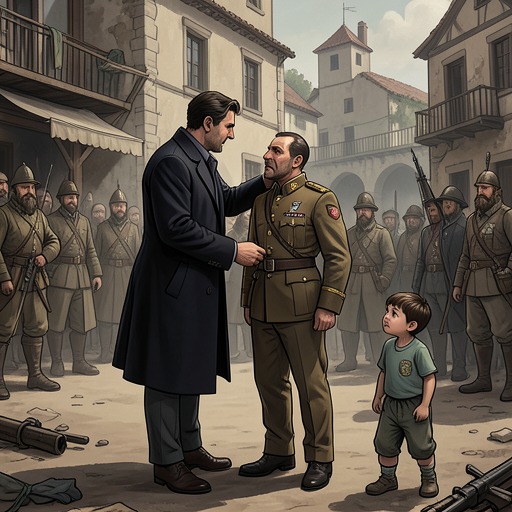
Dmitri publicly humiliates Snegiryov
The Brothers KaramazovDmitri publicly humiliates Snegiryov in a sudden assault that drags a discharged captain from a tavern by his beard and into the street. The scene’s decisive consequence lies beyond the physical indignity: Snegiryov’s young son Ilusha sees his father being pulled away, rushes to defend him, and is subsequently taunted by schoolboys. A public act of violence thus becomes a lasting humiliation shared by father and son, while the child’s instinctive loyalty gives the episode its moral weight.
Causes and Setting
The assault is recalled as having occurred about a week before it is discussed. Dmitri encounters the discharged officer in a low tavern; the account says that he somehow loses his temper, seizes Snegiryov by the beard, and drags him out. Snegiryov later emphasizes that he had done nothing to provoke the attack and that Dmitri happened upon him in a towering rage. The scene is presented as a hasty, unjust, and disgraceful action, not as a dispute whose particulars justify what follows.
The captain’s beard becomes the incident’s humiliating emblem. When Snegiryov recounts the scene, he explains that the boys call his beard a “wisp of tow,” a nickname that carries the street’s degradation back into the schoolyard. The violence is therefore not confined to the tavern and market place: its visible mark becomes a handle for repeated mockery.
The Assault and Ilusha’s Intervention
Dmitri drags Snegiryov out of the tavern and into the market place. The attack coincides with the schoolboys’ departure from school, so the public space fills with witnesses. Among them is Ilusha, who sees his father in distress and runs to him. Calling out that Snegiryov is his father, the boy catches hold of him, embraces him, and tries to pull him away, pleading with the assailant to let go and forgive him.
The child’s intervention sharply alters the scene’s meaning. Snegiryov is not only a man subjected to a public assault; he is a father whose son sees him degraded and tries, with a child’s limited strength, to protect him. The spectators’ laughter deepens the humiliation. What Ilusha encounters is both the violence itself and the surrounding crowd’s refusal to answer his appeal with help.
Aftermath and the Schoolyard
The assault continues to shape Ilusha’s life after the immediate scene has ended. Snegiryov reports that, since the incident, the boys have teased his son about the “wisp of tow.” The nickname turns the father’s beard into a schoolyard refrain, making the public humiliation recur in the place where Ilusha must meet his peers.
Snegiryov describes the boys as individually capable of gentleness but, together, often merciless. In his account, their teasing stirs a gallant spirit in Ilusha rather than making him ashamed of his father. The child’s response distinguishes his loyalty from the crowd’s ridicule: the same humiliating scene that exposes his father to laughter also reveals Ilusha’s willingness to stand by him.
Significance
The episode connects adult violence to its consequences for a child without making the assault merely a prelude to the physical injury. Dmitri’s action publicly strips Snegiryov of dignity; Ilusha’s attempt to shield him turns the father’s distress into an intimate test of filial loyalty, witnessed and mocked by others. The beard carries the injury forward as a repeated taunt, so the event’s aftermath is social as well as emotional.
The scene also develops through opposed responses to vulnerability. Dmitri’s uncontrolled force and the bystanders’ laughter leave Snegiryov exposed, while Ilusha answers with an urgent embrace and a plea. That contrast gives the incident its enduring significance: the boy’s appeal cannot undo the humiliation, but it makes visible a bond the crowd’s mockery cannot extinguish.