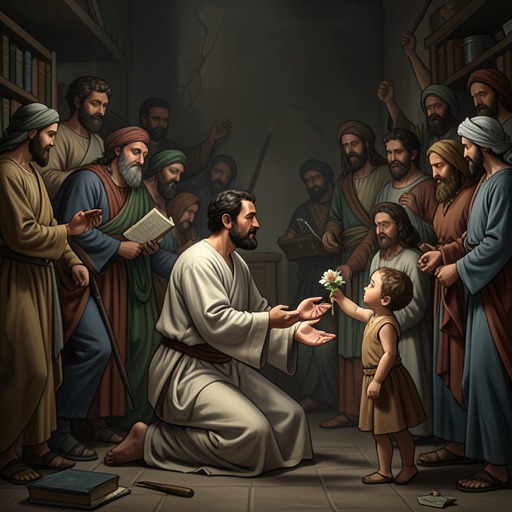
Dmitri’s crossroads confession
The Brothers KaramazovDmitri’s crossroads confession is a nocturnal encounter between Dmitri and Alyosha in which a startling ambush gives way to urgent disclosure. After hearing Alyosha’s account of what happened at Katerina Ivanovna’s, Dmitri reveals that he expects terrible disgrace and will proceed with a base plan despite knowing he could still stop. The scene makes his decision, and Alyosha’s role as its witness, explicit before its consequences unfold.
The encounter at the crossroads
Alyosha is walking quickly along a deserted road from the monastery. Night has nearly fallen; it is too dark to see clearly more than thirty paces ahead. Halfway along the road, at a crossroads beneath a solitary willow, a figure waits. When Alyosha reaches the meeting point, the man rushes out and shouts, “Your money or your life!” The theatrical threat briefly disguises the encounter’s real purpose: Dmitri has chosen a place where he can intercept his brother.
Alyosha recognizes Dmitri and is violently startled. Dmitri explains that he had wondered where to wait for him. Waiting by her house seemed uncertain, because three roads led away from it and Alyosha might have taken another route. The crossroads therefore becomes a practical meeting point shaped by Dmitri’s desire to find Alyosha—and, in the conversation that follows, a threshold at which private knowledge and impending disgrace are brought into the open.
Alyosha’s account
Dmitri is struck dumb when he hears that Grushenka was with Katerina Ivanovna. He responds with disbelief, asking whether Alyosha is raving. Alyosha then describes what happened from the moment he entered Katerina Ivanovna’s house. The account takes ten minutes. He does not tell it fluently or in perfect sequence, but he makes the events clear and leaves nothing out.
This report changes the encounter from an ambush into a reckoning. Dmitri has intercepted Alyosha to hear news connected with the women and the conflict surrounding them; Alyosha, in turn, supplies the full account rather than merely a fragment. The scene gives its narrative weight to the act of telling: before Dmitri makes his final disclosure, Alyosha has listened and recounted what he witnessed, creating the conditions for his brother’s confidence.
A confession made in advance
Dmitri abruptly turns toward the town, and Alyosha watches, unable to believe he is leaving so suddenly. Dmitri turns back and calls for one more confession, made to Alyosha alone. He tells him to look closely: terrible disgrace lies ahead, he says, and strikes his chest with his fist as he points to what he bears within himself. The gesture makes the threatened dishonor bodily and personal, not merely a danger imposed from outside.
Dmitri insists that he has never done anything, and never will do anything, comparable in baseness to the dishonor he now carries. Crucially, he says he is still free to prevent what is coming. He can stop or carry it through; he could pull back and recover at least half of his lost honor the next day. Yet he declares that he will not stop. He will carry out his base plan, and Alyosha can bear witness that he announced his intention beforehand.
Choice, witness, and dramatic consequence
The confession turns on the distance between freedom and decision. Dmitri does not describe himself as powerless: he recognizes a way to withdraw and names the honor he might recover if he did. His declaration that he will nevertheless go forward makes the threatened disgrace a choice he understands, not simply a fate he fails to foresee. The crossroads setting sharpens that structure: more than one road is available, while Dmitri insists that he will take the dishonorable course.
Alyosha’s presence gives the decision a witness and a human relation. Dmitri does not simply leave after delivering the news about Katerina Ivanovna; he turns back to entrust Alyosha with what he has not yet told him. The exchange thus binds disclosure to responsibility: Alyosha knows in advance that Dmitri intends to proceed, while Dmitri makes his brother the person who can testify that the decision was declared openly.
The encounter’s decisive revelation is not the full content of the plan, which remains unnamed in this account, but Dmitri’s conscious commitment to it and his anticipation of disgrace. That withheld detail keeps the scene focused on the moral fact it does disclose: he believes he can stop, understands what continuing will cost, and says he will continue. The confession makes the coming dishonor feel both imminent and chosen.