Father Paissy
The Brothers KaramazovFather Paissy is a learned, physically delicate monk of the hermitage whose combination of doctrinal conviction and practical loyalty gives him a distinctive place in the novel’s religious life. He argues that the Church should ultimately embrace the whole social order, yet he is also the careful attendant who watches over the dying Father Zossima, guides Alyosha, and helps preserve the elder’s final words and promises. His role joins public argument to intimate service: the Church’s future is debated in his presence, while its daily obligations take form in his care for others.
Identity and Place in the Hermitage
Father Paissy is introduced among the monks waiting in Father Zossima’s cell. He is described as a very learned man, delicate in health but not old; the Father Librarian is with him, as are other visitors awaiting the elder. His learning and frailty coexist from the beginning. He is not merely an abstract theologian: his physical delicacy places him within the vulnerable community he serves, while his command of religious argument makes him one of its most articulate representatives.
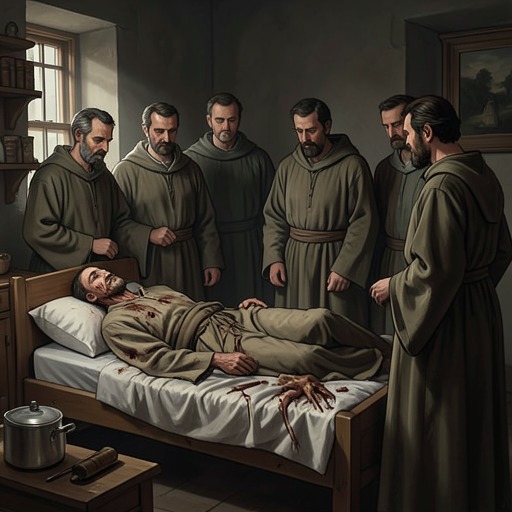
He belongs to the hermitage’s close circle around Father Zossima. In the elder’s final days, he appears repeatedly beside him and alongside Father Iosif, the warden Father Mihail, and the novice Porfiry. The monks gathered for what may be Father Zossima’s last conversation have been his devoted friends for many years. Father Paissy’s recurring presence marks him as both an intellectual interlocutor and a trusted member of the elder’s community.
The Church and the State
Father Paissy intervenes decisively in the discussion of the Church’s relation to the State. When the argument turns to the proposal that the Church should encompass the whole State rather than occupy only a corner within it, he assents fervently. The prospect of making this the chief aim of Christian society’s future development is, for him, no merely theoretical arrangement: it expresses the scale of the Church’s claim on collective life.
His agreement is not a passive nod. In a debate involving Ivan’s writing and Miusov’s objections, Father Paissy challenges the reduction of the Church to a limited institution among others. He objects to what he considers an unworthy play on words in the account of the Church as a divine institution and a human organization, and he presses the point that the Church’s vocation cannot be exhausted by describing it as a kingdom not of this world. The dispute makes visible his characteristic method: close attention to doctrinal distinctions, delivered with the force of a man who believes that language about the Church carries consequences for how society should be ordered.
He summarizes the position he opposes as the idea that the Church should be transformed into the State. In his view, that formula reverses the proper direction of the relationship and compromises the Church’s permanent foundations and sacred vocation. The exchange reveals both his intellectual seriousness and his readiness to confront an argument directly. He is not simply defending clerical custom; he is defending a vision in which Christian society, rather than secular power, provides the governing horizon.
Miusov interprets this vision as an impractical utopia, comparing its promised abolition of war, diplomacy, and banks to socialism and wondering whether it implies that the Church would itself prosecute and punish criminals. Father Paissy’s presence in this exchange places him at the center of the tension between a spiritual ideal and the skeptical demand to specify its institutional consequences. The discussion does not make him a detached observer: his forceful assent and interruptions show how deeply he regards the question as a matter of the Church’s actual vocation.
Attendant to Father Zossima
The novel’s other sustained portrait of Father Paissy emerges through his service to Father Zossima. When the elder has grown weak and drowsy, Father Paissy quietly tells Alyosha that he is difficult to rouse and must not be disturbed. Father Zossima has awakened only briefly to bless the brothers and send them a message. Paissy’s subdued explanation is practical and protective: he is attentive not only to the elder’s spiritual authority but to the limits imposed by his failing strength.
After Father Zossima has delivered a message concerning an extraordinary report, Alyosha reads the letter and gives it to Father Paissy as confirmation. Paissy frowns over the news, yet cannot entirely restrain his inward emotion; his eyes gleam and a grave, solemn smile appears. The reaction shows a man who subjects claims of spiritual significance to caution without becoming emotionally impervious to them. His austerity does not prevent wonder, but gives it a measured outward form.
In another moment, Father Zossima summons Alyosha after returning to bed. Father Paissy is in the cell with Father Iosif and the novice Porfiry. After the elder speaks to Alyosha, Paissy accompanies him from the cell and offers an exhortation about the power of worldly science, which has analyzed what the holy books hand down as divine. His intervention extends the elder’s influence beyond the immediate bedside scene: he sends Alyosha back into the world with a warning about the intellectual forces confronting religious belief. Paissy is thus both guardian of Zossima’s presence and an independent voice of counsel.
The Elder’s Final Conversation
On the day of Father Zossima’s final gathering with his friends, the visitors wait in the cell, confident that he will rise and speak again as he promised. Father Paissy has assured them that the elder will get up. The confidence matters because Father Zossima has only recently risen from bed, and the gathering may be their last opportunity to hear him. Paissy’s assurance sustains the group’s expectation and helps make the conversation possible.
The circle consists of four monks: Father Iosif, Father Paissy, Father Mihail, and another longtime companion of the elder. Their presence gives the meeting the character of a shared farewell, though no one supposes that Father Zossima will die that night. Father Paissy’s confidence is therefore not a prediction of death but a testament to his trust in the elder’s promise and his willingness to organize the others around it.
During the conversation, Father Zossima speaks of having bowed the day before to the great suffering awaiting someone. Father Iosif, who witnessed the scene, exchanges glances with Father Paissy. The look links Paissy to the small community that recognizes the weight of the elder’s words, even when their meaning remains unclear to Alyosha. The scene gives his attentiveness a quiet, interpretive dimension: he registers what has happened and shares the uncertainty surrounding it rather than claiming to explain it.
As Father Zossima’s breath fails and his voice weakens, he lies down to rest without falling asleep, while the visitors remain seated. Father Paissy reads from the Gospel during pauses in the conversation. Reading is not a dramatic interruption but part of the group’s vigil, maintaining a religious rhythm as speech gives way to exhaustion. No one present believes the elder will die that night; after his deep sleep during the day, he has seemed unexpectedly revived. Father Paissy’s Gospel reading and steady presence hold the gathering together at the threshold between conversation and silence, while the mistaken expectation of more time gives the scene its poignancy.