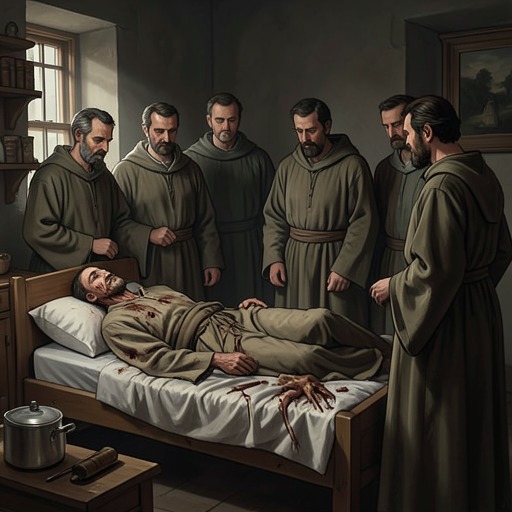
Ferapont’s confrontation at Zossima’s coffin
The Brothers KaramazovFather Ferapont’s confrontation at Elder Zossima’s coffin converts the monastery’s scandal over the elder’s rapidly decomposing body into a public contest over holiness and spiritual authority. Ferapont enters with a crowd of monks, invokes an exorcism he performs wherever he goes, and interprets the odor from the coffin as a sign from God. Father Paissy answers that driving out devils does not prove that the exorcist is not serving them himself. The scene makes the body at the center of the dispute a contested sign: its decay can be treated as evidence against Zossima, while the certainty of those who claim to read it becomes a further object of scrutiny.
Causes and Setting
The confrontation takes place amid the excitement following the discovery that Zossima’s body has begun to stink. The episode has unsettled expectations surrounding the elder’s death, and the gathered monks watch for what will happen next. The passage outside the cell erupts into disorder as Ferapont arrives in open defiance of decorum, accompanied by a crowd. The unusual entrance brings the wider monastery’s agitation directly to the coffin, where the death and its disputed meaning have become a focus of attention.
The immediate provocation is not simply the odor but the religious interpretation placed upon it. Ferapont points toward the coffin and declares that Zossima had not believed in devils and had used medicine to keep them away; now, he says, the elder himself has begun to stink, which he presents as a great sign from God. By linking bodily decay to the question of devils, Ferapont turns a physical change into an accusation about Zossima’s spiritual standing. The scene offers no neutral resolution of that interpretation: instead, it stages the conflict over who may claim to discern what the body signifies.
Ferapont’s Exorcism
Ferapont enters with his hands raised and roars, “Casting out I cast out!” He immediately makes the sign of the cross toward the cell’s four walls and corners, repeating, “Satan, go hence! Satan, go hence!” The action is both urgent and familiar to the monks: they know he performs the same ritual wherever he goes and will neither sit nor speak until he has driven out the evil spirits. His declaration that he wants to sweep the spirits out with a birch broom reinforces the forceful, physical character of his approach.
The entrance and repeated gestures make Ferapont’s piety a public performance before the crowd. He does not quietly counsel those troubled by the scandal; he claims the cell as a place occupied by evil and begins cleansing it through ritual. His words and movements assert confidence in his ability to identify and expel devils. That confidence lends his interpretation of the coffin’s odor a force beyond a private opinion, but it also makes the authority behind his certainty part of the confrontation.
Father Paissy’s Challenge
Father Paissy refuses to let the exorcism stand as proof of Ferapont’s spiritual discernment. He tells him that although he casts out the evil spirit, he may perhaps be serving it himself, then asks who can call himself holy. His challenge turns Ferapont’s own language back upon the exorcist: the act of naming evil does not establish that the person naming it is free of error or spiritual danger. Paissy speaks fearlessly in the midst of the disturbance, directly confronting the man who has entered with the crowd and taken command of the room through his ritual.
The exchange also sets two kinds of religious authority against one another. Ferapont presents visible, repeated action as an exorcism and reads the elder’s decay as a divine sign. Paissy questions the reliability of that claim without offering a competing declaration that the odor means the opposite. His warning preserves uncertainty about the body while shifting scrutiny toward the interpreter: spiritual judgment cannot be secured merely by denouncing devils or appearing certain of their presence.
Consequences and Significance
Ferapont’s reference to devils has a local precedent within the monastery. Another monk had been haunted first in dreams and later, while awake, by visions of evil spirits. The account helps explain why Ferapont’s exorcising gestures are familiar, but it also distinguishes reported visions from his sweeping claim about what is present in Zossima’s cell. The scene places the monk’s experiences, the elder’s body, and Ferapont’s interpretation in the same charged religious atmosphere without making them identical evidence.
The confrontation therefore sharpens rather than settles the scandal. Ferapont treats decomposition as a sign from God and the cell as a place to cleanse; Paissy challenges the holiness and discernment implied by that posture. The coffin remains the physical center of the dispute, yet the dramatic focus moves outward to the competing claims made around it. In a scene driven by spectacle, repeated ritual, and rebuttal, the monastery’s crisis becomes a test not only of what the body means but of how readily religious certainty can turn another person’s death into evidence for an accusation.