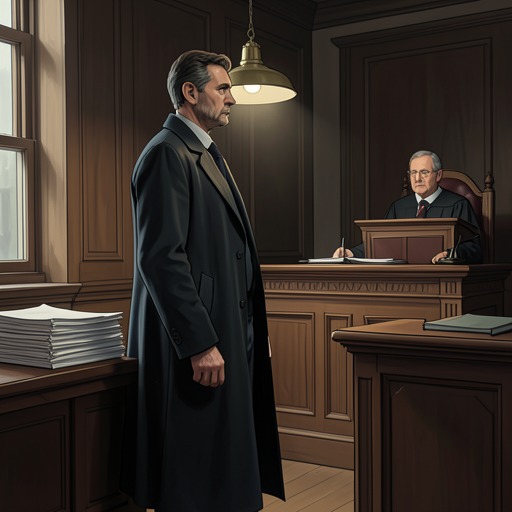
Fyodor Pavlovich’s garden fence
The Brothers KaramazovFyodor Pavlovich’s garden fence is the high boundary around Fyodor Pavlovich’s garden that Dmitri uses both to enter the grounds and, after striking Grigory, to try to escape. Its importance is practical and structural: the fence channels the movement of the scene, bringing Dmitri into the garden and then placing Grigory directly in his path as he climbs back out.
Setting and Physical Form
The fence runs around the garden beside a deserted, uninhabited alley. On the alley’s other side stands a neighbour’s hurdle fence around a kitchen garden, so the scene places a strong, high enclosure opposite a more ordinary boundary. The contrast marks Fyodor Pavlovich’s garden as a distinct, secured space, while the empty alley gives Dmitri a concealed approach.
The garden fence is close to the bathhouse, and from its top Dmitri can also see the lit windows of the house. The two landmarks connect the garden’s edge to both the bathhouse and the occupied house, making the fence a vantage point as well as a barrier. From astride it, Dmitri is poised between the hidden approach and the visible household.
Dmitri’s Entry into the Garden
Dmitri first circles Fyodor Pavlovich’s house rather than going straight to it. He crosses the lane, runs down Dmitrovsky Street, crosses a small bridge, and reaches the deserted alley behind the garden. This long detour brings him to the fence from the rear, avoiding a direct approach to the house.
At the fence, Dmitri chooses what seems to be the very spot where, according to local tradition, Lizaveta once climbed over. He recalls that precedent and reasons that if she could climb it, he can too. The remembered crossing gives this stretch of fence an earlier history, but Dmitri treats it as a practical test: he jumps, catches the top, pulls himself up, and sits astride the barrier. The fence is therefore not merely scenery; it becomes the obstacle around which his route and decision are organized.
The Fence During the Attack and Flight
Later, after Grigory follows the running figure through the garden and around the bathhouse, Dmitri heads for the fence again. Grigory knows the garden better and takes a shortcut, keeping Dmitri in sight as he runs after him. He reaches the fence just as Dmitri is climbing over and seizes Dmitri by the leg with both hands.
That grip turns the point of escape into the point of confrontation. Grigory recognizes Dmitri and cries out that he is a parricide, but falls almost at once, as though struck by lightning. Dmitri jumps back into the garden and bends over the fallen man; the brass pestle is in his hands, and he flings it into the grass, where it lands conspicuously on the path. The fence thus frames the interruption of Dmitri’s flight and the immediate aftermath of his blow: he has reached the boundary, but Grigory’s intervention pulls him back into the garden and into the scene of violence.
Narrative Significance
The fence structures the episode through a repeated crossing. Dmitri uses it first to get into the garden, choosing a place associated with Lizaveta’s earlier climb; on his return to it, Grigory’s grasp prevents a clean escape. The same boundary that offers concealment and access also exposes Dmitri to recognition and pursuit.
Its height and strength sharpen the scene’s physical logic without making the enclosure an impenetrable barrier. Dmitri can climb it, but crossing is slow enough for Grigory to catch him. The fence consequently concentrates movement, memory, and danger at a single threshold: the route into the garden becomes the place where flight is arrested and the violence becomes unmistakable.