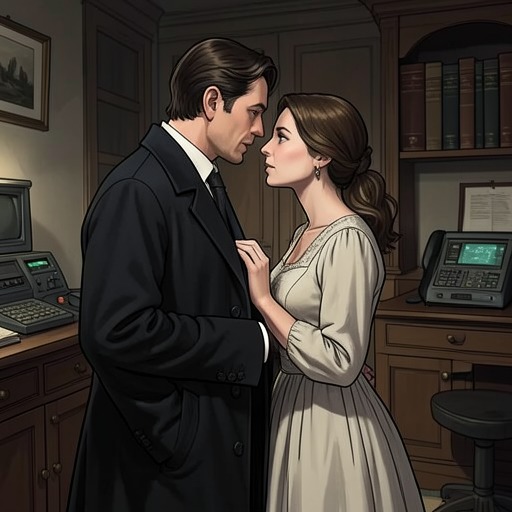
Grushenka’s departure to meet the officer
The Brothers KaramazovGrushenka’s departure to meet the officer is a sharp reversal in which a few lines on a note send her rushing toward the man from her past, away from Alyosha and Rakitin, and out of the unsettled world she has shared with Mitya. The scene does not present the departure as a simple choice between two men: Grushenka calls the journey a new life even as her farewell to Mitya recognizes the misery she has caused and insists that their love, though brief, was real.
The Note and the Decision
A letter is brought to Grushenka while she is with Alyosha and Rakitin. She snatches it from the woman holding it and carries it to the candle. The note contains only a few lines, but she reads it at once. Its brevity makes the change it triggers striking: the message is enough to turn her attention from the people beside her toward the officer who has summoned her.
Grushenka cries that he has sent for her and compares his summons to a whistle. In the same burst, she tells the little dog to crawl back. Her words frame the summons as a humiliating call, but her response is immediate and intense. For an instant she appears to hesitate; then blood rushes to her head and her cheeks glow. The visible alteration follows the pause, marking a decision that has passed from uncertainty into action without making the emotional conflict disappear.
She announces that she will go and bids Alyosha goodbye. Calling out that five years of her life are at stake, she declares that her fate is sealed and orders everyone to leave her alone. She describes herself as flying to a new life. The language turns departure into a threshold: Grushenka does not linger to explain the note or negotiate with those present, but casts herself as already in motion toward a future whose outcome remains unknown.
The Farewell to Mitya
The departure acquires its lasting emotional meaning in the message Grushenka sends after Alyosha and Rakitin have reached the bottom of the steps. Three fresh horses are being led through the open gate when her bedroom window suddenly opens and she calls after Alyosha. The scene briefly divides her: she is preparing to leave, yet returns to the window to speak to Mitya through his brother.
She asks Alyosha to give Mitya her greetings and to tell him not to remember the evil she has done him, though she has brought him misery. This is not a denial of harm. Grushenka names the suffering she believes she has caused and asks that it not become the only meaning of their attachment. Her words make the farewell at once an acknowledgment of injury and an appeal against lasting resentment.
She adds a harsher judgment of her choice: Grushenka has fallen to a scoundrel, not to Mitya, whom she calls a noble heart. The contrast sharply separates the man she is going to meet from the man she is leaving behind. Yet it does not stop her departure. The message holds together her condemnation of the destination and her decision to go, preserving the scene’s painful tension rather than resolving it into a clean romantic choice.
One Hour Preserved
Grushenka tells Alyosha to add that she loved Mitya for only one hour, one short hour, and commands him to make Mitya remember it all his life. The hour is presented as brief, but the instruction gives it a future beyond the moment of departure: Mitya is to carry it as a lasting memory. Her farewell thus offers no promise of reunion. It leaves him instead with a bounded image of love, defined by its intensity and brevity.
The message ends in sobs, and the window slams shut. That ending closes off the possibility of further conversation at the very instant Grushenka has made herself heard. Her final words reach Mitya indirectly, through Alyosha, while the shut window and the horses at the gate make the separation concrete. The scene’s decisive gesture is therefore both a departure and a last act of address: Grushenka leaves, but ensures that Mitya will know how she remembers their love.