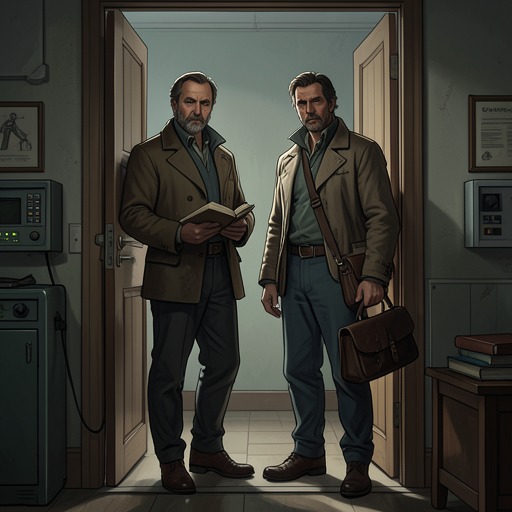
Ivan and Alyosha’s tavern conversation
The Brothers KaramazovIvan and Alyosha’s tavern conversation is the brothers’ private encounter in which an argument about God, suffering, and moral freedom becomes a test of whether intellectual disagreement can coexist with love. Ivan sets out why he cannot accept a harmony purchased at the cost of innocent suffering; Alyosha does not resolve the argument, but answers Ivan’s fear of being excluded from his brother’s heart with a quiet kiss. The gesture changes the scene’s emotional direction without making its philosophical conflict disappear.
Setting and Invitation
Alyosha comes to the room where Ivan is dining alone, after being told that Ivan is in a separate room and will meet him on the steps. The arrangement makes their conversation distinct from the family setting in which Ivan had earlier declared that there was no God: here, brother speaks to brother without the surrounding audience. Their meeting is at once a discussion of first principles and an attempt to establish what place they can have in one another’s lives.
Ivan opens the exchange by inviting Alyosha to choose the subject, proposing the existence of God. Alyosha takes up the invitation by recalling Ivan’s declaration at their father’s house. The question is not treated as abstract speculation alone: the brothers’ different convictions already bear on their relationship, and the conversation will make that personal stake explicit.
Ivan’s Rebellion and the Returned Ticket
Ivan’s case turns on the price of universal harmony. Even if he were mistaken, he says, he would remain with suffering and indignation; the cost demanded for harmony is beyond what he can pay. He therefore describes himself as returning his entrance ticket. His distinction is deliberate: he does not reject God so much as refuse the world’s terms for entering a final order that would reconcile suffering.
The image of the ticket gives Ivan’s objection the force of a decision rather than a detached puzzle. Harmony might promise that pain will ultimately be justified, but Ivan will not consent in advance to that justification. The conversation thus places moral protest beside the theological question: his refusal is directed at the suffering built into the world he sees, and it remains unresolved between the brothers.
The Threat of Separation
The disagreement becomes intimate when Ivan says that, on leaving, he had thought at least he had Alyosha, but now fears there is no place for him even in his brother’s heart. He names the formula that he will not renounce: all is lawful. The claim links the conversation’s argument about belief to the danger of moral consequence, while Ivan’s question asks whether Alyosha will reject him for holding it.
Ivan’s fear reveals that the debate is also a request for continued attachment. The brothers have not reached agreement, and Alyosha does not answer by retracting Ivan’s principle or by offering a counterargument. Instead, he rises, goes to Ivan, and softly kisses him on the lips. The physical act meets the question the argument has exposed: whether love can remain when assent is absent.
The Kiss and Its Aftermath
Ivan calls Alyosha’s answer plagiarism, recognizing it as a repetition of his own poem, but says he is grateful. His delighted response turns the kiss from a solemn gesture into a shared reference between the brothers. The allusion does not settle the disagreement; it gives them a form of recognition and humor within it.
Ivan then tells Alyosha to get up because it is time for them both to go. The ending returns the brothers to movement together rather than leaving them fixed in debate or estrangement. Their philosophical opposition persists, but the conversation has established that Ivan’s refusal does not, by itself, end their brotherly bond.
Narrative Significance
The scene’s decisive shift is from threatened emotional exclusion to renewed closeness. Ivan’s arguments remain forceful and unanswered, while Alyosha’s kiss supplies a response of affection rather than proof. The contrast keeps the exchange from collapsing either into a victory for one brother or into a simple reconciliation of ideas: the question of suffering remains open, yet the relationship survives the test Ivan places before it.
The conversation also makes the distinction between stating a principle and living its consequences dramatically concrete. Ivan’s claim that everything is lawful is presented alongside his vulnerability to Alyosha’s judgment, and Alyosha responds not by treating him as a proposition but by approaching him. The scene’s ending holds together what its debate might seem to divide: moral and religious disagreement on one side, and the brothers’ capacity for tenderness on the other.