Mikhail’s murder of the landowner’s widow
The Brothers KaramazovMikhail’s murder of the landowner’s widow was a crime concealed for fourteen years by a false trail that brought an innocent serf to trial. As Mikhail later disclosed it to Father Zossima, the account connected his rejected proposal of marriage to the widow with his clandestine entry into her home, the killing, and his efforts to implicate her servants. The serf’s death in custody closed the case publicly without revealing the truth, while Mikhail’s eventual admission transformed a hidden crime into the beginning of an extended reckoning with guilt.
Background and Motive
Fourteen years before the confession, Mikhail had fallen passionately in love with a wealthy, handsome young widow who owned a house in the town. He declared his feelings and tried to persuade her to marry him. His account gives the rejected proposal as the background to the crime, but does not describe the widow’s response in detail or establish any further relationship between them.
Mikhail had not been a close confidant of the widow. He was generally reserved and silent, had no friend to whom he would open his heart, and was regarded as an acquaintance rather than an intimate. During the fortnight before the murder, he had not visited her at all. That distance and absence helped keep his connection to the crime from attracting suspicion, despite the history of his feelings.
Entry and Murder
Mikhail entered the widow’s house through a skylight and descended a ladder to a door that servants sometimes left unlocked. He expected the door to be open and found it so. Moving through the dark, he reached her bedroom, where a light was burning. Her two maids were away at a birthday party on the same street; the other servants slept in the servants’ quarters or in the kitchen downstairs.
The circumstances of the entry offered opportunity, but Mikhail’s account identifies his own changing emotions as the immediate context for the attack. At the sight of the sleeping widow, he says, passion gave way to vindictive, jealous anger. He killed her before she could cry out. He then took her purse and used keys from beneath her pillow to open her chest and remove some possessions, making the robbery appear to belong to the crime rather than to a visitor who had come for personal reasons.
The False Accusation and Its Cost
Mikhail deliberately arranged the scene to direct suspicion toward the servants. Suspicion instead settled on Pyotr, one of the widow’s serfs, amid circumstances that seemed to support the accusation. The widow had decided to send him as a recruit because he had no relations and his conduct was unsatisfactory. People had heard him threaten her while drunk in a tavern, and two days before her death he had run away. Other details also appeared to implicate him, including evidence that the maids had gone to the party without permission and that the street door had been left open until they returned.
Pyotr was arrested and tried for the murder. A week after his arrest he fell ill with fever and died unconscious in the hospital. The authorities, judges, and townspeople let the matter end there: the apparent case against the serf had produced no disclosure of Mikhail’s role. His death made the miscarriage of justice irreversible and left the crime officially unresolved in substance, even as the community ceased to pursue it.
Confession and Significance
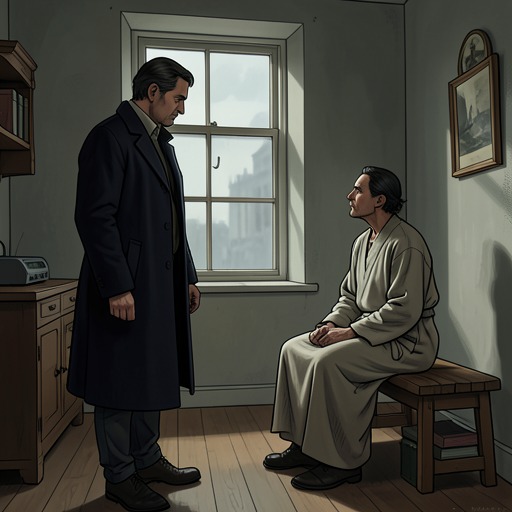
Mikhail’s account reached Father Zossima fourteen years after the killing. He went to see the elder three days running and told him what he had done. Father Zossima initially thought him mad, but came to believe the confession, responding with grief and amazement at the scale of the crime. The repeated visits make the telling itself part of the event: what had been hidden from the town and from Mikhail’s acquaintances was finally spoken to a listener who accepted its truth.
The murder’s narrative force lies in the contrast between apparent evidence and concealed responsibility. The details that had seemed to prove Pyotr’s guilt were not invented from nothing; Mikhail’s manipulation of the circumstances allowed ordinary facts—the recruit decision, the threats, the flight, the open door—to form a persuasive but false account. The eventual confession exposes how a calculated crime can exploit the community’s readiness to interpret suspicious behavior as proof, and it connects Mikhail’s private guilt to the innocent man who bore its public consequences.