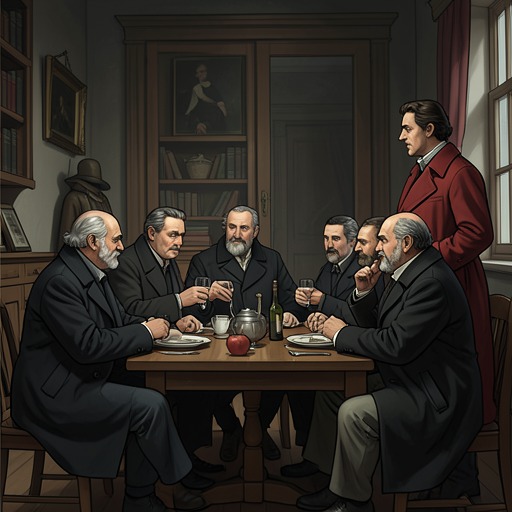
Mitya is arrested for parricide
The Brothers KaramazovMitya’s arrest for parricide transforms a private reunion with Grushenka into an official accusation of murder. As investigators enter and charge him with killing his father, Fyodor Pavlovitch Karamazov, Mitya draws a distinction between his murderous intention and his innocence of the crime itself; Grushenka, in turn, tries to share his punishment. The scene establishes the central tension between intention, legal accusation, and responsibility, while making their separation the immediate consequence of the arrest.
The Investigators Enter
While Mitya and Grushenka are together, she notices someone watching them through the curtains and asks who it is. Mitya turns, sees that the curtains have been parted, and approaches the intruder. A firm voice calls him to come over. When he passes through the curtain, he finds the room filled with unfamiliar people. He recognizes them, and his first response is bewilderment: he asks what their presence means.
The interruption is swift and formal. The newcomers are not the people who had been in the room earlier; they are investigators and others involved in the case. Mitya’s question is overtaken by the proceedings, and the little lawyer addresses him as an ex-lieutenant before formally informing him that he is charged with murdering his father that night. The prosecutor also speaks, but Mitya hears the words without understanding them. The scene’s shift from a private encounter to a room full of officials gives the arrest its force: the charge is no longer a threat or suspicion at a distance, but a public statement delivered directly to him.
The Charge and Mitya’s Denial
The accusation is specifically that Mitya murdered Fyodor Pavlovitch Karamazov. In the later account of the arrest, Mitya looks wildly at the people around him, unable to follow what is being said, then rises and protests that he is not guilty of his father’s blood. His denial is qualified by an admission: he says that he meant to kill his father, but insists that he did not commit the murder.
That distinction is decisive to the scene. Mitya does not deny the murderous intention that makes the accusation plausible; he denies that intention is proof of the act. His words expose the gap between what he wanted or believed himself capable of doing and what he claims actually happened. Yet the formal charge has already fixed the investigators’ immediate view of him, and his denial does not stop the arrest or the proceedings that follow.
Grushenka’s Plea and Their Separation
As Mitya protests, Grushenka rushes from behind the curtain and throws herself at the police captain’s feet, declaring herself at fault. She begs that they be judged together and punished together, saying she will go with Mitya even if it means death. Her plea makes the arrest a shared emotional crisis: she presents herself not as a detached witness but as someone who believes her own wrongdoing has helped bring them to this moment.
Mitya immediately rejects her attempt to take responsibility for the murder. He kneels beside her, holds her, and insists that she is not guilty of any bloodshed. Their opposing appeals—Grushenka’s request to share his punishment and Mitya’s insistence that she is innocent—cannot change the officials’ course. Mitya later remembers being forcibly pulled away from her by several men; Grushenka is led out, and when he recovers his composure he is sitting at the table with the men bearing metal badges beside and behind him. The arrest thus ends their physical reunion and places Mitya in the custody of the authorities.
Significance of the Arrest
The arrest turns the story’s conflict over Mitya’s father into a legal crisis. Its dramatic center is not simply the announcement of guilt, but the collision between an acknowledged intention and a denied act. Mitya’s words preserve that distinction even as the investigators proceed against him, while Grushenka’s plea reveals how deeply she understands herself to be implicated in his fate. Their separation gives the accusation an immediate personal cost, and the formal charge begins the process through which Mitya will be treated as his father’s murderer.