Moral Guilt and Legal Guilt
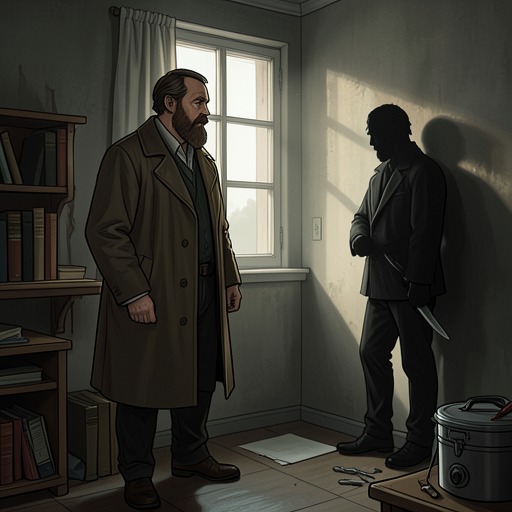
The Brothers KaramazovMoral Guilt and Legal Guilt are placed in direct tension during Dmitri Karamazov’s interrogation: he accepts responsibility for having killed another old man, but insists that he did not kill his father, Fyodor Pavlovitch. The distinction is not a simple claim of innocence. Dmitri knows that his threats and conduct make him a compelling suspect, and he is morally troubled by the crime he does acknowledge; nevertheless, he refuses to let that guilt stand in for proof of the parricide charged against him.
The Interrogation and the Two Claims
When the investigating lawyer asks whether he is innocent of his father’s death, Dmitri answers with two propositions: he is not guilty of that death, but he is guilty of another old man’s blood. He says that he killed the other man and knocked him down, and that he weeps for it. The admission is grave, but it is also carefully bounded: Dmitri separates an acknowledged act and its moral burden from the murder for which the investigators are questioning him.
He describes the accusation against him as a terrible murder he did not commit, one that he must answer for despite his denial. The result is an unsettling double position: Dmitri does not present himself as innocent of all wrongdoing, yet he maintains that he is innocent of the particular death that has become the center of the inquiry. His moral self-accusation and his legal defense coexist rather than cancel each other out.
How Suspicion Becomes a Verdict in the Mind
Dmitri recognizes why the investigators suspect him. He says he told people he would kill his father, and now his father has been killed; from those facts, he understands, the conclusion will appear obvious. He even says that he can make allowances for the investigators and that he is himself bewildered by the question of who else could have done it. This acknowledgment makes his denial more complicated than a flat rejection of the evidence: he can see how his own words and the murder fit together in the eyes of others.
The repeated question of who could have killed his father if not him expresses both the force of the circumstantial case and Dmitri’s inability to resolve it. He insists that he wants to know who killed his father and asks where and how the murder occurred. His urgency is directed not only toward escaping an accusation but toward an explanation that he does not possess. The inquiry’s evidentiary pressure thus becomes, in his speech, a genuine crisis of knowledge as well as a threat of legal punishment.
Guilt Without Confession to the Charge
As the questioning continues, Dmitri refuses to disclose how much money he had, after being asked about his statement to Perhotin that he received three thousand from Madame Hohlakov. The exchange shows the practical limits of his openness: he has admitted a separate act and acknowledged damaging circumstances, but he does not agree to answer every question or provide every detail the investigators seek. The distinction between what he chooses to own and what he refuses to concede remains active throughout the interrogation.
At another point, when asked to explain a disgrace, he breaks off the discussion rather than give its nature. He says he has already soiled himself enough through the investigators and will not trouble himself further. His evasiveness does not establish guilt of the murder; instead, it shows that shame and self-reproach extend beyond the charge while remaining distinct from it. The prosecutor’s dark expression registers the strained exchange, but it does not settle what Dmitri has or has not done.
Punishment, Truth, and the Unresolved Murder
Dmitri finally declares that the person who opened the door to his father and entered through it killed and robbed him. He says he cannot work out who that person was, but insists that it was not Dmitri Karamazov. He then tells the investigators to exile or punish him, while asking them to leave him alone and call their witnesses. The willingness to face punishment does not amount to a confession: Dmitri distinguishes suffering a penalty from accepting responsibility for this murder.
That distinction gives the interrogation its ethical and narrative force. Dmitri’s acknowledged guilt makes him morally compromised, while the evidence and his earlier threats make him legally vulnerable; neither fact, by itself, answers who killed his father. His repeated return to the question of the murderer prevents his self-condemnation from resolving the case. The episode therefore separates moral responsibility, legal accusation, and factual truth, showing how easily a person’s admitted wrongdoing can make an unproved charge seem settled.