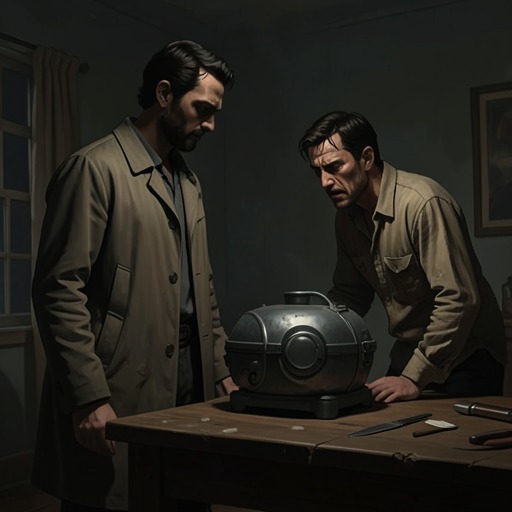
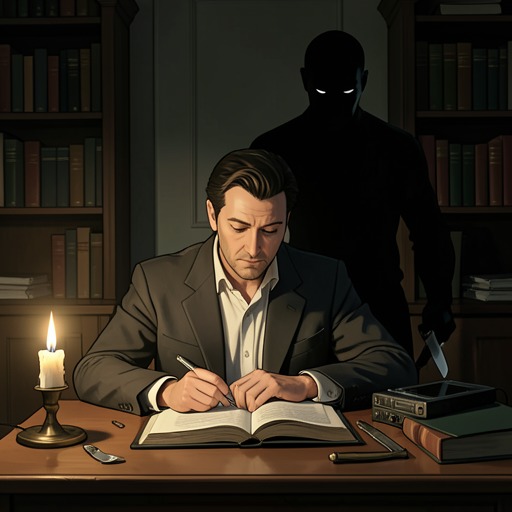
Smerdyakov hangs himself
The Brothers KaramazovSmerdyakov hangs himself in his cottage shortly before Alyosha visits Ivan, and the news reaches Ivan through the brother who has just carried it to the police. The discovery is not presented as an isolated death: a note beside the body declares Smerdyakov’s own responsibility while denying that anyone else should be blamed. Alyosha’s choice to leave the note where it lies, report the facts, and then go directly to Ivan makes the suicide both a material discovery and a moral crisis whose meaning is not settled by Smerdyakov’s final words.
Discovery in the Cottage
A little over an hour before Alyosha arrives at Ivan’s, Marya Kondratyevna has gone to Smerdyakov’s rooms to clear away the samovar. There she finds him hanging from a nail in the wall. The ordinary household task and the stark fact of the body meet without preparation: death is encountered not in a public place or during a confrontation, but in the cottage through which Marya has entered to perform a domestic chore.
Marya does not first alert the police. Shaken and apparently beside herself, she runs straight to Alyosha, having told no one else. Her hurried arrival makes her the first witness to carry the news beyond the room, but not yet an official reporter. Alyosha asks whether she has informed the authorities; when he learns that she has not, he runs with her to the cottage and sees that Smerdyakov is still hanging.
The Note and the Question of Blame
On the table lies Smerdyakov’s written statement: “I destroy my life of my own will and desire, so as to throw no blame on anyone.” The note presents the death as deliberate and claims to protect others from blame. Its language is therefore more than a confirmation that Smerdyakov has died: it anticipates the moral and legal question of who might otherwise be implicated in what has happened.
The declaration does not make that question disappear. By specifying that Smerdyakov acts of his own will, the note asserts personal responsibility; by adding that he means to throw no blame on anyone, it also places other people’s possible responsibility in view. The contrast between those claims gives the note its force. It offers a final explanation, yet its appeal to absolve others cannot by itself determine what they knew, wanted, or did.
Alyosha’s Report and Ivan’s Reception
Alyosha leaves the note on the table and goes straight to the police captain, telling him everything he has learned. Having made the death known to the authorities, he then comes directly to Ivan. His sequence of actions matters: he does not conceal the body or take the note away, and he does not treat the discovery as news to be held within the family. He reports first, then brings the account to his brother.
Ivan’s response gives the announcement an immediate personal charge. Before opening the door, he has cried fiercely that he told Alyosha not to come and demanded to know, in two words, what he wanted. Alyosha answers from the yard that Smerdyakov hanged himself an hour earlier. Ivan then opens the door. The abrupt exchange frames the news not as a composed explanation but as a rupture in a strained encounter: the death cuts through Ivan’s demand for brevity and compels him to admit his brother.
Inside, Alyosha recounts how Marya found the body, how he went with her to the cottage, and how the note lay on the table. He explains that he left it there, reported the matter to the police captain, and came straight from him to Ivan. As he finishes, he looks intently into Ivan’s face and has not taken his eyes off him. The fixed attention makes the delivery of the facts a form of witnessing: Alyosha tells Ivan what has happened while watching how his brother receives it.
Consequence and Narrative Significance
The suicide ends Smerdyakov’s life but does not close the question of responsibility surrounding him. His note attempts to assign the act to his own will and withhold blame from everyone else, while Alyosha’s immediate report brings both the death and that written claim into the authorities’ knowledge. The text distinguishes the existence of the note from the truth of every implication it makes: the statement is evidence of what Smerdyakov chose to say, not a substitute for the unresolved moral reckoning.
The scene also connects a hidden death to a widening chain of disclosure. Marya carries the news from the cottage to Alyosha; Alyosha carries it to the police captain and then to Ivan. Each step changes the audience for the fact without changing its stark physical origin, the body hanging on a wall nail and the note resting on the table. At Ivan’s door, that chain reaches the brother whose reaction Alyosha watches so closely, leaving the announcement suspended between official report and intimate accusation without declaring either one the final meaning of Smerdyakov’s death.