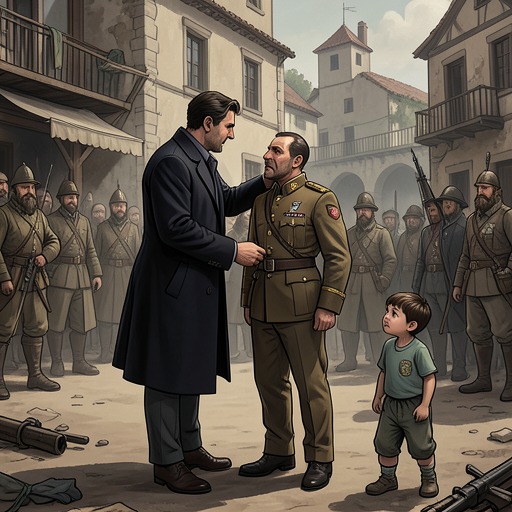
Snegiryov refuses Katerina’s money
The Brothers KaramazovCaptain Snegiryov refuses Katerina Ivanovna’s money in a scene where charity, humiliation, and paternal responsibility collide. After seeming to accept two hundred rubles brought by Alyosha, he crushes and tramples the notes, insisting that he cannot take money in exchange for his family’s shame. His abrupt reversal protects his sense of honor, but it also exposes how sharply an offer of help can wound someone already made vulnerable by public insult and poverty.
The Offer and Its Terms
Alyosha brings the captain a message from Katerina Ivanovna, whom Dmitri has also insulted. He stresses that the assistance comes from her alone: not from Dmitri, who has abandoned her, and not from Alyosha as his brother. Katerina asks the captain to accept her help because both have suffered cruelty from the same man; she approaches him, in Alyosha’s account, as a sister helping a brother in misfortune.
The distinction matters to the offer. Alyosha presents the money not as payment from the man who humiliated the captain, but as an act of solidarity from someone herself injured by Dmitri. He appeals to the captain’s generous heart and asks him to recognize that there can still be brothers on earth, even when people have reason to regard one another as enemies. The appeal frames acceptance as a bond between fellow sufferers rather than a transaction with Dmitri.
A Moment of Acceptance
The two men stand alone near a great stone beside the fence when Alyosha holds out two new, rainbow-coloured hundred-ruble notes. The captain is startled; the sum produces a visible impression, and he takes the notes. For a moment he can scarcely answer, and his face changes as he registers the scale of the gift. He says he has not seen so much money in four years and asks whether it is really true that Katerina calls herself his sister.
His response gives the proposed help a material weight that Alyosha’s moral appeal cannot erase. The money is not an abstraction: two hundred rubles is a sum the captain has not seen for years. Yet his initial acceptance does not settle the meaning of the gift. As the conversation continues, he keeps the notes by one corner between thumb and forefinger, and his face grows pale and frenzied. His lips move before he can make his thought audible; the change from astonishment to distress unfolds in his body before it becomes a declaration.
The Reversal: Money Trampled
The captain suddenly shows Alyosha the notes, crumples them savagely, and throws them onto the sand. He tramples them under his heel, gasping as he rejects the money. A gesture that began with receiving help becomes a public rejection of the terms he believes the gift carries: he will not let his family’s shame be compensated in cash.
He draws himself upright before Alyosha, his figure expressing pride, and tells him to inform those who sent him that the man called the wisp of tow will not sell his honor. The phrase turns the captain’s contemptible nickname into the speaker’s own emphatic self-description. The act is not a quiet refusal made at a distance: Alyosha must watch the new notes be crushed and pressed into the sand, while the captain insists, through both words and gesture, that poverty has not made his dignity available for purchase.
His Son and the Cost of Refusal
The captain runs a few steps, turns back, and kisses his hand to Alyosha. His face is no longer contorted with laughter; it trembles with tears, and his voice falters as he asks what he should say to his boy if he took money for their shame. His thought of his son makes the refusal more than a defense of personal pride. Accepting would, in his understanding, mean carrying home not simply financial help but an account of how that help had been obtained.
He runs on without turning back, and Alyosha understands that he will not be called after. The scene leaves the emotional burden with both men: the captain must preserve a form of honor that poverty has made agonizingly costly, while Alyosha is left grieving at the force of the decision. After the captain is out of sight, Alyosha picks up the notes. They are heavily crushed and pressed into the sand, yet uninjured; when he unfolds and smooths them, they rustle like new money. The money can be restored to its shape, but the encounter has exposed a wound that an offered sum cannot simply settle.
Significance
The episode makes charity ethically difficult without denying its generosity. Katerina’s offer is explicitly separated from Dmitri’s insult, and Alyosha tries to establish it as kinship between people whom Dmitri has both wronged. The captain, however, experiences the help through the shame attached to his family’s condition, and his son becomes the measure by which he judges whether he can accept it. Good intentions do not cancel the recipient’s fear of what acceptance would say about him.
The scene’s reversal is carried by the notes themselves. They first appear new and momentous, pass into the captain’s hands, are crushed beneath his fingers and heel, and are then gathered and smoothed by Alyosha. Their physical return to something like their original condition contrasts with the captain’s tearful departure: the notes survive the trampling, but they cannot convert humiliation into reconciliation. His refusal preserves dignity at the cost of aid, while Alyosha’s recovery of the money leaves open the painful distance between offering help and being able to receive it.