The Town School
The Brothers KaramazovThe Town School is both a place of instruction and the social arena in which Kolya Krassotkin’s reputation for strength and self-command develops. Its boys’ treatment of the smaller Ilusha Snegiryov—first teasing, then taunting and beating him—helps set in motion the injury and estrangement that Kolya later recounts to Alyosha. The school’s significance lies in this contrast: academic competition and boyish bravado coexist with a hierarchy enforced through ridicule and force.
Setting and Education
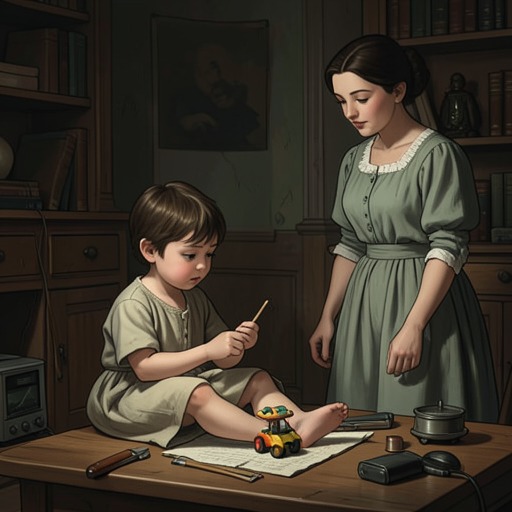
When Kolya began attending school, his mother immersed herself in studying the subjects alongside him so she could help with his lessons. She also hurried to make the acquaintance of his teachers and their wives, an involvement so conspicuous that the boys mocked Kolya as a “mother’s darling.” Her care was meant to protect him from teasing, laughter, and beatings, but it became a source of further teasing in the schoolyard.
Kolya did not remain defined by his mother’s vigilance. He could defend himself, and the school rumor that he was “tremendously strong” was borne out by his agility, strong will, and audacity. He was good at his lessons; pupils even said he could beat Dardanelov, his teacher, at arithmetic and universal history. Though he looked down on others, he was also a good comrade rather than simply a conceited boy. The school thus gives his character two public dimensions at once: intellectual distinction and a physical confidence that makes him difficult to intimidate.
Kolya’s Reputation and Conduct
The school’s account of Kolya is not limited to his academic ability or strength. He could sit for hours by the bookcase, absorbed in a book rather than going out to play, and in this way read material considered unsuitable for his age. His precocity extends beyond classroom achievement into an appetite for knowledge that is not always matched by adult judgment.
At the same time, his mischief had recently grown more reckless, alarming his mother. The narrator distinguishes this wildness from viciousness: Kolya generally knew where to draw the line, but his pranks had become audacious enough to trouble the people closest to him. That distinction matters to the school’s portrait of him. He is not presented as a straightforward bully; his independence and capacity for mischief coexist with loyalty and a later readiness to acknowledge the harm done to Ilusha.
Ilusha and the Schoolboys
Ilusha entered the preparatory class in the spring, among a group of much younger boys. Kolya, two classes above him, initially watched from a distance as the others began teasing him. Ilusha was small and weak, but resisted rather than giving in; Kolya noticed his pride and fiery eyes and says he liked children of that kind. His first response was therefore admiration, not contempt.
That response changed when Kolya decided Ilusha needed to be “smoked out” for being quick-tempered. He began treating him with contempt, turning away or smiling sarcastically whenever they met. The change came just as Ilusha was already distressed by what had happened to his father. Kolya’s withdrawal gave the other boys a signal: seeing that Kolya had given Ilusha up, they renewed their taunts, shouting “Wisp of tow, wisp of tow!” and became involved in regular skirmishes with him. Kolya later says he was very sorry for those fights and that the boys seem to have given Ilusha a severe beating.
Violence, Memory, and Repair
The school conflict extends beyond ordinary mockery. Ilusha, defending his father when the boys jeered at him with the same cruel nickname, stabbed Kolya with a penknife. That act establishes a direct physical consequence of the boys’ persecution, but it does not make Ilusha’s violence an isolated incident: Kolya’s recollection places it within a sequence of taunting, rejection, and repeated fights. The school is where the personal injury between the two boys becomes inseparable from the group’s treatment of Ilusha.
When Kolya explains the episode to Alyosha, he does so because he wants the full story understood before they go in. The recollection is an act of accountability as well as explanation: he describes his own decision to turn away, the escalation that followed, and his regret at the boys’ fights. Later, he shows the dog the tricks he had taught it, not at a command but from excited gratitude; the narrator identifies him as the boy Ilusha had stabbed. That detail reconnects Kolya’s present loyalty and feeling to the earlier school conflict, without erasing his part in it.
Narrative Significance
The school’s importance comes from the way it makes a private bond answerable to a wider group. Kolya’s choice to withdraw his approval does not remain a private experiment in discipline; other boys take it as permission to taunt and attack Ilusha. The episode shows how a child’s standing among his peers can shape the treatment of someone already made vulnerable by family humiliation.
It also gives Kolya’s later account its moral weight. His intelligence and strength might have made him merely the school’s celebrated prodigy, but his story of Ilusha includes an admission that his own contempt helped worsen the boy’s isolation. The Town School therefore anchors both the beginning of their conflict and the circumstances Kolya must remember when he seeks to make sense of it. The school’s lessons are not confined to arithmetic and history: its social life teaches how readily admiration can become rejection, and how quickly a group can turn that rejection into violence.