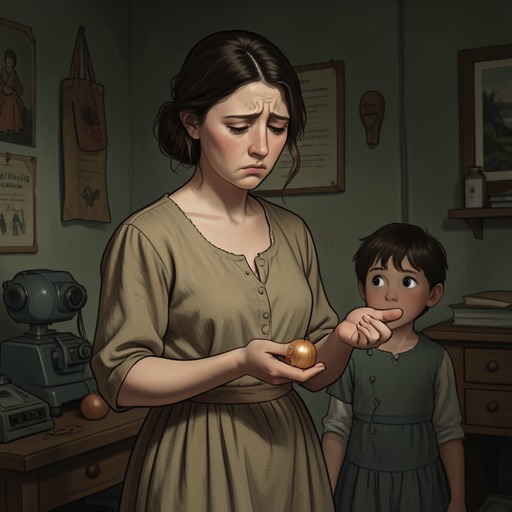
The little onion
The Brothers KaramazovThe little onion is a folktale and recurring moral image through which Grushenka measures the distance between a small act of kindness and the harder work of sharing its mercy. She tells it to Alyosha as a confession of selfishness, yet its fragile rescue becomes a language in which he can answer her with compassion. Later, at Mokroe, she recalls the onion while speaking of forgiveness, prayer, and the goodness still possible in a flawed world.
The folktale Grushenka remembers
Grushenka introduces the tale as one she heard in childhood from Matryona, her cook, who is still with her. Its central figure is a wicked peasant woman who dies without a good deed to her name. Devils plunge her into a lake of fire, and her guardian angel searches for anything that might count in her favor. He remembers that she once pulled up an onion in her garden and gave it to a beggar woman.
God tells the angel to hold out that onion so the sinner can grasp it and be pulled from the lake. The rescue becomes possible through an object almost comically slight: not a fortune, a lifetime of virtue, or a grand act, but the single onion given to someone in need. The angel pulls, and the woman is nearly out when the other sinners seize hold of her in the hope of being drawn up too.
The woman refuses to share the rescue. She insists that the onion is hers and that only she should be saved, then kicks the others away. At that moment the onion breaks. She falls back into the lake, where she remains, while the angel weeps and departs. The story’s turn makes the charitable deed matter not as a private possession but as the beginning of a mercy the woman cannot bear to extend to anyone else.
Grushenka’s confession and Alyosha’s answer
Grushenka does not offer the story as a boast about having done good. She corrects the claim she has made to Rakitin and tells Alyosha that she is like the wicked woman: she has done nothing but give away one onion, and that is the only good deed she can name. The confession turns the folktale from an example about an unnamed sinner into Grushenka’s own self-judgment. She regards her one act as meager, but also refuses to disguise it as more than it was.
Alyosha answers not by disputing her account or praising her from a distance, but by placing himself inside the image. He bends toward her with a tender smile, gently takes her hands, and tells her that he has given her an onion too: a tiny one, nothing more. He is moved to tears as he says it. The exchange changes the tale’s moral geometry. Grushenka had imagined herself alone in the role of the sinner who must grasp at a last, inadequate good deed; Alyosha presents compassion itself as another small gift, offered between people rather than owned by one person.
The onion therefore joins confession to relationship. Its first appearance in the tale is a gift to a beggar; in Alyosha’s answer, giving becomes a mutual gesture that helps Grushenka feel she might be loved otherwise than through shameful desire. The image does not erase her account of herself. Instead, it gives that account a reply: the worth of a small kindness can be met by another kindness, and the possibility of being rescued need not be a solitary claim.
From the story to a hope of forgiveness
The folktale returns in the vision that follows Alyosha’s crisis. He imagines a feast with a bride and bridegroom, a wise governor tasting new wine, and many guests. In that scene, Grushenka’s onion becomes her reason for imagining herself among the celebrants: she gave one onion to a beggar, and others there, too, have given only one little onion each. The scale remains deliberately modest. The vision does not require that every guest arrive with a record of great deeds; a single act of kindness can belong within a larger joy.
Alyosha’s own act toward a famished woman is folded into this vision. Grushenka tells him that he, too, has given an onion that day, and urges him to begin his work. The image now travels beyond her confession: a deed offered to one person can become part of a community of mercy, joining the giver and receiver to a hope larger than either of them. Alyosha, however, says that he is afraid and dares not look at the vision. The scene preserves the difference between Grushenka’s confident welcome and his trembling response, even as the onion gives them a shared figure for hope.
The onion at Mokroe
Later, during the revel at Mokroe, Grushenka again makes the onion part of her speech and conduct. She asks Mitya to give a present to a poor man, explicitly connecting generosity with the poor and insulted. Then she declares that she may one day enter a nunnery, though for that day she wants to dance. Her thought moves without denial from pleasure to prayer: she wants to play now, believes God will forgive them, and says that if she were God she would forgive everyone.
Her wish to be forgiven is personal as well as expansive. She asks the good people present to forgive her, calls herself a foolish girl and a beast, and says that she wants to pray. She recalls the little onion as she speaks, linking the one good deed she has confessed to this new desire for prayer. Her invitation to forgive everyone also revises the selfish woman’s claim in the folktale. At the lake, that woman refuses to let other sinners share her rescue; at Mokroe, Grushenka imagines forgiveness extending to everyone.
She goes further, declaring that everyone in the world is good, even the worst, and that the world remains good although people themselves are bad. That affirmation does not cancel the wrongdoing and shame she has just acknowledged. Its force comes from holding the two together: a person can be wicked, seek forgiveness, and still perceive goodness in others and in the world. The remembered onion is the small, concrete hinge between those claims.
Meaning and narrative function
The onion’s power depends on its disproportionate fragility. A charitable act can open a path out of punishment, but the rescuer’s offer is not a guarantee: the sinner can break the connection by treating mercy as private property. The folktale makes the woman’s refusal visible in a simple physical action, kicking away those who grasp at her, and gives that refusal an equally simple consequence, the onion breaking. Kindness begins with a small gift; salvation, as the story imagines it, cannot be separated from willingness to share.
Grushenka’s repeated return to the image traces a change in what she can imagine about herself and others. First she identifies herself with the woman who has only one good deed and judges herself through that narrow measure. Alyosha then offers her another onion, not as proof that her past is spotless, but as an act of tenderness she can receive. In the later vision and at Mokroe, she speaks instead of many people with only one onion, of giving to the poor, and of forgiving everyone. The image’s repetition preserves the humility of the original act while enlarging its reach.
The little onion thus connects an intimate exchange of hands, a visionary feast, and a noisy celebration into one moral sequence. It is not a symbol of effortless innocence: its first giver is a wicked woman, its gift nearly fails, and Grushenka continues to call herself bad. Its hope rests instead on the possibility that a small act can be remembered, answered, and shared—and that the person who once thought only of her own rescue can begin to wish mercy for others.