The plan to help Dmitri escape
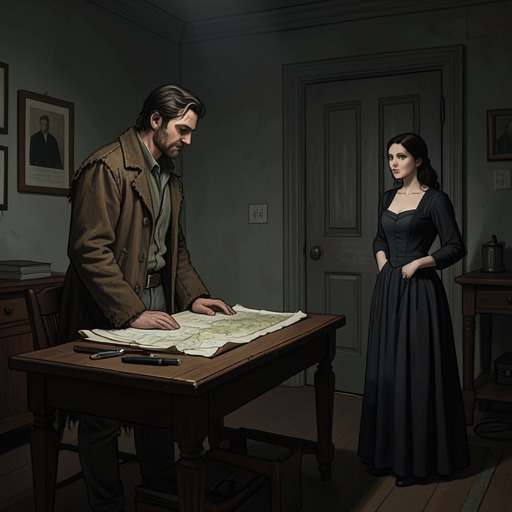
The Brothers KaramazovThe plan to help Dmitri escape is an effort by Ivan to save his brother from penal exile, entrusted to Katerina in case Ivan’s illness or death prevents him from carrying it out himself. Its practical outline points toward the third stage of a prisoner transport to Siberia; its moral and emotional meaning is more complicated. Ivan’s foresight and sacrifice give the escape plan the shape of a promise, while Dmitri imagines that even flight must lead through labor, homesickness, and the possibility of renewed punishment.
Origins and Preparation
Ivan had entered into negotiations for Dmitri’s escape before becoming dangerously ill. He told Katerina that a chance to act would likely arise at the third stage of the journey, when a party of prisoners was being taken toward Siberia. The identity of the person in charge of that party was not yet known, making the plan necessarily provisional: Ivan had made preparations, but the decisive practical detail remained unresolved.
Ivan also visited the superintendent of the third stage. That meeting suggests that his scheme was not merely a private hope or a brother’s promise; he was already sounding out the people and circumstances on which an escape would depend. Yet even with these negotiations underway, the timing was distant, and Katerina acknowledged that the plan could not be completed in detail until the party’s leadership became known.
Katerina as Custodian
Several days after an earlier conversation, Ivan brought Katerina a sealed envelope and instructed her to open it immediately if anything happened to him. He foresaw that his illness might become serious. The envelope contained the escape plan in detail, and his instruction made Katerina its designated custodian: if he died or became dangerously ill, she was to save Dmitri alone.
Ivan also left Katerina nearly ten thousand roubles. The prosecutor had referred to the notes in his speech, having learned that Ivan had sent them to be changed. The money therefore belonged to the same concealed preparation as the envelope, although the evidence does not specify its exact distribution or the practical transactions it was meant to cover. Its presence establishes that Ivan had provided material means as well as instructions.
Katerina presents the arrangement as proof of Ivan’s self-sacrifice. Although he remained jealous of her and believed that she loved Dmitri, he still confided in her and entrusted her with his brother’s rescue. She had wanted to show reverence for what he had done, but feared that Ivan would mistake her response for joy at the prospect of Dmitri’s escape. The plan thus passes through a relationship already strained by jealousy and misunderstanding: the person who must help enact Ivan’s devotion is also the person whose feelings he distrusts.
Dmitri’s Idea of Escape
Dmitri does not treat escape as an escape from responsibility. He tells Alyosha that flight is settled, but insists that he will condemn himself and pray for his sin. He imagines exile continuing in another form: America would not mean pleasure or happiness, but another punishment, perhaps as harsh as Siberia. His account makes the plan a paradoxical rescue, one that may remove him from the sentence without offering him an inward release from guilt.
That prospect changes when he considers Grushenka’s presence. He cannot imagine her as an American, and pictures her as Russian to the marrow, homesick for her country. Her suffering would be visible to him every hour, and he says he would feel himself choking there. The proposed escape would therefore bind the pair together not through uncomplicated freedom, but through shared estrangement and the pain of living away from Russia.
America, Return, and the Plan’s Meaning
Dmitri turns this imagined exile into a detailed future. He and Grushenka would go to a remote place, work the land in solitude, and study grammar for three years until they spoke English like English people. Once they had learned the language, they would return to Russia as American citizens, hiding far from their former town, in the north or south. Their return depends on disguise and distance; it does not mean that they could resume their old lives openly.
The imagined disguise grows almost grotesque in its particulars. Dmitri supposes that doctors might give him a wart, or that he could put out one eye, grow a very long beard, and turn grey from longing for Russia. These are his speculative devices, not arrangements specified in Ivan’s sealed instructions. Their function in Dmitri’s vision is to make return conceivable while acknowledging how completely flight would have altered him and Grushenka.
Discovery remains possible, and Dmitri accepts its consequence in advance: if they were recognized, they could be sent to Siberia, which he says he would not care about. The plan’s final destination is not secure freedom but the acceptance of fate. Even if they remained hidden and worked the land in Russia, he imagined living there disguised as an American. What mattered most to him was that he and Grushenka would die on their own soil. Ivan’s rescue scheme therefore meets Dmitri’s own imagined terms only as a passage through exile, concealment, labor, and the continuing risk of punishment. Their escape is at once a practical possibility and a declaration that return to Russia matters more than safety elsewhere.