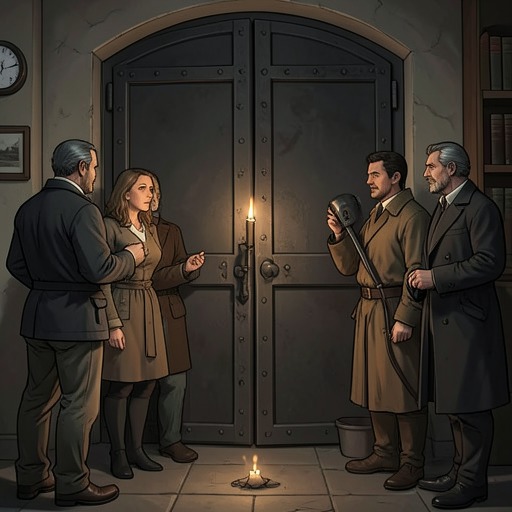
The preliminary investigation of Mitya’s parricide case
The Brothers KaramazovThe preliminary investigation of Mitya’s parricide case is the first formal effort to determine what happened on the night Fyodor Pavlovich was killed. Its decisive tension lies between Mitya’s emphatic denial of the charge and the accumulating testimony that seems to contradict his story. As he tries to explain himself, the investigators record his words as evidence, but the details he considers crucial do not always register with them as he intends.
The Investigation Begins
The investigation belongs to Book IX, “The Preliminary Investigation,” and begins with Perhotin’s official career. Its procedural setting changes the terms of Mitya’s predicament: he is no longer simply recounting events to acquaintances, but answering an investigating lawyer and a group of officials who are writing down his account and assessing it against other evidence.
Mitya’s emotional state makes that change difficult. He speaks quickly and at length, nervously and effusively, as though his listeners were his best friends. Yet the questioning is formal: the lawyer asks whether he declares himself innocent of his father’s death, and Mitya answers that he is. He adds that he is guilty of the blood of another old man, but not of his father’s. His distinction acknowledges other guilt without conceding the central accusation.
Mitya’s Account and the Investigators’ Record
The investigators summarize his position in official language: for the present, the record will state that he absolutely denies the charge. The secretary writes down what the lawyer dictates. This act of recording gives Mitya’s denial a clear place in the proceedings, but it also marks the difference between his expansive, emotionally charged narrative and the compact formulations entered into the protocol.
That difference is especially apparent when Mitya describes deciding to give his father the “signal” that Grushenka had arrived, so that Fyodor Pavlovich would open the window. The lawyers pay no attention to the word “signal,” apparently failing to grasp its meaning in this context. Mitya notices their incomprehension. A detail that matters to his reconstruction of the night therefore risks being flattened or overlooked in the very process meant to establish what happened.
In another sudden disclosure, Mitya says that he would have killed Fenya had he had time. The investigators carefully write down this statement as well. His willingness to describe a violent intention adds to the record, even though it does not establish that he killed his father. The investigation’s pressure thus lies partly in the distinction between what Mitya admits about his conduct and the particular crime he denies.
Money, Evidence, and Contradiction
The question of money becomes the central point of the witness examination. The officials seek to establish whether Mitya spent three thousand or fifteen hundred roubles at Mokroye on his first visit a month earlier, and whether he spent three thousand or fifteen hundred on the more recent occasion. The difference is not a minor bookkeeping issue: it bears on Mitya’s account of the money and on how the events surrounding the murder are interpreted.
At a key moment, Mitya interrupts his own account to make what he calls a full confession: the money was his own. The lawyers react with surprise because this is not the confession they expected. The reversal shows how easily the word “confession” can mislead when the investigators and Mitya attach different meanings to it. His disclosure concerns the money, not an admission that he killed his father.
The witness evidence, however, does not resolve the dispute in Mitya’s favor. The narrator reports that all the testimony bears against him; not one witness supports his account, and some introduce new facts that nearly crush it by contradicting what he has said. The investigation therefore ends this phase with a widening gap between Mitya’s denial and the evidentiary picture presented by others. It does not itself establish his guilt, but it makes the case against him appear increasingly formidable.