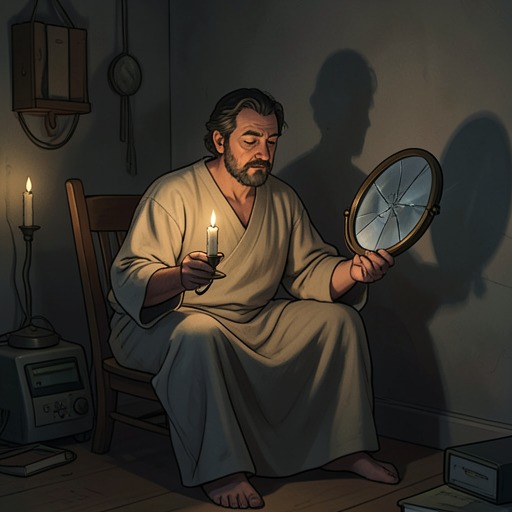
Zosima predicts Vassya’s return
The Brothers KaramazovZosima predicts Vassya’s return after a sergeant’s widow asks whether she may pray for her missing son as if he were dead. He rebukes the practice as a kind of sorcery, then comforts her with the assurance that Vassya is alive and will soon either come home or write. A letter from Siberia arrives almost as soon as she returns home, fulfilling the prediction and making the episode a small but consequential test of faith, hope, and the monastery’s response to apparent miracles.
The widow’s question and Zosima’s answer
The episode reaches Alyosha through a letter from Madame Hohlakov. Rakitin has unexpectedly come from town carrying it, and Madame Hohlakov recounts an incident from the previous day, when women had come to receive Zosima’s blessing. Among them was Prohorovna, a sergeant’s widow whose son Vassya had gone to Irkutsk and had sent no news for more than a year. With no word from him, she asked whether she might pray for the repose of his soul.
Zosima first answers sternly. To pray for someone who may still be living as though he were dead, he says, is a kind of sorcery. But his rebuke does not become a condemnation of the grieving mother: he forgives her because she does not understand what she is doing. He then gives her comfort, saying that Vassya is certainly alive and will either return very shortly or send a letter. She should go home and expect him. The movement from correction to consolation matters: Zosima rejects the widow’s fearful assumption of death without dismissing her longing for her son.
A prediction fulfilled by a letter
The news that follows seems to confirm Zosima’s words with striking speed. Scarcely has Prohorovna reached home when a letter from Siberia is delivered to her. Its writer says that he is an official and hopes, three weeks after the letter reaches his mother, to embrace her. The evidence therefore confirms contact and an announced intention to return, rather than recording the reunion itself; the prediction’s immediate fulfillment lies in the letter’s arrival and its promise of a meeting soon afterward.
Madame Hohlakov presents the news to Alyosha as a prophecy fulfilled literally, and even more than literally. Her excitement gives the event its public force: she warmly urges Alyosha to tell the Superior and the brotherhood, insisting that everyone ought to know. The incident has thus passed through several voices before it reaches the assembled monks—Zosima’s encounter with the widow, the letter’s account as relayed by Madame Hohlakov, and her request that Alyosha carry the report onward. The speed and layered transmission heighten the sense of wonder, while the fact that the confirmation is an ordinary letter keeps the episode anchored in a concrete event.
The monastery receives the news
Alyosha conveys the account to the monks. Even the most austere among them are affected, and Father Paissy appears graver than the rest. The reaction is not merely a burst of celebration: Zosima’s prediction has become a matter for the whole brotherhood, touching a community already alert to the significance of the elder’s words and example.
When the news of the “miracle” reaches Zosima, he cannot entirely suppress his inner emotion. His eyes gleam, and a grave, solemn smile comes to his lips. He exclaims, “We shall see greater things!” The monks around him repeat, “We shall see greater things, greater things yet!” Their shared response turns the widow’s private relief into a moment of communal expectation. Yet the scene does not end in unqualified acclaim. Father Paissy, frowning again, asks the others to wait at least for a time, placing restraint beside their excitement.
Hope, wonder, and restraint
The episode’s significance rests on a careful sequence: grief leads the widow to speak of her son as though he were dead; Zosima corrects that assumption but answers her distress with confidence and hope; a letter then confirms that Vassya is alive and intends to embrace his mother. The prediction gives the bereaved mother a reason to expect reunion rather than mourn prematurely, while its fulfillment makes an intimate act of consolation visible to the monastery.
The monks’ responses preserve a tension rather than resolving it. Madame Hohlakov wants the incident proclaimed as a miracle, and Zosima’s words about greater things seem to welcome a future beyond this single occurrence. Father Paissy’s caution, however, interrupts any rush from striking coincidence to settled judgment. The passage presents wonder as a powerful communal experience, but also shows that the community’s response includes a voice urging patience. Its ending holds those impulses together: hope has been renewed, the prophecy appears fulfilled, and the meaning of the event is not reduced to a simple declaration.