Bayonne
The Caine MutinyBayonne is the setting of the Caine’s decommissioning, where the worn minesweeper reaches the end of its service and Willie Keith faces the dissolution of the naval identity that had shaped his adult life. The location brings the ship’s long, undistinguished wartime labor to a close: its guns are gone, its crew is diminished, and the ceremony marking its end is followed by the practical transfer of its remaining records and equipment. For Willie, leaving Bayonne is not simply a journey home. It marks the difficult passage from command back to a life he no longer quite recognizes as his own.
Setting and Arrival at the End of Service
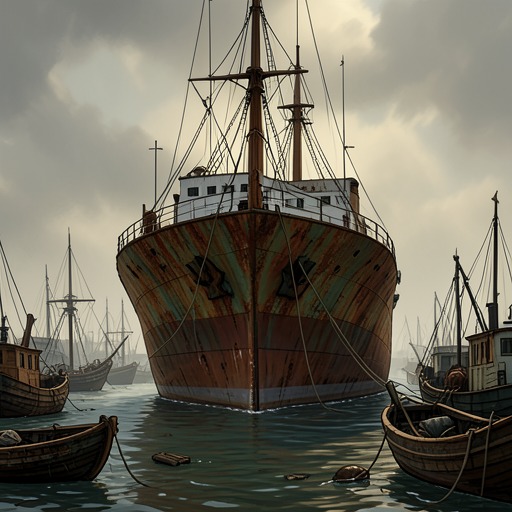
On the morning of October 27, the Caine lies alongside a dock in Bayonne, beside the supply depot. Willie sits in the cabin reading Pascal’s Pensées while the ship is stripped of its guns and left without ammunition or fuel. It has been tied up for three days; the paperwork is complete, and the decommissioning ceremony is due to begin in half an hour. The setting is therefore defined less by a new assignment than by the work of finishing one: the ship is still physically present, but its military function has already been dismantled.
The view from Willie’s cabin places the ship within a plain industrial landscape of sheds, muddy flats, and oil tanks. That environment contrasts with the distances he has recently traveled as captain. Since leaving Pearl Harbor, he has taken the Caine through the Panama Canal and along the eastern seaboard, eventually bringing it into the harbor near the landmarks of his childhood. Those passages had seemed dreamlike to him; in Bayonne, with the vessel immobilized and its service concluded, the return to the United States becomes inseparable from the end of his naval role.
The Decommissioning Ceremony
Before the ceremony, Willie underlines a sentence in his book about life resembling a dream. The thought reflects his sense that the journey home has unsettled the boundary between his military self and the person he was before the Navy. The ceremony gives that transition a public form. His executive officer reports that the ship’s company is assembled, and Willie goes out to return the crew’s salute on the forecastle, standing where the number-one gun had been mounted.
Willie has prepared a long address but finds that he cannot deliver it as planned. The ship’s company before him is not the familiar group that had shared the Caine’s earlier service. Many of the men released through the Navy’s discharge-point system have gone; Willie looks for Keefer, Steve Maryk, Harding, Jorgensen, Rabbitt, and Ducely, but they are absent. A few familiar sailors remain alongside newer officers and men, including draftees who had joined late in the war. The altered crew makes the ship’s ending concrete: even before the Caine is formally decommissioned, the community that gave it continuity has largely dispersed.
Instead of the speech he intended, Willie reads the decommissioning order aloud. He then tells the assembled men that the Caine was obsolete, achieved nothing spectacular, and performed mainly routine fleet work, including escort duty over great distances. He also stresses that the ship’s modest record does not make its service meaningless. In his account, the work done aboard the Caine formed part of the larger effort that sustained the country and helped win the war. Bayonne thus becomes the place where a record of ordinary, necessary service is recognized at the very moment the ship itself is being taken out of service.
Closing the Ship’s Affairs
After dismissing the men from quarters, Willie completes the remaining handover. The decommissioning detail chief waits at his cabin while Willie turns over keys and records and signs the last logs. Steward’s mates carry his bags to the dock, and a sailor brings in the wrapped Union Jack, which Willie addresses to the parents of a former crew member for mailing. These final tasks replace the routines of command with an orderly transfer of property, paperwork, and responsibility.
Willie then walks down the abandoned gangplank without saluting. There are no colors left to salute and no officer of the deck to receive the customary acknowledgment. The ship has become, in practical terms, junk. The unsaluted departure is a quiet but decisive ending to the shipboard world: the ceremony has concluded, the crew has been dismissed, and the familiar forms of naval service no longer have an object or an audience.
Bayonne as a Threshold
A yard jeep takes Willie to the gate, where Mrs. Keith is waiting in her Cadillac. She has driven to Bayonne every day since the Caine’s arrival and now takes him home. Willie resents the reversal implicit in the journey: his mother once drove him to the Navy’s gates, and now she is driving him back. His reaction makes Bayonne a threshold between two versions of his life, rather than a settled homecoming. The Navy is finished with him, but civilian life does not immediately restore the identity he had before enlistment.
His return is further complicated by his inability to locate May Wynn. He has tried repeatedly to reach Marty Rubin’s office, without success, and his mother avoids speaking about May. Willie misreads that silence as evidence that his mother has prevailed in their disagreement, while Mrs. Keith is actually afraid of pushing him toward a declaration of independence. Bayonne therefore closes the ship’s story without resolving Willie’s personal one: the Caine has been decommissioned, but his relationships and his future remain unsettled.
The setting belongs to a fictional account of World War II rather than to a documented naval episode. The novel’s prefatory note states that the Caine, its people, and its events are imaginary, and that military details were altered. Within that invented history, Bayonne serves as the material endpoint of the ship’s career and the narrative threshold of Willie’s return to civilian life.