Blakely
The Caine MutinyBlakely is the president of the court-martial of Steve Maryk, the naval officer accused of relieving Philip Francis Queeg of command. A former submariner and the toughest disciplinarian at Com Twelve, he gives the proceedings a severe institutional presence. The defense’s challenge to Queeg must pass through a courtroom that Blakely controls, where legal argument, military hierarchy, and the accused officer’s fear are all sharply visible.
Identity and Reputation
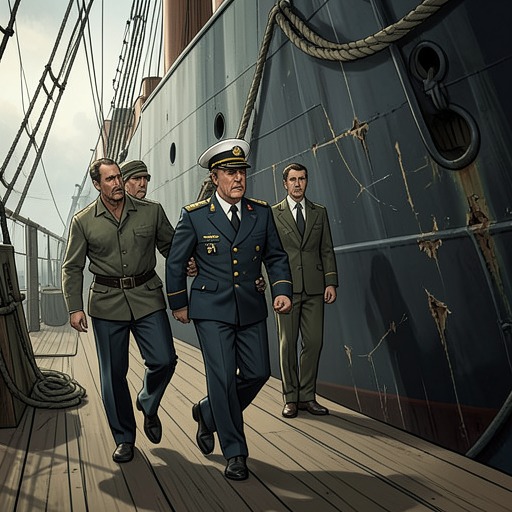
At the opening of the trial, Blakely stands at the center of the bench, directly in front of the American flag. He is described as gray, with a sharp nose, a thin mouth, heavy eyebrows, and small, distrustful eyes. His reputation intensifies the effect of his appearance: he came up from the ranks as a submariner, was later put ashore because of a heart condition, and was known at Com Twelve as its toughest disciplinarian.
Blakely presides over a seven-member court. The six officers alongside him consist of one regular lieutenant commander and five lieutenants, including both regular and reserve officers. The setting makes the court’s authority feel physically imposing to Maryk: the flag hangs between the accused and the sunlight and water outside, while Blakely’s face is the one that makes Maryk shake after the oath.
Control of the Proceedings
Blakely’s most consequential early intervention comes when Barney Greenwald explains the defense’s theory. Greenwald argues that Articles 184, 185, and 186 of the Navy Regulations supplied Maryk’s authority, and that Queeg’s conduct as captain supplied justifiable cause. He also insists that the officers’ nickname for Queeg, Old Yellowstain, and the incidents behind it are relevant to judging whether the relief was warranted. Blakely responds by ordering the court cleared.
When the court reconvenes, Blakely cautions Greenwald that the case is unusual and delicate because it concerns an officer with fourteen years of unblemished service, including lengthy combat duty. He acknowledges that the defense must challenge Queeg’s competence, but emphasizes that legal ethics, military respect, and subordination remain in force. He makes Greenwald personally responsible for the conduct of the defense, including any abuse of cross-examination. After that warning, however, he overrules the prosecutor’s objection and directs the stenographer to repeat the question about Old Yellowstain. His response both constrains the defense and allows it to proceed.
Discipline and the Question of Evidence
Blakely’s approach is also apparent when the defense questions Urban, a signalman, about the typhoon. After Urban gives an uncertain account of a moment when the captain and executive officer appeared to want different turns, Jack Challee presses him for more. Blakely leans forward and reminds Urban that he is under oath and that evasiveness can constitute contempt of court, then tells him to think over his answer. The exchange shows Blakely enforcing the demand for testimony while placing pressure on a witness whose recollection is already uncertain.
Later testimony raises a different evidentiary problem: whether Queeg’s behavior amounted to a disabling condition for command. Dr. Forrest Lundeen, the psychiatrist who headed the medical board that examined Queeg, describes traits including rigidity, persecutory feelings, suspicion, withdrawal from reality, perfectionist anxiety, and self-righteousness as mild and compensated. Under Greenwald’s questioning, Lundeen identifies the cluster as paranoid but stresses that a label alone does not establish disability; the practical issue is whether a condition impairs a person’s functioning. Greenwald then presents a hypothetical commander who becomes frightened under fire, damages government property and denies it, falsifies records, extorts money, and imposes excessive punishments. Lundeen replies that the question is incomplete without knowing whether the commander otherwise performs his duties satisfactorily. Blakely’s role here is that of presiding judge: the testimony puts diagnosis and fitness for command before the court without making them interchangeable.
The Defense and the Limits of the Record
When Maryk presents his own account of the morning of December 18, he repeats Willie Keith’s version and affirms that the ship was in the last extremity when he relieved Queeg. That testimony brings the defense’s central claim directly before the court: the act was not merely a breach of command authority but, in Maryk’s judgment, a necessary response to an emergency. The governing regulation sets a stringent standard, requiring circumstances so clear that retaining the commander would seriously and irretrievably prejudice the public interest, as well as careful investigation and a reasonable, prudent officer’s conviction that relief was necessary. Blakely presides over a case in which the court must weigh that standard against the defense’s account of Queeg and the prosecutor’s challenge to the defense’s strategy.
Greenwald later tells Maryk in the corridor that Blakely dislikes Jews, citing what he hears in Blakely’s intonation of his name. This is Greenwald’s interpretation, offered privately to a distressed client; the evidence presents no independent confirmation of bias. The distinction matters because Blakely’s stern manner is established in the courtroom, while the alleged prejudice remains an accusation rather than a demonstrated fact. The court-martial ultimately acquits Maryk, but the convening authority disapproves that acquittal. The record establishes Blakely as the court’s formidable presiding officer, not as the sole author of either outcome.