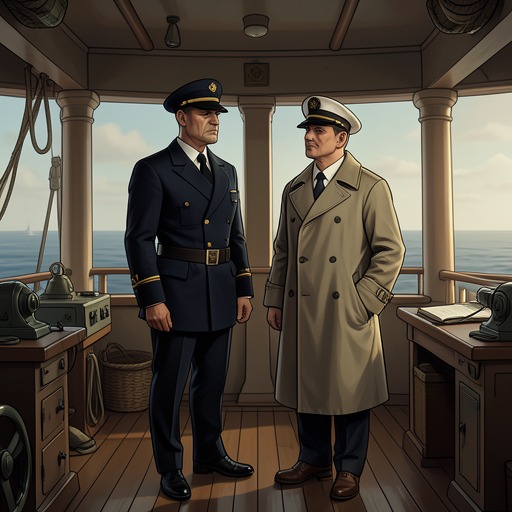
Burt Gorton
The Caine MutinyBurt Gorton is the executive officer of the USS Caine, a destroyer-minesweeper whose long and often unglamorous service shapes his role in the novel. A lieutenant with five years aboard, he stands between the captain’s authority and the officers who must carry out the ship’s work. His scenes show him receiving newcomers, transmitting orders, and being asked to advise on contested decisions; they offer a portrait of experienced shipboard competence exercised within strict limits.
Identity and Long Service
Gorton’s five years aboard the USS Caine mark him as a deeply established member of its company. When Willie Keith arrives, Gorton explains that personnel in the DMS service are difficult to transfer. He points to two chiefs who have served aboard for more than a hundred months and notes that Captain de Vriess has spent seventy-one months on the ship. Gorton speculates that a personnel file may have been lost in Washington, then welcomes Willie and tells him that he will get sea duty. His account presents the ship not as a brief assignment but as a place where personnel can remain for years, whether by institutional inertia or the Navy’s reluctance to move them.
Gorton’s welcome is matter-of-fact and cheerful. He gives Willie an initial sense of the ship’s arrangements, while the physical reality of the assignment soon becomes clear: Willie sleeps in a cramped metal clipping shack, where Ensign Harding lies on a bunk welded close to the deck. That harsh accommodation belongs to the wider life of the crew rather than to Gorton alone, but it helps define the conditions within which an experienced officer like him works. The contrast between his easy welcome and the cramped quarters makes his familiarity with shipboard hardship part of his understated authority.
Orders, Watches, and Daily Operations
Gorton’s executive role is clearest when he communicates changes in routine. In port, he informs Tom Keefer of new watch-standing orders requiring four officers to remain aboard at all times, including the captain or Gorton and all three officers of the duty section. The rule frustrates Keefer’s plan to go ashore, and Steve Maryk volunteers to take his watch. Gorton’s announcement sets the limit; the officers’ exchange shows how that limit immediately affects their personal plans and how the duty section absorbs the inconvenience.
Gorton also works at the boundary between the ship’s paperwork and its movements. After an action message arrives, Willie decodes the order canceling the USS Caine’s departure for Pago Pago and assigning the USS Moulton to convoy duty instead. The USS Caine is to remain at Pearl Harbor for target towing and obtain towing gear from a repair base. Gorton is present as the message is decoded and reacts to the abrupt switch. The episode places him inside a chain of naval communication in which a few terse lines can redirect a ship’s work without explaining the reasoning to its crew.
The wider account of the ship’s life emphasizes how such duties accumulate. Officers endure watches, paperwork, interrupted sleep, and prolonged periods at sea; Gorton belongs to that professional environment, though the narrative does not assign him every task described collectively. The USS Caine’s routine is governed by orders and administrative work as much as by operations, and Gorton’s recurring role in watch arrangements and message handling makes him one of the people who translate that system into immediate shipboard obligations.
The Grounding Inquiry and Queeg’s Decisions
When the USS Caine’s assignment changes after its grounding in West Loch, Gorton goes to the office of ComServPac to ask whether the change had anything to do with the incident. He dresses carefully for the visit and presents himself to Captain Grace, who dismisses him. Gorton asks the question anyway, after being dismissed, and Captain Grace reacts with marked displeasure. Gorton then leaves the office. His brief challenge is cautious but consequential: he seeks an explanation for a decision that affects the ship, yet does not press the confrontation once the senior officer has made his position clear.
Back aboard, Gorton is summoned to Captain Queeg’s cabin and asked for the information he has obtained. Later, after the USS Caine has lost its towed target and Queeg decides to head for Pearl Harbor, Gorton is in the charthouse calculating a sun line. Tom Keefer tells him that the captain wants a course to Pearl, and Gorton is surprised to learn that the target has been lost. Steve Maryk explains Queeg’s reasoning and urges Gorton to persuade the captain to recover it. When Queeg asks for Gorton’s opinion, Gorton responds that Steve can be relied on if he says the recovery is possible. He expresses confidence in Maryk’s judgment, but stops short of making the recommendation himself. Queeg calls for Chief Bellison, and the decision remains with the captain.
Character and Narrative Role
Gorton’s scenes repeatedly place him between knowledge and authority. He can ask why an order has changed, relay what he learns, and offer a measured assessment when the captain requests one; he cannot make those actions equivalent to command. His visit to Captain Grace ends in retreat, while his exchange with Queeg leaves the recommendation qualified and indirect. The pattern distinguishes his practical responsibility from the captain’s formal power without turning Gorton into an open opponent of that power.
The novel gives little independent access to Gorton’s private life or a separate personal arc. Instead, his significance lies in the working relationships and routines he makes visible: long service aboard the USS Caine, the friction between port liberty and watch requirements, the rapid redirection of operational orders, and the difficulty of advising a commander whose choices affect the ship. He is neither presented as a dramatic dissenter nor reduced to a mere messenger. His restrained interventions show how an executive officer can recognize a problem and still remain inside the limits of naval hierarchy.