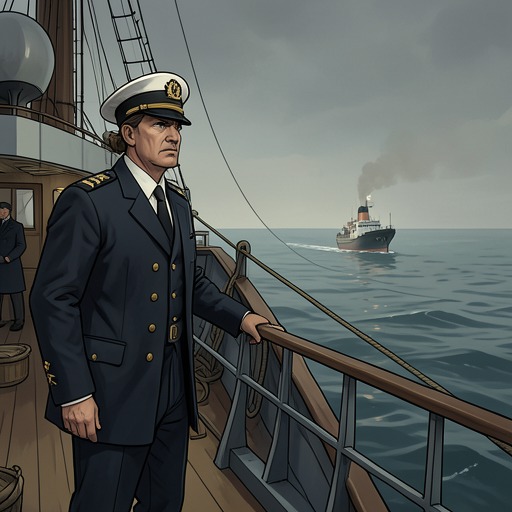
Caine target-towing fiasco
The Caine MutinyThe Caine target-towing fiasco was a failed attempt to recover a gunnery target that brought Philip Francis Queeg under scrutiny from ComServPac and exposed the widening gap between his official defense and his later account. The lost target was an operational failure; the inquiry turned it into a question of command judgment, responsibility, and Queeg’s hostility toward John Stilwell.
The order to report
A mailgram delivered the demand in stark, compressed terms: at 1300 on 22 October, the commanding officer of the Caine was to submit a written report on the latest fiasco, in person, to the operations officer of ComServPac. The insistence on appearing personally made the report more than routine paperwork: Queeg would have to answer for the episode face to face.
The message reached him in a moment of visible distress. Burt Gorton, the executive officer, first caught sight of Queeg in his cabin, still in his underwear with his face covered in shaving lather. After a brief wait, a frantic buzzer summoned Gorton back. Queeg sat at his desk with the envelope torn open, the flimsy message in hand, his head lowered and his left hand trembling. He silently passed the mailgram to Gorton, then asked what it meant. The contrast between the formal order and Queeg’s shaken response established the pressure the inquiry placed on him before he had even presented his account.
Queeg’s defense before Captain Grace
When Captain Grace questioned him, Queeg began by accepting full responsibility in principle, while also describing the ship’s training as inadequate and promising that he had taken steps to correct it. Asked directly why he had not recovered the target, however, he said the chief boatswain’s mate did not know how to proceed and his officers had failed to give him precise information. He maintained that returning the Caine to base for further duty mattered more than spending an uncertain amount of time on complicated maneuvers, and called that his decision.
Grace rejected the premise that recovery was especially difficult. Other minesweepers had done it repeatedly, he pointed out, and a recovery could be completed in half an hour; the target cost money, and a tug sent to look for it had been unable to find it. Grace then pressed Queeg on the towline itself, asking how much of a turn he had been making when it broke. Queeg insisted he had used standard rudder and referred Grace to his logs, but the question was not about the rudder setting: Grace wanted to know how far the ship had turned, offering possibilities from twenty or sixty degrees to a full reversal of course. The exchange exposed a gap between Queeg’s procedural defense and the specific maneuvering question Grace was trying to answer.
A later admission, and a new target for blame
The incident returned in a later confrontation with Steve Maryk. Angry over Maryk’s handling of John Stilwell’s emergency, Queeg ordered him to write the Red Cross to verify whether Stilwell’s mother was actually ill or dead. Queeg connected the trouble he had had with ComServPac to the earlier towline incident, and, in the course of his accusation, acknowledged for the first time that the line had been cut.
That admission did not lead Queeg to accept responsibility for the loss. Instead, he blamed Stilwell for failing to warn the commanding officer that the ship was in danger. He reasoned that Stilwell had kept quiet out of resentment because Queeg had reprimanded him that morning for being too forward and making decisions at the helm. Queeg described Stilwell as a vindictive troublemaker and promised to pursue him. The shift is significant: the previously defended failure now appears in Queeg’s own account as a cut line, but his explanation turns immediately toward an alleged subordinate’s motive and culpability.
Significance
The fiasco unfolds through different kinds of evidence: an urgent mailgram, Queeg’s formal explanation to Captain Grace, and his later outburst to Maryk. The first demands an accountable written report; the second shows Queeg presenting the failure as a decision made amid incompetent support; the third supplies the admission that the towline was cut while redirecting blame toward Stilwell. Read together, these moments make the lost target a recurring measure of Queeg’s command. The technical question of how the line broke remains unresolved in the available account, but the consequences are clear: the incident draws outside scrutiny and feeds Queeg’s campaign against a subordinate he regards as an enemy.