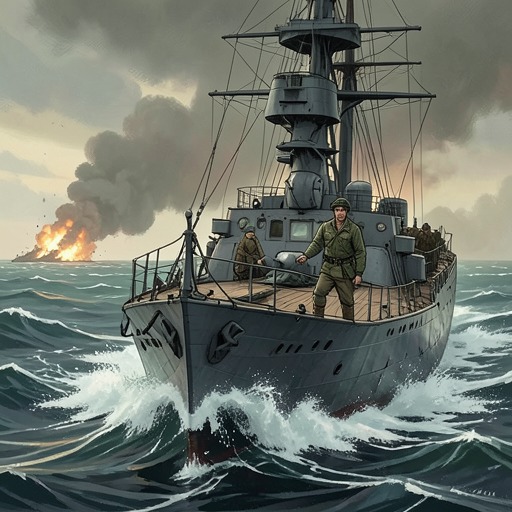
Caine's Failure to Join the Tokyo Bay Minesweeping Operation
The Caine MutinyCaine's Failure to Join the Tokyo Bay Minesweeping Operation marks the gap between the crew's determination to return to active duty and the Navy's judgment that their ship could not safely make the voyage. After the USS Caine's pumps were repaired, Willie Keith and Tom Keefer sought permission for the minesweeper to join the ships preparing to clear Tokyo's harbor; the request was refused, and the ship remained behind as the war ended.
Background and Attempt to Rejoin Operations
The episode came after the USS Caine had finally swept a mine in the China Sea, seventeen days before the end of the war. Its crew had therefore experienced the work of minesweeping, but that late encounter did not make the ship fit for another deployment. When Willie returned aboard, he appealed to the black gang to repair the pumps, explaining that the ship's chances of getting home depended on making it serviceable. The pumps were repaired in two days.
An order then went out to the destroyer-minesweepers in the harbor to prepare for a voyage to Tokyo, where they would sweep ahead of the victorious fleet. The USS Caine was not included. Willie and Tom Keefer went together to the MinePac office aboard the Terror and asked Captain Ramsbeck to reconsider, arguing that their ship was ready for sea. Their visit made the crew's effort visible to the command, but it did not change the decision.
The Refusal
The operations officer acknowledged the men's spirit but considered the USS Caine washed up. He pointed to the risk of another breakdown on the way to Tokyo and to the typhoon season: with only twelve knots of power available, the ship might have to face a typhoon en route. The refusal rested not on the failure to repair the pumps, but on the wider question of whether the old minesweeper could be trusted to complete the passage and withstand the conditions it might encounter.
Willie and Tom Keefer accepted the answer with rueful grins as they watched the minesweepers stream out of Buckner Bay. Keefer joked that his epitaph might read almost, but not quite, then turned to the routine question of what film was playing that night. His humor compresses the disappointment into a small reversal: the prospect of going to Tokyo gives way almost immediately to the shipboard movie schedule.
Aftermath and Significance
The USS Caine swung at its rusted, mossy anchor in an almost empty harbor while its officers and crew listened to the surrender ceremonies over the radio. Its exclusion left the ship outside the planned final minesweeping deployment; the sequence does not show it joining the operation later. The contrast is especially sharp because the crew had just repaired the pumps in hopes of earning a passage home, only to remain behind as the fleet moved on.
The novel's preliminary note identifies the ship and its events as fictional and warns that operational details have been altered. Within that fictional history, the episode gives the USS Caine's deteriorated condition a final practical consequence: crew initiative could restore a piece of machinery, but it could not persuade the command that the vessel was seaworthy enough for the mission. The surrender broadcast, heard from the anchored ship, closes the gap between the crew's frustrated wish to see Tokyo and the war's arrival at its end.