Caine's Typhoon Encounter
The Caine MutinyCaine's Typhoon Encounter is the December 1944 storm crisis in which the USS Caine is pushed toward loss of control and Steve Maryk takes command from Philip Francis Queeg. The episode turns a routine fleet-support voyage into a test of judgment under conditions in which the ship may not respond to its helm. Its stakes extend beyond survival: Maryk invokes Article 184 and accepts personal responsibility, while Willie Keith learns to distinguish fear that can be endured from terror that disables action.
Background and Approach
The novel places the storm within a war whose broad strategic outlook and immediate experience sharply differ. By early 1944, major turning points had passed and Allied industrial power was increasing; from Willie’s station aboard the old minesweeper, however, the prospect of Pacific operations remained dangerous and uncertain. In January, a large fleet had left Hawaii in formation for Kwajalein. The operation’s immense scale and precise coordination offered Willie reassurance, but his view of the war remained that of a junior officer facing the prospect of mines, shore batteries, and air attack rather than a historian looking back on a favorable strategic balance.
The USS Caine’s work also belonged to a larger cycle of communications, support, and movement. At Funafuti Atoll, Willie used a destroyer tender’s communications office to avoid days of decoding the many fleet messages that burdened destroyer communicators. Later, the minesweeper joined a tanker group whose passage followed familiar wartime precautions. On this voyage, Willie consulted a typhoon chart whose blue area between Ulithi Atoll and the Philippines contained no red warning squares. He took the blank space to mean there were no typhoons there and continued his duties with an unwarranted sense of security. The incident exposes the limits of treating a chart—or a customary routine—as a guarantee about conditions at sea.
The novel explains why the weather could make a powerful warship difficult to control. A ship’s rudder depends on water moving past it; if wind drives the water along with the vessel, the rudder may lose its effective grip. Wind, waves, and the ship’s own motion can also exert conflicting forces, producing erratic responses to the helm. In sufficiently severe conditions, the ship may be unable to turn as its captain intends. This explanation gives the crisis a material basis: the danger is not simply that the crew is frightened, but that ordinary instruments of command may cease to produce predictable results.
The Storm Intensifies
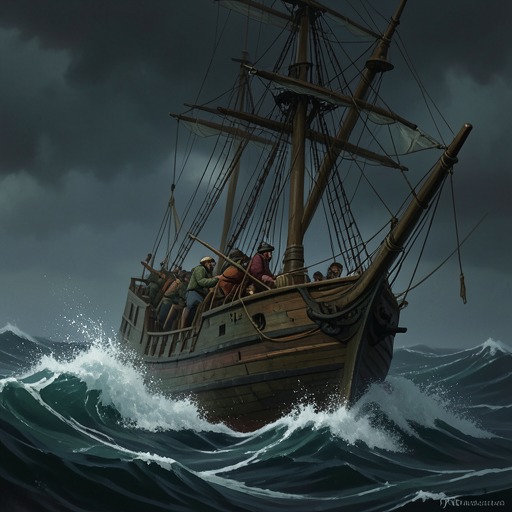
On the night of December 16, the USS Caine began rolling hard. Rough motion was familiar to Willie, who had previously experienced the bridge inclinometer reaching forty-five degrees, but this weather soon developed into a much more serious test. By morning, Willie and Maryk looked out from the port wing at a sea filled with large waves and a fleet of battleships, carriers, tankers, and destroyers moving through the conditions. Water continually covered the forecastle. The Caine pitched heavily, and the deck’s rise and fall made movement around the ship difficult.
Willie’s account of the scene is closely tied to what an officer on the bridge can observe and do. Sent to the radar shack to determine the ship’s place in the formation, he had to fight his way through the wind to its door. Inside, sailors in life jackets and equipped with waterproof searchlights crowded together. Their presence makes plain that the danger had reached the people responsible for keeping watch, not merely those observing the weather from a safe distance. Yet the ship’s work continued: the bridge needed information about the formation even as getting to the radar shack became hazardous.
As conditions worsened, the USS Caine’s bridge itself became vulnerable. A large wave struck the port side and water entered the wheelhouse. Maryk urged that the ship be turned into the wind, while the helmsman reported that it was not responding to the engines. The ship rolled nearly onto its port side, and the gyro light went out. These failures compounded one another: the bridge was taking water, the ship was not answering as expected, and a key instrument had gone dark. At that point, the crisis was no longer a matter of keeping to the planned formation. It was a question of whether the captain’s orders could still preserve the ship.
Command and Rescue
After the USS Caine righted itself, Willie asked Maryk what was happening. Maryk’s answer was that they needed to ride out the storm. Later, with Queeg insisting that he had received no orders to maneuver at discretion, the ship again faced deteriorating conditions. When a wave flooded the bridge and the vessel failed to answer its engines, Maryk challenged the course being followed and sought to turn into the wind. Queeg threatened the officers with punishment for collusion in mutiny. Maryk replied that he had acted on his own, under Article 184, and that he would take responsibility if he had applied it incorrectly. He directed the others to obey his orders.
The decision is presented as an assumption of responsibility in an emergency, not as a routine change of command. Maryk tells the officers that the act is his and that the ship is following the course he ordered. The distinction matters in a novel preoccupied with naval hierarchy: obedience remains essential, but the storm raises the possibility that preserving the ship may require an officer to act when the existing command is failing to meet the danger. The event also places formal rules in direct relation to physical conditions. Article 184 is invoked not as an abstract argument but as the basis for action amid a rapidly changing situation.
The crisis does not end with the USS Caine’s immediate efforts to survive. Stilwell spotted what appeared to be another ship close ahead. Maryk ordered a hard turn and full astern; the object proved to be the wreck of a capsized vessel. He then ordered the crew to keep watch for survivors and directed the Caine to circle the ship. Queeg objected that searching endangered the Caine, but Maryk answered that they could not simply pass by. The rescue attempt therefore becomes a second test of command: the storm still threatened the minesweeper, yet the crew was also responsible for people in the water. The ship circled in the difficult conditions, though Maryk eventually concluded that the wreck had probably gone under.
Consequences and Significance
During the circling maneuver, Willie took another barometer reading: it had risen to 29.10. The higher reading did not mean the danger had passed. Maryk explained that the ship remained about thirty miles from the typhoon’s center and that conditions could still change. The detail undercuts any simple equation between a single instrument reading and safety. The crew had to continue responding to the conditions around them rather than treating one encouraging measurement as a resolution.
The encounter changes Willie’s understanding of fear. During the search around the capsized vessel, he recognizes a difference between fright that remains bearable and a more overwhelming terror that incapacitates. He believes he can face the danger without being overcome by it, particularly with Maryk nearby. This is not presented as freedom from fear; it is a change in his ability to act and endure while afraid. His development is tied to a particular working relationship on the bridge, where he observes Maryk making decisions and accepts the demands of the situation.
The storm also belongs to the USS Caine’s longer record of arduous support work rather than standing apart from it. Seventeen days before the end of the war, the minesweeper finally swept a mine in the China Sea, where the mine rose in its wake and was marked for destruction. Later, as destroyer-minesweepers prepared to sweep Tokyo Harbor ahead of the victorious fleet, the USS Caine was excluded because its condition made it unfit for the assignment. Its officers argued that it was ready, but the operations officer questioned whether it could withstand another breakdown or a typhoon with only twelve knots of power. That later refusal echoes the storm’s central problem: the gap between a ship’s assigned duty and its actual capacity. The novel identifies the USS Caine and its shipboard events as fictional, while placing them against a historical wartime setting whose specific operational details have been altered.