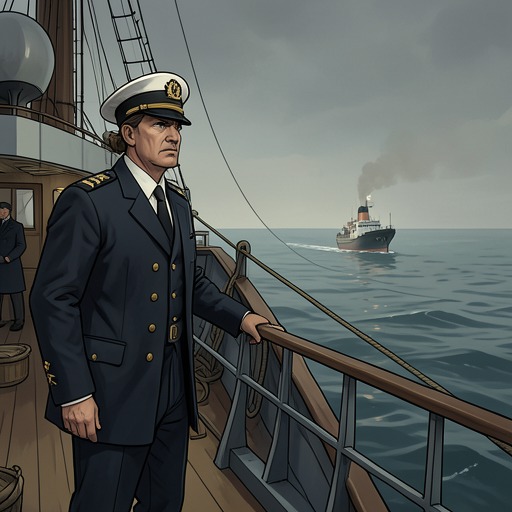
Captain Grace
The Caine MutinyCaptain Grace is the officer who confronts Philip Francis Queeg over the failed recovery of a towed target and helps shape what follows: rather than seek Queeg’s removal, he favors a transfer and recommends the USS Caine for overhaul. His combination of direct criticism and procedural fairness makes him an important counterweight to a story in which command decisions carry consequences for both officers and crew.
Position and the Review
Captain Grace receives Queeg after the target-towing failure and examines the report Queeg has submitted. He reads it before pronouncing it unsatisfactory, then presses on a central omission: why Queeg did not recover the target. The exchange places Grace in the position of evaluating both the event and the explanation offered by the captain responsible for it.
Queeg’s account distributes responsibility among subordinates, including the chief boatswain’s mate and his officers, while also noting the ship’s poor training. He says he chose to return to base rather than spend time on what he considered complicated and futile maneuvers. Grace challenges the premise of that explanation: target recovery, he points out, was a routine task that other destroyer-minesweepers had performed, and it should have taken about half an hour. A tug sent to locate the missing target had not found it. Grace’s questions therefore connect Queeg’s decision to a concrete loss and to the practical expectations of the assignment.
Candor and Judgment
Grace initially treats the interview as an official review, but then changes its tone. He acknowledges that a first command can make an officer anxious about mistakes and describes his own experience of making errors before becoming competent. He invites Queeg to speak candidly, separating this portion of their conversation from the formal interview. The shift is conciliatory, but it does not dilute his assessment: Grace tells Queeg that he failed to recover the target because he did not know what to do.
This judgment is notably specific. Grace does not merely repeat that the report is inadequate or blame the ship’s condition; he identifies a gap between Queeg’s stated reliance on subordinates and the captain’s responsibility to act. At the same time, Grace does not treat one failure as sufficient proof that Queeg should lose command. His responses distinguish a serious professional shortcoming from a case that can fairly support formal relief. That distinction defines his role in the episode: he is critical without turning criticism into a predetermined punishment.
Transfer and the USS Caine’s Overhaul
Grace raises the possibility of transferring Queeg to a shore assignment, presenting it as a correction of an unsuitable posting rather than a judgment that Queeg’s service aboard the USS Caine has been unsatisfactory. He also offers to ensure that Queeg’s fitness report would not make the transfer look like removal from his first command after only a month. Queeg’s concern about how such a short command would appear in his record makes the potential cost of the proposal explicit. Grace’s offer responds to that concern by seeking to protect Queeg’s professional record while moving him elsewhere.
When asked whether Queeg should be recommended for relief, Grace answers no. He says that nothing definitely known warrants that step and that the tension of a first command could account for what has happened so far. This is not an endorsement of Queeg’s performance: Grace has already called the report unsatisfactory and challenged his handling of the target. Rather, he refuses to convert suspicions and troubling incidents into a formal judgment unsupported by established facts.
The alternative that follows is operational as well as personal. Grace supports recommending the USS Caine for a stateside overhaul, and the admiral approves the proposal. The ship had spent twenty-two months in the forward area; its previous captain, Captain de Vriess, had been unable to secure an overhaul during a year of combat steaming. Under Queeg, the recommendation comes in his first four weeks in command. The transfer possibility and the overhaul thus emerge together: Queeg is to take another command elsewhere, while the aging ship receives a long-sought chance for repair.
Narrative Role and Limits
Captain Grace’s intervention redirects the consequences of the target-towing failure without erasing it. Queeg is neither simply cleared nor formally condemned: his decision is exposed as poor, but Grace concludes that the available evidence does not justify recommending his relief. The practical result is a change of assignment rather than a public finding against him, alongside an overhaul for the USS Caine. Grace’s measured response also clarifies the difference between evaluating a command failure and establishing grounds for a formal sanction.
The novel’s prefatory note identifies the people and events aboard the USS Caine as imaginary and states that the ship does not exist. Captain Grace should therefore be understood as a fictional participant in a historical setting, not as a portrait of an identifiable naval officer. Within that fiction, his importance lies less in a sustained personal history than in a brief but consequential exercise of judgment: he recognizes Queeg’s failure, offers a face-saving route away from the command, and declines to claim certainty where the record does not provide it.