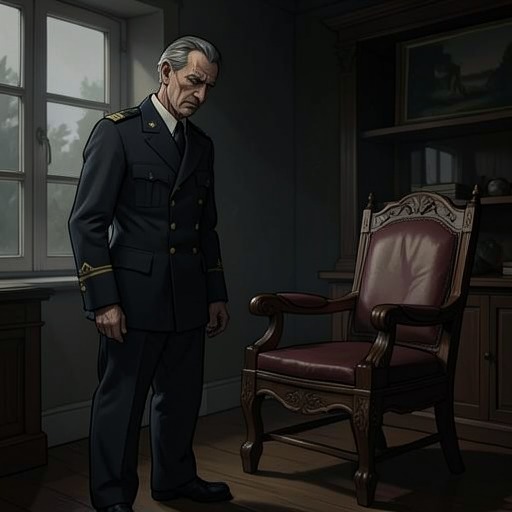
Captain Queeg and Stilwell's antagonism
The Caine MutinyCaptain Queeg and Stilwell's antagonism turns routine discipline aboard USS Caine into an increasingly personal conflict. Queeg makes Stilwell an example for reading on watch, then treats the sailor’s emergency leave as a possible evasion and links him to an earlier command difficulty. The consequences extend beyond the two men: Stilwell becomes a target of Queeg’s suspicion and a focus for a divided crew, while the formal processes of discipline allow the captain to punish him through other officers.
The first disciplinary confrontation
The antagonism becomes visible when Queeg returns to USS Caine and notices Stilwell at the officer-of-the-day’s desk, looking through a comic book. The gangway messenger calls attention, and Stilwell turns and salutes. Queeg appears unperturbed and asks for the officer of the deck; Ensign Harding is forward, arranging new chafing gear on a line. When Queeg later challenges Harding, the ensign begins to explain the work, but Queeg rejects the explanation as an alibi and holds him responsible for everything that happens during his watch. He removes Harding from the watch bill until, in the captain’s judgment, he understands the job’s responsibilities.
Queeg then turns to Stilwell, orders him placed on report, and proposes six months’ restriction to the ship. The punishment is framed not only as a response to reading on watch but as a lesson for the rest of the crew. The incident establishes a pattern: Queeg makes an individual sailor’s offense serve as an example, and Stilwell is singled out as the example in this case. His earlier actions are not presented as a mitigating consideration in the captain’s public response.
The formal machinery of the punishment reinforces the imbalance. Willie Keith records Stilwell’s sentence and watches the captain’s mast, where offenders appear before Queeg and receive their sentences. Keith understands that, as far as he knows, all the men at mast have been reported on Queeg’s orders. Queeg does not submit the reports himself; he directs the nearest officer to place a man on report, then receives the accuser’s account with apparent surprise and interest. Stilwell’s case thus takes the shape of a hearing with an accuser, an accused sailor, and a judge, although the captain has already initiated the action. The procedure preserves the appearance of separate roles while concealing how directly Queeg has shaped the accusation.
Stilwell’s request for leave
After the mast, Stilwell approaches Keith, who is serving as morale officer, and asks whether his restriction bars him from going home on leave. He explains that he has a wife and child in Idaho, has been away for two years, and has reason to doubt his wife’s faithfulness. Keith believes the restriction should not prevent leave for a sailor who has spent so long in a combat area, but Stilwell asks whether this is actually the regulation or merely Keith’s opinion. His question shows how little certainty the punishment leaves him about whether the captain’s decision has closed off his chance to go home.
The issue resurfaces at sea. Stilwell asks Keith whether he has spoken to Queeg about the leave; Keith admits that he has not yet had the chance, though he reassures the sailor that the request should be all right. Stilwell’s face falls. The exchange exposes the gap between Keith’s sympathy and his limited ability to change the captain’s decision. When Keith eventually argues with Queeg, he points out that Stilwell is a good sailor and that the crew had not previously been punished so severely for looking at a magazine during a watch. Queeg answers that wartime discipline requires greater pressure on enlisted men, and that the ship’s organization could fail if its rules were relaxed.
Queeg also defends making Stilwell the example because the sailor happened to be caught first. He insists that he has to worry about the entire ship, even as he treats one man’s family concern as secondary to enforcing his wishes. Keith’s appeal ends without changing the sentence. Stilwell accepts the news with a stiff, blank expression and thanks Keith for trying. Their exchange leaves the antagonism intact: Queeg’s order governs Stilwell’s immediate prospects, while the captain’s rationale presents the punishment as necessary for everyone aboard.
A private grievance becomes explicit
At a later muster, Queeg asks Maryk whether Stilwell was present and suggests that the sailor may have gone over the hill. Keith intervenes, saying that he saw Stilwell at the gangway shortly after muster. Maryk then reveals that he has granted Stilwell seventy-two hours’ leave because Stilwell received a telegram saying that his mother was dying. Rather than accept the emergency as the reason for the absence, Queeg challenges Maryk’s decision and summons him to the executive officer’s room. Keith, watching the exchange, fears for both Maryk and himself.
In private, Queeg calls Maryk’s action a stupid trick and orders him to write the Red Cross to establish the exact truth about Stilwell’s mother. Queeg ties the incident to trouble he had with the superior command after the earlier towline failure. He says that the trouble began with that incident and blames Stilwell for not warning him that the ship was in danger. Queeg recalls having rebuked Stilwell that morning for being too fresh and making his own decisions at the helm, then interprets the sailor’s silence as deliberate retaliation. He describes Stilwell as a vindictive troublemaker and declares his intention to get him. These are Queeg’s accusations and suspicions; the episode establishes what the captain believes, not independent proof that Stilwell acted to harm him.
The captain’s account makes the antagonism more than a dispute over a comic book or a leave pass. Queeg reads Stilwell’s actions through an accumulated grievance: the sailor’s failure to warn him during the towline incident becomes, in his view, evidence of a grudge, and the emergency leave appears to him as another suspicious act. The demand for a Red Cross inquiry places the sailor’s family crisis under investigation while giving Queeg another formal means to pursue him.
The crew and the circle of compliance
The conflict acquires a wider social effect aboard USS Caine. The crew knows that Stilwell is Queeg’s particular object of dislike, and Stilwell waits anxiously for an answer to Maryk’s Red Cross letter about his mother. As weeks pass without a reply, he grows gaunt and finds each helm watch within Queeg’s range of attention distressing. Sailors opposed to the captain make a point of befriending Stilwell and trying to encourage him. Other crewmen avoid him, fearing that Queeg’s hostility might extend to those associated with the gunner’s mate. Stilwell consequently becomes both a person under pressure and a point around which opposition to Queeg gathers.
That division fits the ship’s broader pattern of selective compliance. After Queeg cancels liberty for the entire crew over a cigarette butt in a scupper, the deck force keeps the main deck swept; once the ship sails, the order is mostly abandoned, apart from the small area the captain passes. The crew has learned to observe Queeg’s rules within the range of his eyes and ears while allowing ordinary shipboard life to continue elsewhere. The narrator describes this as a circle of compliance, not a conscious conspiracy. Within that arrangement, Stilwell’s case is unusually exposed: his punishment and the captain’s attention make him a visible object of the enforcement that most sailors otherwise learn to evade.
Maryk’s position sharpens the contrast. He recognizes his duty to enforce the captain’s rules but also understands that many are difficult or damaging to enforce aboard an overworked, crowded ship. He keeps the ship functioning beyond the zone of Queeg’s direct attention. Queeg, by contrast, treats the Stilwell matter as a test of obedience and presses his subordinates to carry out the consequences. Their different responses leave Stilwell caught between the captain’s command and the informal judgments of the officers and sailors around him.
Significance and limits
The antagonism shows how command authority can make an ordinary infraction carry consequences far beyond its immediate scale. Reading on watch leads to restriction; the restriction becomes a question about family leave; a separate emergency then prompts Queeg to revisit the earlier towline failure and accuse Stilwell of deliberate hostility. Each step strengthens the captain’s personal case against the sailor without resolving whether his suspicions are justified. The repeated use of reports, mast proceedings, and an inquiry gives the conflict an official shape, even as Queeg’s own account reveals its personal dimension.
Stilwell’s predicament also tests the officers around him. Keith sympathizes with him but cannot secure the leave he hopes will be available; Maryk grants emergency leave and is challenged for doing so. Meanwhile, the crew’s mixed response—some sailors rallying around Stilwell, others keeping their distance—shows how a captain’s hostility can reorganize everyday loyalties aboard a confined ship. The evidence establishes the antagonism’s growth and its effects on discipline and morale, but does not show a final reconciliation or a settled resolution between Queeg and Stilwell.