Captain de Vriess
The Caine MutinyCaptain de Vriess is the USS Caine’s commanding officer when Willie Keith first reports aboard, and his relaxed authority gives Willie an immediate, unexpected introduction to naval life. De Vriess’s brief appearance establishes a captain who treats ceremony lightly; much later, his faith in Willie’s potential and his contrast with Philip Francis Queeg give that first impression a deeper significance. The book identifies the Caine and its people as fictional, so De Vriess’s character should not be read as a portrait of a real naval officer.
Identity and Introduction
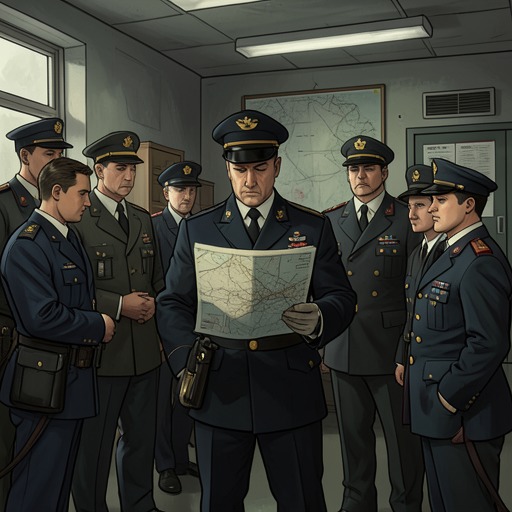
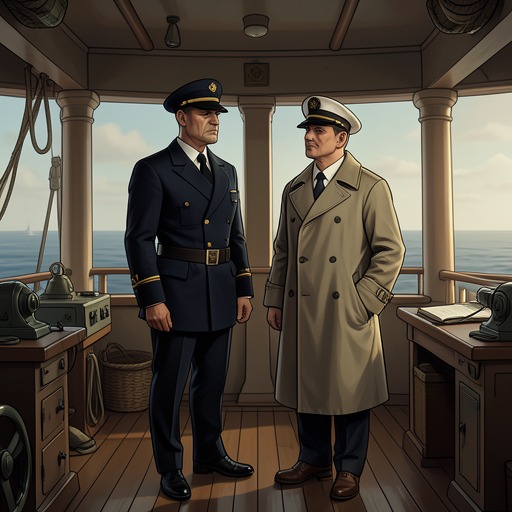
De Vriess first appears at the doorway after Paynter announces that Willie Keith has reported aboard. He is uncovered, carrying soap and a lighted cigarette, and welcomes the new ensign with a voice that combines authority with irony. Willie, unsure whether to salute, remembers that regulations forbid saluting an uncovered superior. The encounter puts the rules Willie has learned beside a captain who seems comfortable bending the rituals of command without surrendering his rank.
De Vriess immediately asks whether Willie knows anything about communications. When Willie explains that he has been doing that work for CincPac while waiting for the ship, the captain accepts the answer and turns to Paynter, restoring him to duty as an assistant engineering officer. His attention moves briskly from greeting a new arrival to assigning work; there is no formal welcome ceremony or extended account of the ship’s needs.
Command and Shipboard Conditions
The USS Caine’s working and living arrangements reveal the limits of De Vriess’s apparently casual command. Willie and Harding are assigned to the clipping shack, a metal compartment on the main deck measuring roughly seven feet by six by three. It contains ammunition cases and empty machine-gun belts, and Harding’s recently welded bunk sits in a space whose temperature is about 105 degrees. The cramped, overheated quarters are not merely an inconvenience: they establish the conditions under which the ship’s junior officers are expected to work and sleep.
When the executive officer points out that the shack is already crowded and proposes hanging bunks in officers’ rooms or over the wardroom couch, De Vriess answers that ensigns are expendable. He then says he needs to shower and leaves. The exchange suggests a hierarchy in which the hardship of junior officers does not prompt an immediate change of plan. At the wardroom table, where Willie and Harding eat in silence while the other officers trade stories, De Vriess eats his pork chop and makes light of their having slept in the shack. His humor may soften the welcome, but it does not alter the arrangement.
The personnel aboard the ship also give that arrangement a longer institutional context. Lieutenant Gorton explains that destroyer-minesweeper personnel are difficult to transfer and notes that De Vriess has seventy-one months in the outfit. Gorton’s own five years aboard the USS Caine underline how prolonged service in the unit can become ordinary. De Vriess is therefore not simply the captain in a comic first encounter: he occupies a shipboard world where crowded quarters and lengthy assignments have become familiar features of service.
Reputation and Judgment of Willie Keith
De Vriess’s most consequential appearance in Willie’s later story comes through other officers’ memories. After Willie has become captain, Tom Keefer recalls discussing the young ensign with De Vriess on the night Willie left an action dispatch in discarded trousers for three days. Keefer admits that he considered Willie a hopeless case. De Vriess, by contrast, predicted that Willie would eventually become an outstanding officer. Keefer says he never understood how De Vriess could see that potential so early; by the later conversation, Willie has earned a medal, making the old judgment look prescient.
The recollection adds discernment to the captain’s first impression. The man who had greeted Willie with an ironic welcome and handled personnel matters without ceremony had also recognized a capacity that a more skeptical observer missed. The evidence does not show De Vriess explaining the basis for his confidence, so the significance lies in the contrast between Keefer’s dismissive assessment and De Vriess’s long-range prediction, later borne out by Willie’s development.
Contrast in the Meaning of Command
Keefer’s later description of De Vriess sets him against Queeg, but it is explicitly Keefer’s interpretation rather than a neutral account of De Vriess’s inner life. He calls De Vriess an ox who either did not see the dangers of command or lacked the imagination to be troubled by them, and credits him with an instinctive, sure-footed sense of the right course. Keefer describes Queeg instead as a man with ambition and nerves but without the judgment to manage them. The contrast makes De Vriess’s apparent ease part of the novel’s examination of command: steadiness may protect a captain from the anxieties that overwhelm another, though it can also look like an absence of reflection.
That recollection does not erase the early scene in which De Vriess accepts the clipping shack as suitable for ensigns, nor does it establish that his casual manner was a deliberate leadership philosophy. Rather, the novel presents separate pieces of evidence: a captain who handles the ship’s daily business briskly, a long-serving officer whom Keefer remembers as sure-footed, and a superior who saw promise in Willie before his later record made that promise visible. Together they make De Vriess a compact but significant measure of judgment and command, especially against which Willie’s eventual growth and Queeg’s failure can be read.