Challee
The Caine MutinyChallee is the prosecution’s judge advocate in the court-martial of Steve Maryk, the executive officer who relieved Captain Queeg aboard the Caine. His case turns a disputed act of emergency command into a test of naval authority: he regards Maryk’s conduct not only as an offense, but as a dangerous precedent for the entire chain of command.
Position and personal circumstances
Challee holds the temporary wartime rank of lieutenant commander and is portrayed as earnest and bright. After several years at sea, he requested legal duty partly to spend time with his wife, a photographer’s model. When that request was granted, he felt some guilt about obtaining a shore assignment; the shame sharpened rather than softened his approach to the work, and he pursued the prosecution with exceptional zeal.
His personal investment becomes explicit in the way he treats Maryk’s conviction as his own war aim. That intensity does not make him careless: Challee has considered the legal distinction between mutiny and the charge ultimately brought. He knows a mutiny charge would be harder to prove, while the broader charge of conduct prejudicial to good order and discipline appears to him to fit the acknowledged fact that Maryk relieved his commanding officer.
The prosecution’s case
Challee believes the prosecution has a prima facie case. In his analysis, the decisive terms are whether Maryk acted without proper authority and without justifiable cause. He plans to establish those points by showing that Queeg was not, and had never been, a madman. The evidence he expects to rely on includes Captain Weyland’s deposition, three Navy psychiatrists who examined Queeg for weeks, and statements from twenty Caine chiefs and enlisted men who said they had seen nothing crazy or questionable in the captain’s conduct. Challee also arranges for sailors and chiefs to appear in court and repeat their favorable accounts.
Against that body of testimony stands Maryk’s secret medical log. The board of investigation had dismissed it as a collection of trivial complaints and read it as evidence of Maryk’s disloyalty. Challee expects the court to take the same view. He considers eccentric, oppressive commanders a familiar hazard of military service, not grounds for an executive officer to depose his captain. His reasoning therefore moves from the particulars of Queeg’s behavior to the institutional risk of allowing such a relief to go unpunished.
Courtroom conduct and strategic misjudgment
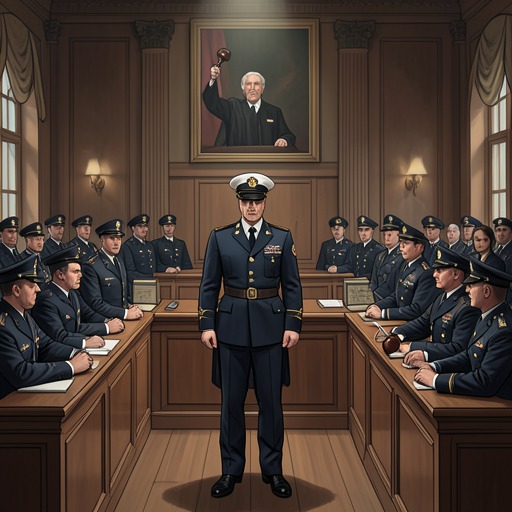
During the trial, Challee leads Urban, a signalman who was in the wheelhouse when Queeg was relieved, to establish who was present and what Urban’s duties were. The testimony gives the prosecution a witness to the event itself, while Challee’s larger argument asks the court to distinguish the fact of the relief from its justification.
Challee correctly anticipates that Greenwald will argue Maryk acted for the good of the service, even if his judgment about Queeg was mistaken. He is prepared to characterize that defense as sophistry and to insist that an officer cannot set aside the chain of command on his own assessment of a superior. His estimate of the case is described as sound, but he errs in predicting Greenwald’s strategy. The error exposes the limit of Challee’s confidence: he has built his prosecution around the apparent strength of the evidence and the institutional danger of acquittal, but has not accurately foreseen how the defense will attack the case.
Narrative role
Challee gives the prosecution a coherent institutional logic rather than presenting it as mere personal hostility toward Maryk. His concern that any unusual captain might otherwise be summarily relieved makes the Navy’s need for command authority a genuine stake in the proceedings. At the same time, his conviction that the case is straightforward sits uneasily beside the investigation’s tangled facts and the disputed meaning of Maryk’s log. He embodies the force of procedure in the courtroom, while the gap between his careful preparation and his strategic misreading helps sustain the trial’s uncertainty.