China Sea
The Caine MutinyThe China Sea becomes the setting for a short-lived change in the USS Caine’s wartime work: after a long career in which its crew scarcely believed it would sweep a mine, the ship enters an active minefield and encounters several. The episode joins the danger of the operation to the practical limits imposed by the ship’s machinery, making the sea both a place of belated action and the point from which the Caine’s remaining wartime opportunities narrow.
Setting and Wartime Context
The novel places the China Sea episode near the end of the war. Earlier, the Allied advance had been presented from Ensign Willie Keith’s more limited perspective aboard ship, in contrast with the broad historical view that the war’s major turning points had already passed. A vast fleet had steamed from Hawaii toward the Kwajalein landing site; the later China Sea sweep belongs to the continuing work of naval operations, after those great movements had made the war’s outcome appear increasingly clear.
The account also sets its fictional action apart from a documentary record. The novel’s prefatory note states that it alters details of actual military operations, ships, missions, and naval procedures, and that the USS Caine and the events aboard it are imaginary. The China Sea is therefore a setting within a historical-war fiction whose operational details the book itself warns readers not to treat as an exact account of real events.
The Minesweeping Operation
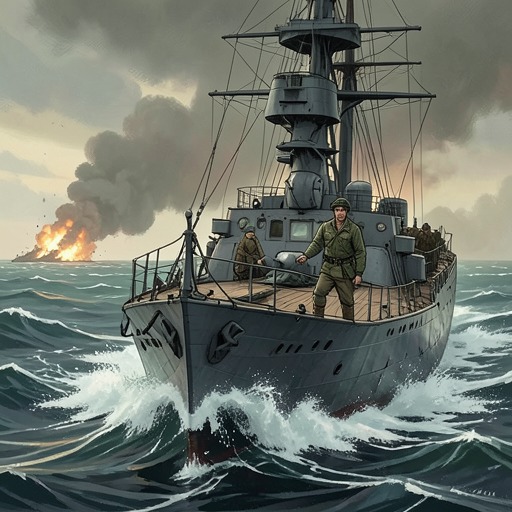
Seventeen days before the end of the war, the USS Caine finally swept a mine. It was part of a double line of minesweepers stretching five miles across the water. As the ships advanced cautiously into the minefield, a mine surfaced in the Caine’s wake. The crew dropped a dye marker and raised a warning flag; a sub chaser fired on the mine until it exploded in a high column of spray.
The danger was not confined to the first contact. More mines appeared across the formation, marked by yellow-green dye. With the Caine in the second line, its crew watched the water ahead. Another mine appeared directly in the ship’s path, and the bridge filled with hurried, conflicting maneuvering orders as the Caine closed on it. The mine disappeared in an explosion; further mines were then spotted and swept. The concentrated succession of contacts turned the ship’s long-anticipated task into a brief, chaotic reality.
Mechanical Limits and Withdrawal
The Caine’s participation ended because its machinery could not safely sustain the work. The fuel pumps for the number-one boiler failed, reducing the ship to twelve knots. In an area of drifting mines, that loss of speed left it below the required margin of maneuverability. The officer in tactical command ordered the Caine out of the line and back toward Okinawa, where an auxiliary minesweeper took its place.
On the return, Willie Keith spotted another mine, which the ship’s guns attacked before it exploded. The Caine’s crew did not know that this would be its final mine of the war. The ship limped into Buckner Bay, and Tom Keefer requested a period alongside the tender Pluto. The tender could not accommodate the Caine promptly, and the ship was directed to attempt repairs with materials supplied from outside.
Consequences and Narrative Significance
The China Sea sweep briefly fulfilled a purpose that had seemed almost unreal to Willie: the minesweeping equipment carried on the fantail proved functional, and mines were not merely an abstract hazard in a manual. Yet the ship’s first real engagement with them also exposed the cost of its weakened condition. Its pumps, rather than any lack of willingness, determined when the Caine had to leave the operation.
Later, an order sent destroyer-minesweepers from Buckner Bay to sweep Tokyo Harbor, but the Caine was not included. Although the pumps had been repaired, Captain Ramsbeck judged that a further breakdown en route could leave the ship dangerously underpowered in typhoon season. The China Sea episode thus marks both an arrival and a limit: the Caine at last performed the work it had been equipped to do, but its condition prevented it from joining the next major sweep.