Circle of Compliance
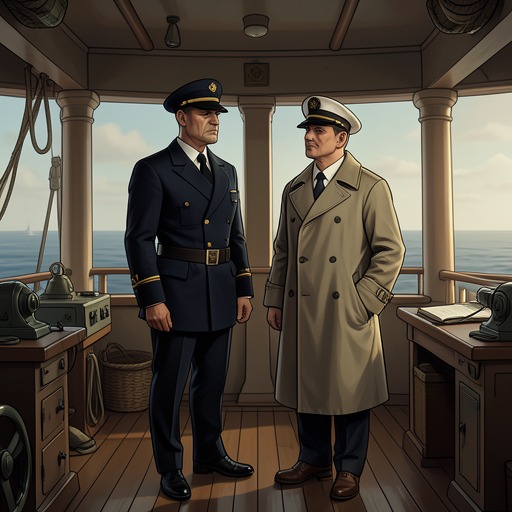
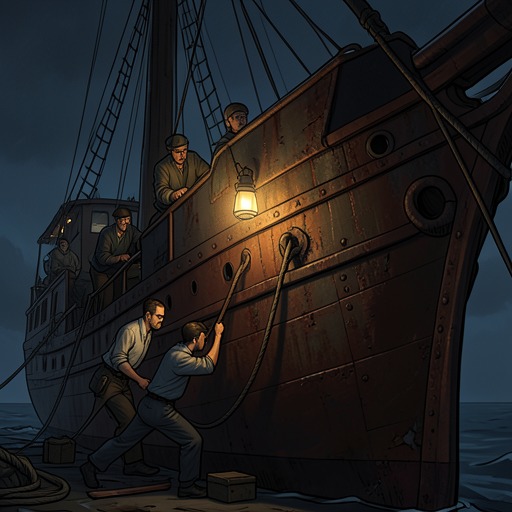
The Caine MutinyThe Circle of Compliance names the uneven system of obedience that takes shape aboard the USS Caine under Philip Francis Queeg. His orders have force where his attention reaches, but beyond that limited range, the ship continues according to the crew’s habits and informal rules. The expression is not an official naval term in the account; it is an image for the gap between a captain’s formal authority and the daily reality of governing an overworked, close-quartered crew.
The expression and its first example
The pattern begins with a small matter of cleanliness. In Pearl Harbor, Queeg notices cigarette butts mashed on deck, rebukes the officer of the deck, and dictates Ship’s Standing Order #6-44. It requires the main deck to remain spotless and threatens disciplinary action against the entire crew for a failure. When Queeg finds another cigarette butt in a forecastle scupper the next morning, he cancels the crew’s liberty. For a time, the deck force keeps the main deck continually swept.
Once the USS Caine sails for Kwajalein, however, the sweeping order is effectively shelved. The main deck is dirty except during periods of cleaning, while one deck hand is assigned to maintain a small, visible route: the patch between Queeg’s cabin, the bridge ladder, and the hatch leading to the wardroom. That patch of deck makes the expression concrete. Compliance is concentrated along the captain’s ordinary path, rather than extended uniformly across the vessel.
How the circle works
The circle is described as following Queeg like a spotlight, reaching as far as his eyes and ears. The crew has learned his habits and routes and responds to what he is likely to see or hear. But his excursions outside the familiar area disrupt that arrangement. When he encounters something he disapproves of, the resulting commotion may become a new shipboard rule; sailors then observe the new edict where Queeg can oversee it, while ignoring it elsewhere.
This is not presented as a planned conspiracy. Individual sailors would likely be surprised to hear their shared pattern described that way, and might deny that it accurately represented shipboard life. The circle instead emerges from repeated adjustments to Queeg’s attention and from the crew’s practical knowledge of the ship. Its outward appearance is obedience; its limits are exposed by the contrast between the carefully maintained patch near the captain and the conditions beyond it.
The arrangement also reflects the difficulty of enforcing Queeg’s rules throughout a crowded, heavily worked ship. Steve Maryk recognizes that the executive officer is responsible for enforcing the captain’s orders, yet many rules are impossible to apply to the crew as it actually exists, or can be enforced only at a cost to the USS Caine’s already narrow margin of seaworthiness. Maryk therefore tolerates the circle and works to keep the ship functioning adequately outside it. His response is neither simple endorsement of Queeg nor an attempt to impose every order without regard to consequence: it is a practical accommodation to the conflict between formal discipline and the vessel’s capacity to operate.
The crew and its divisions
The circle does not mean the crew shares one attitude toward Queeg. Sentiment ranges from mild dislike to intense hostility among sailors who have clashed with him. Some men even consider him the best skipper they have had, provided they stay out of his sight. For those sailors, the limits of his attention make the ship easier to live in; for others, the rules and punishments remain a source of resentment.
John Stilwell becomes a particular focus of Queeg’s dislike. While waiting for a response to Maryk’s letter to the Red Cross about his mother’s illness, Stilwell grows increasingly anxious. His watches at the helm within Queeg’s range are especially difficult. Sailors opposed to Queeg make a point of befriending and encouraging Stilwell, while others avoid him for fear that the captain’s hostility might reach his associates. The circle thus shapes not only where rules are observed but also how sailors judge the risks of being seen with one another.
The officers’ wardroom has its own divisions. Queeg becomes more secluded; Maryk keeps a stolid silence and maintains what contact remains between the captain and the ship; and the other officers, with Tom Keefer as their ringleader, increasingly bond through ridicule of Queeg. Willie Keith is regarded as Queeg’s favorite and is teased for it, although he too joins in the officers’ satire. Maryk alone avoids the mockery, sometimes defending Queeg or leaving when the jokes continue. The circle aboard ship is therefore accompanied by a social map: the captain’s reach, the executive officer’s effort to preserve operations, and the officers’ separate forms of opposition and restraint.
A shipboard order under pressure
The expression gains force from the conditions in which it operates. The USS Caine is a cramped working environment: Willie’s first sleeping place is a metal clipping shack only about seven feet high, six feet long, and three feet wide, with a temperature around 105 degrees. Later, a succession of watches, coding work, publication corrections, meals, and interrupted sleep narrows his world to the ship and its routines. Such details do not make the circle a literal boundary on the deck. They show the crowded, repetitive setting in which small rules, watchfulness, and informal accommodations govern daily life.
The ship’s wider service offers a further contrast. After reaching Funafuti Atoll, the USS Caine is drawn into the Seventh Fleet’s grinding escort duty, moving repeatedly between assignments. Weeks and months blur into watches, logs, reports, audits, heat, and rain. Against this routine, the captain’s visible rules are one part of a larger life governed by hierarchy and recurring naval work. The circle is a local arrangement within that larger system: it describes how authority is encountered and adapted to aboard one vessel, not how every sailor or every command operates.
The novel’s prefatory note is important to that distinction. It identifies the work as fiction set during World War II, says that operational details and naval procedures have been altered, and states that the people and events aboard the Caine are imaginary and that no ship named USS Caine existed. The Circle of Compliance is therefore best understood as a device for describing the novel’s particular shipboard order, not as a claim that a documented vessel or actual crew followed this precise system. Its significance lies in the tension it makes visible: rules may be formally general, yet daily compliance can contract to the area where authority is present, leaving the rest of the ship to survive through its own practices.