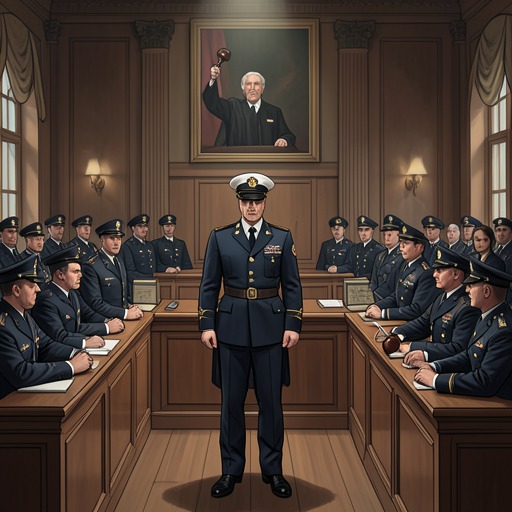
Conduct to the Prejudice of Good Order and Discipline
The Caine MutinyConduct to the Prejudice of Good Order and Discipline is the catch-all charge brought against Steve Maryk for relieving Philip Francis Queeg aboard the USS Caine. It gives the prosecution a way to treat Maryk’s action as a threat to naval order without relying on a conventional mutiny charge, while leaving the decisive question unresolved: whether removing Queeg was unauthorized and unjustified, or necessary under the circumstances.
The Charge and Its Specification
The charge emerges from a case the Navy’s existing categories do not neatly contain. Courts and Boards presents a systematic catalogue of offenses, ranging from mutiny to unlawful use of a distilling apparatus, but Theodore Breakstone, the captain responsible for preparing the case, sees no charge that precisely fits Maryk’s unusual act. It resembles mutiny, yet Maryk invoked Article 184 and subsequently acted with legal procedure in mind. Breakstone therefore selects Conduct to the Prejudice of Good Order and Discipline, a broad offense suited, in his view, to rare or complicated cases.
The specification makes the accusation concrete. It states that, on or about December 18, 1944, aboard the USS Caine, Maryk willfully and without proper authority or justifiable cause relieved the duly assigned commanding officer, Lieutenant Commander Queeg, while the United States was at war. The wording acknowledges the observable act but contests its authority and justification. The prosecution need not deny that Maryk took command; Maryk’s own logs record that he did. Instead, the case turns on whether Queeg was lawfully exercising command and whether Maryk had sufficient grounds to intervene.
The Prosecution’s Theory
Jack Challee, the judge advocate, expects the charge to be easy to prove. He regards the specification as a plain description of the facts and believes that establishing Queeg was not mentally ill will establish that Maryk acted without justifiable cause. Challee has Queeg’s deposition, assessments by three Navy psychiatrists who examined him for weeks, and testimony from twenty Caine chiefs and enlisted men who said they had seen nothing crazy or questionable in the captain’s conduct. In his account of the available evidence, only Maryk’s medical log stands against this body of testimony; the board of investigation has already dismissed it as a collection of trivial complaints and treated it as evidence of Maryk’s disloyalty.
Challee understands that Barney Greenwald may argue that Maryk acted for the good of the service, even if his judgment of Queeg was mistaken. Challee plans to answer that good intentions cannot excuse an officer who disregards military tradition and removes his commanding officer on what Challee considers an erroneous assessment. For the judge advocate, allowing such an act to go unpunished would endanger the chain of command: any executive officer who thought a captain eccentric might claim the power to relieve him. His theory therefore treats the preservation of command authority as a central purpose of the charge, not merely as a background concern.
Why Mutiny Is Not the Charge
The choice of offense also registers the case’s legal uncertainty. Breakstone recognizes that the affair looks more like mutiny than an ordinary disciplinary offense, but Challee believes a mutiny charge would be harder to establish. Maryk’s reliance on Article 184 and his subsequent legalistic conduct complicate any simple portrayal of his action as a revolt against authority. The broader charge can encompass the alleged injury to naval order while avoiding a direct claim that the case fits the ordinary meaning of mutiny.
That flexibility does not settle the central issue. The specification’s phrases without proper authority and without justifiable cause carry the burden of the dispute: they assume the possibility that a commanding officer can be relieved, but make Maryk’s entitlement to do so the question to be tried. The accusation thus places two forms of institutional risk in tension. Removing a captain without sufficient grounds could weaken the Navy’s chain of command; refusing to recognize a justified intervention could leave a ship under an officer unable to command it safely.
Command at Sea and the Stakes of Order
The conflict has force because the Caine’s hierarchy governs practical, time-sensitive work as well as discipline. In an ordinary watch, Willie Keith relays a fireroom request to Maryk, who grants permission to blow the tubes after considering the wind. During a collision while leaving West Loch, Queeg gives a tangle of wheel and engine orders as the Caine damages the Moulton and runs aground. Later, in the typhoon, a large wave floods the wheelhouse and the ship rolls sharply; Stilwell reports that the vessel is not answering the engines, while Maryk calls for a turn into the wind. These situations are not themselves the charge, but they show why command authority cannot be treated as an abstract ceremonial matter: coordination and judgment bear directly on a ship’s operation and safety.
The novel also sets formal authority against the working habits that develop aboard a ship. Under Queeg’s new order, a cigarette butt in a scupper leads him to cancel the crew’s liberty. Sailors then keep the main deck clean while the rule is under close observation, but return to old conditions beyond the captain’s view. The narrative describes this pattern as a circle of compliance: the captain’s edicts are observed within his immediate reach, while informal crew practices govern much of the rest of the ship. That contrast gives the trial’s concern with good order a wider context. Order can be asserted through rules and punishment, but its actual operation depends on how authority meets the conduct and needs of the people aboard.
Limits and Narrative Significance
The charge becomes the legal frame for a dispute that cannot be resolved merely by proving that Maryk took command. Challee considers his case strong and anticipates a defense based on Maryk’s intentions, but the narration says that his assessment is sound except for his guess about Greenwald’s strategy. The qualification signals that the prosecution has not yet understood how the defense will contest its account; it does not, by itself, disclose the trial’s outcome.
The novel’s prefatory note further limits how the case should be read as history. It identifies the people and events aboard the Caine as fictional, states that the ship did not exist, and notes that the author knew of no actual court-martial resulting from a captain’s relief at sea under the cited naval regulations. The charge is therefore central as a fictional instrument for examining the collision between obedience and emergency judgment, not as evidence that this particular prosecution occurred in the historical Navy. Its broad language captures the institutional dilemma without resolving it in advance: discipline protects the command structure, but the question of what discipline requires becomes acute when the authority being protected is itself challenged.