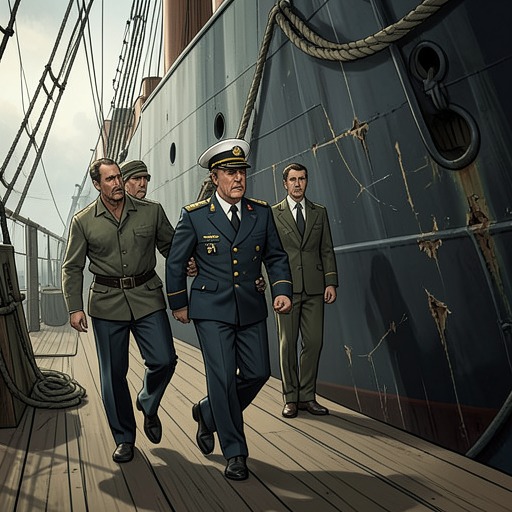
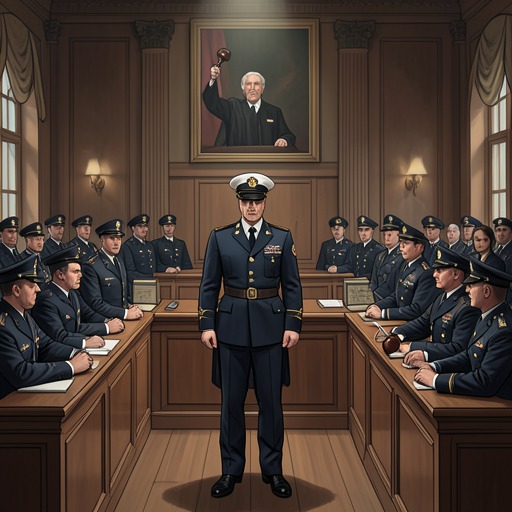
Court-martial Order 7-1945
The Caine MutinyCourt-martial Order #7-1945 is the documentary reversal that complicates the apparent resolution of Steve Maryk’s court-martial: Maryk was acquitted, yet the order disapproved the acquittal and treated his removal of Philip F. Queeg as an improper breach of command authority. Its judgments move beyond the trial’s verdict, reaching Willie Keith as well, and show how official review can leave an officer technically acquitted while condemning the action that produced the case.
Identity and Documentary Setting
The order appears as the controlling reference in a later Bureau reprimand letter to Lieutenant Keith. That letter identifies the order as its attached enclosure and states that, under its findings, Keith’s conduct in the irregular relief of Lieutenant Commander Queeg from command of the USS Caine on December 18, 1944, constituted improper performance of duty. The document is therefore not merely a record of Maryk’s trial: it supplies the institutional judgment on the wider chain of actions surrounding Queeg’s removal.
The order’s reach is visible in the career file where Keith keeps his naval papers. The reprimand letter says a copy will be placed in his promotion jacket; Keith then files the citation and reprimand together in a red cardboard folder alongside his orders, commission, promotions, and unsuccessful transfer applications. A formal judgment thus becomes a lasting entry in the record by which his service and prospects may be assessed.
Findings on the Trial and the Relief
The order’s comments reject the trial’s result even though Maryk has been acquitted. The convening authority’s assessment, reproduced in the order, maintains that the specification against the accused was proved beyond a reasonable doubt. It characterizes the acquittal as a miscarriage of justice, argues that an officer has escaped punishment for a serious offense, and warns that the outcome establishes a dangerous precedent. The order therefore preserves a sharp distinction between the court’s verdict and the judgment of the authorities reviewing it.
At the center of that disagreement is the authority to remove a commanding officer. The review insists that a ship can have only one government-appointed commander and that a second-in-command exceeds his powers by removing that officer irregularly rather than referring the matter to the highest available authority. It invokes Articles 184, 185, and 186 as rare exceptions, arguing that their existence reinforces rather than weakens the rule. In this account, danger aboard ship does not reduce responsibility: the review says that hazard makes the duty to maintain naval discipline more pressing.
The official reasoning thus confronts the question Maryk had faced in court: whether the situation on the morning of December 18 justified relieving Queeg. Maryk testified that the ship was in the last extremity when he acted, repeating Willie Keith’s account of that morning. The order’s position does not accept the danger as mitigation. Instead, it frames the irregular transfer of command as a threat to the system of authority precisely because it occurred under pressure.
Medical Judgment and Its Limits
The order also records the Navy’s conclusion about the psychiatric evidence concerning Queeg. A medical board had examined him, and its recommendation was that he be restored to duty; the review states that the board found no evidence of mental ailment. It concludes that the officers who relied on their own uninformed medical opinions displayed gross ignorance of medical facts and extreme want of judgment, given the serious consequences of removing a commanding officer.
That conclusion follows testimony presented during the trial by Dr. Forrest Lundeen, the Navy hospital’s chief of psychiatry and head of the board that examined Queeg. Lundeen said the examination involved three weeks of continuous observation and testing. In cross-examination, Barney Greenwald summarized behaviors that included rigidity, feelings of persecution, suspicion, withdrawal from reality, perfectionist anxiety, an unreal basic premise, and self-righteousness. Lundeen called the symptoms mild and compensated; when asked for an inclusive term, he identified paranoia, but emphasized that diagnosis alone did not establish disability. The relevant question, in his account, was whether a condition became disabling in practice.
Greenwald then put a hypothetical commanding officer’s conduct to Lundeen, including becoming frightened under fire, damaging government property and denying it, falsifying records, extorting money, and imposing excessive punishment for minor offenses. The doctor said the question was incomplete without knowing whether the officer otherwise performed his duties satisfactorily. The order’s finding that the medical board discovered no ailment therefore sits beside a trial record that explored both Queeg’s behavior and the difference between a personality description and incapacity for command. The official review resolves that dispute against Maryk’s reliance on his own medical judgment.
Consequences for Maryk and Keith
The order’s practical force falls differently on the two officers. Keith understands that Maryk cannot be tried again, so the disapproval does not expose him to a second trial. But he also understands the order as ending Maryk’s naval career. The official authorities have not overturned the acquittal in a way that permits a retrial; instead, they have attached an emphatic judgment of wrongdoing to the result and to the conduct that led to it.
Keith himself receives a separate penalty. The Bureau’s letter states that his conduct was improper and formally reprimands him, directing that the reprimand enter his promotion jacket. Its assessment says that Keith’s testimony left no doubt that he had not complied reluctantly but had wholeheartedly sided with Queeg. Keith recognizes the contradiction in receiving a medal and a reprimand in the same morning, then files both documents together. His record holds recognition and censure side by side, leaving later readers of his papers to make sense of the conflict.
The comments following the convening authority’s assessment do not soften the judgment: the higher authorities concur emphatically. For Keith, that unanimity confirms the institutional cost of his involvement. For Maryk, the order preserves the paradox of an acquittal that does not amount to official vindication. The document makes clear that a trial’s immediate legal outcome and a service member’s standing within the Navy can diverge.
Fictional Record and Narrative Significance
The novel’s prefatory note explicitly identifies its events and shipboard personnel as imaginary, says that no USS Caine exists or existed, and states that the author found no instance in thirty years of records of a court-martial resulting from a captain’s relief at sea under Articles 184, 185, and 186. Court-martial Order #7-1945 should therefore be read as a fictional document within the novel, not as a historical Navy order. Its documentary form gives institutional weight to the conflict without making the episode a claim about an actual case.
As an object, the order condenses the novel’s conflict between urgent judgment on board ship and authority exercised afterward through procedure, review, and personnel records. It neither erases Maryk’s acquittal nor lets that verdict stand as the final institutional meaning of his act. Instead, its official comments condemn the relief, its medical findings reject the basis on which Queeg was judged unfit, and its consequences reach into Keith’s promotion file. The order’s force lies in that double record: the courtroom decision remains, but the Navy’s written judgment recasts what the decision means for the officers who acted.