Cowardice and courage under fire
The Caine MutinyCowardice and courage under fire form a contested moral question in The Caine Mutiny, not a simple contrast between a fearful captain and fearless subordinates. Philip Francis Queeg’s conduct is challenged in court through accounts of his movements under fire, while the case also asks how much weight to give those accounts and how difficult it is to judge a commanding officer. The distinction becomes concrete when Willie Keith, faced with a burning ship and an order to abandon it, chooses to stay and organize efforts to save it.
War’s Scale and the Individual View
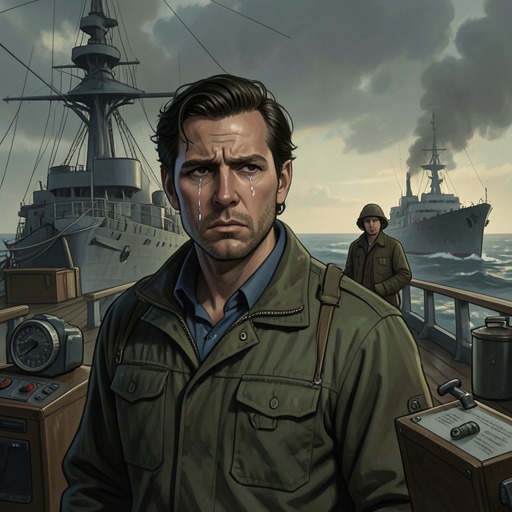
The novel places personal fear against the immense scale of the Pacific War. By the beginning of 1944, major turning points had passed and the Allies’ material advantage was growing; from a broad historical perspective, the war appeared to be moving toward victory. Willie Keith, however, sees it from the wheelhouse of the USS Caine on New Year’s Eve. His private view is much darker: he imagines dangerous island assaults, shore batteries, aircraft, mines, and the possibility of ending at the bottom of the sea. The contrast makes courage less like a settled quality than a response demanded of people who cannot see the war from the safety of hindsight.
That distance between the individual and the larger campaign is reinforced by the armada’s departure for Kwajalein. Hundreds of ships move in a vast, precisely maintained formation, with officers of many civilian backgrounds keeping station. The orderly spectacle offers no assurance that the dangers facing an individual ship or sailor have disappeared. Willie’s confidence in the Navy’s protection coexists with his anxiety about what lies ahead, establishing a tension between institutional security and personal exposure.
The Charge Against Philip Francis Queeg
At the court-martial, Willie identifies Philip Francis Queeg’s alleged cowardice in battle as his chief reason for disliking him. He testifies that Philip Francis Queeg repeatedly ran from shore batteries, recounts the episode at Saipan involving fire directed at the Stanfield, and describes an incident at Kwajalein that helped give the captain the nickname Old Yellowstain. The nickname, Willie explains, referred both to cowardice and to a yellow marker. His testimony turns an apparently casual shipboard joke into evidence about the captain’s conduct and the wardroom’s perception of it.
Willie’s account is not limited to those episodes. He says that in combat Philip Francis Queeg would be found on the side of the bridge away from the firing, and that while patrolling near a beach he changed bridge wings whenever the ship reversed course. Willie describes this as a recurring, widely noticed pattern and says other bridge personnel could corroborate it, if they were not afraid to speak. These are allegations offered by a witness who has already acknowledged his dislike of the captain; the text presents them as testimony, not as an uncontested verdict.
The courtroom dispute also exposes the risk of reducing command fitness to a single visible behavior. In argument, counsel distinguishes the captain’s many alleged errors of judgment from the separate charge that he was a coward under fire, leaving the latter for the court to assess. The issue is consequential precisely because ordinary lapses and fear in combat do not carry the same meaning. The novel makes the judgment difficult without erasing the seriousness of what Willie describes.
Willie Keith’s Decision to Stay
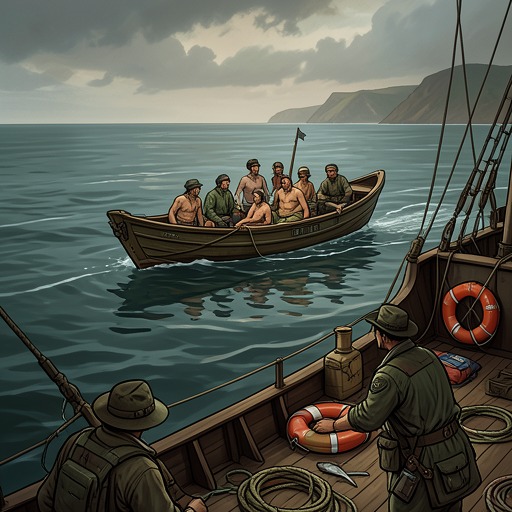
The sharpest counterpoint to the accusation against Philip Francis Queeg comes when the USS Caine is struck by a kamikaze aircraft. As fire and explosions spread, Tom Keefer urges the crew to abandon ship. Willie sees that the men in the water are coming from the bridge, not from the aft part of the ship as Tom Keefer supposes. Instead of following him over the side, Willie asks permission to remain aboard with volunteers and fight the fire. The choice is made amid confusion, with the ship’s condition uncertain and other crewmen already jumping into the water.
Tom Keefer ignores Willie’s attempt to stop him and leaps overboard. Willie remains with Ensign Farrington, takes stock of the damage, and begins directing the response. He orders Farrington to start the auxiliary generator and restore the public-address system, then broadcasts that the damage reports identify the after fireroom, explains that the captain has authorized volunteers to stay, and gives practical instructions for fighting the fire and protecting the magazines. He tells the crew to remain calm, follow their drills, and stay with the ship. Courage here is not simply willingness to face danger: it is the decision to assess what is happening, communicate clearly, and accept responsibility for others when panic could spread.
The change in Willie’s role is marked by his own response to the crisis. He feels peace and personal power as he realizes that the ship may still be saved. His confidence is not an assurance that everything is under control; it accompanies damaged equipment, uncertainty about the fires, and the urgent need for coordinated labor. The episode gives the novel a concrete alternative to the courtroom’s disputed recollections: a present decision whose consequences depend on whether the crew can act together.
Courage, Duty, and Their Limits
The later record of the USS Caine complicates any idea that courage alone determines what a ship can accomplish. Seventeen days before the end of the war, it finally sweeps a mine in the China Sea. The mine appears in the ship’s wake, a dye marker is dropped, and a sub chaser destroys it; mines then begin surfacing across the sweep formation. The scene places the ship’s work in a dangerous operational setting, but it does not turn every routine assignment into proof of individual heroism. Instead, it shows how duty can involve sustained, coordinated work as well as a dramatic emergency.
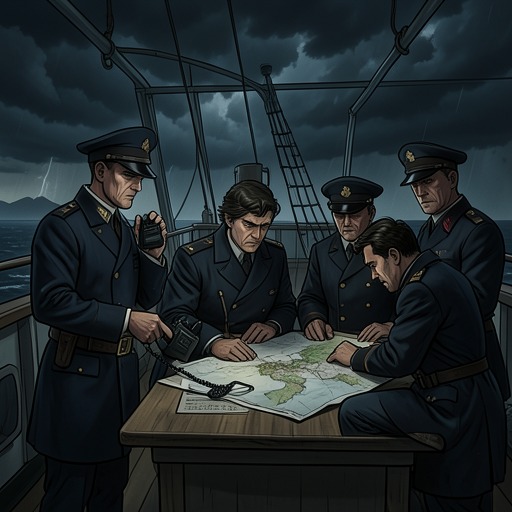
That distinction matters again when the USS Caine is left out of the order to prepare for the Tokyo harbor sweep. Willie Keith and Tom Keefer argue that the ship is ready, but the operations officer is concerned that another breakdown could leave it facing typhoon conditions with only twelve knots of power. The minesweepers depart without it. Their willingness to go does not remove the ship’s mechanical limitations or the officer’s responsibility to judge the risk. The episode keeps courage distinct from recklessness: resolve matters, but it cannot substitute for a seaworthy ship or a sound assessment of what it can do.
The novel’s own note cautions that its ship, people, and events are fictional, despite the historical setting, and that military details have been altered. Within that fictional account, cowardice and courage remain difficult to measure from reputation alone. Philip Francis Queeg’s conduct is contested through testimony and argument; Willie Keith’s conduct is shown in a crisis through the tasks he takes on and the crew he tries to keep aboard. Together, those contrasting forms make courage a matter of both exposure to danger and responsibility for action, while leaving room for uncertainty about how another person’s behavior under fire should be judged.