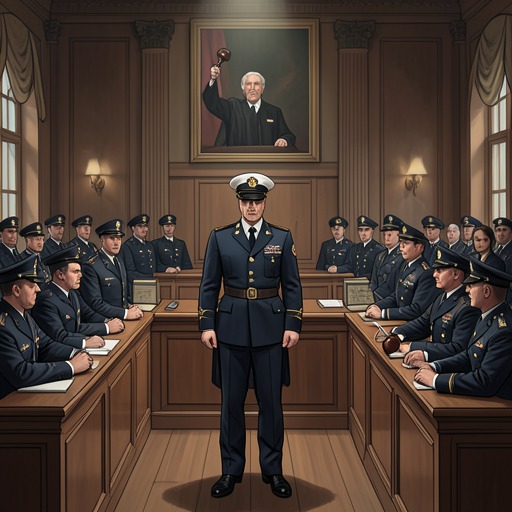
Dr. Forrest Lundeen
The Caine MutinyDr. Forrest Lundeen, chief of psychiatry at the Navy hospital and head of the medical board that examined Philip Francis Queeg, is a key expert witness at Steve Maryk’s court-martial. His testimony neither diagnoses Queeg with a disabling disease nor dismisses the troubling traits described by the defense. Instead, it exposes the gap between identifying a personality pattern and deciding whether a commanding officer can perform under extraordinary pressure.
Position and examination
Lundeen appears on the second afternoon of the court-martial as an experienced Navy psychiatrist: he has specialized in psychiatry in the Navy for fifteen years and chaired the board that examined Queeg. The board had Queeg under constant observation and testing for three weeks, a period Lundeen emphasizes when asked about the basis of its conclusion. Dr. Bird and Dr. Manella, the other practicing psychiatrists involved, were civilian psychiatrists serving as reserve officers.
The board discharged Queeg with a clean bill of health and found no evidence of insanity. Lundeen presents this as the formal medical finding, not as proof that Queeg has no unusual traits. That distinction becomes central as the examination moves from the board’s conclusion to the behavior at issue in Maryk’s defense. The clinical finding answers whether the examination established insanity; it does not, by itself, settle how Queeg would function in every situation of command.
Personality and diagnosis
Under questioning by Barney Greenwald, Lundeen accepts that Queeg’s behavior displays rigidity, feelings of persecution, unreasonable suspicion, withdrawal from reality, perfectionist anxiety, an unreal basic premise, and an obsessive sense of self-righteousness. He stresses that these characteristics are mild and well compensated. When Greenwald presses him to group them under a single psychiatric label, Lundeen objects to calling them a syndrome or disease. He ultimately identifies the pattern as a paranoid personality, while maintaining that it is not a disabling affliction.
Lundeen explains that the difference between illness and adjustment is a matter of degree. Nobody is absolutely normal, he says in substance, and people can live ordinary lives with compensated conditions that resemble an individual physical weakness rather than a disabling impairment. His examples are a sway back and a heart murmur. For his purposes, the decisive issue is not whether a trait can be named, but whether it has become a disabling factor. The distinction keeps the diagnosis from functioning as an automatic verdict on Queeg’s fitness.
He also explains why such a personality might not be obvious to people who meet its possessor. The distinguishing mark of the neurosis, he tells the court, is extreme plausibility: a convincing appearance of normality, particularly when the person is justifying himself. The point complicates any simple assumption that conspicuous madness would be necessary for a serious personality disturbance to exist. Yet Lundeen’s account still leaves open the separate question of functional impairment.
Cross-examination and the limits of expertise
Greenwald tests that gap with a hypothetical commanding officer who becomes bewildered or frightened under fire and runs away, damages government property and denies it, falsifies official records, extorts money from subordinates, and imposes excessive punishments for minor offenses. Asked whether such a man is disabled for command, Lundeen calls the question incomplete. He wants to know whether the officer performs his duties satisfactorily in other respects. Greenwald stipulates that, hypothetically, he does.
The exchange does not produce a clear medical ruling that these alleged behaviors establish incapacity. Lundeen’s request for more context instead underscores how much depends on the relationship between a personality pattern, a person’s ordinary performance, and the circumstances in which judgment is tested. When Greenwald begins to ask for a personal reaction, the judge advocate objects that the question seeks an emotional response rather than expert opinion. Greenwald withdraws it, and Lundeen’s cross-examination ends without his being made to pronounce a categorical judgment on the hypothetical officer.
Extreme stress and command fitness
The court itself takes up the remaining issue. Captain Blakely asks whether a mild condition that does not disable a man under usual command stresses might reduce his efficiency when the stresses are multiplied by an extreme emergency, leaving him confused, rattled, or prone to erroneous judgments. Lundeen answers that extreme stress might produce such effects in almost anyone. Blakely counters that commanding officers are not supposed to be affected in that way.
This brief exchange gives Lundeen’s evidence its sharpest relevance to Maryk’s defense. A three-week examination had resulted in a finding of no insanity and a clean bill of health; the diagnosis of paranoid personality was explicitly described as mild and non-disabling. But the court is also considering the morning of December 18, when Maryk relieved Queeg. Maryk recounts that morning in a version matching Willie Keith’s and says the ship was in the last extremity. Lundeen’s testimony cannot, on the evidence presented here, decide what Queeg did in that emergency or whether Maryk was justified. It frames the harder issue: ordinary fitness and performance in an extreme crisis are related questions, but they are not identical ones.
Narrative role
Lundeen is not presented as a simple instrument for either side. His professional authority confirms a recognizable psychiatric pattern in Queeg, while his insistence on degree and disability resists treating that pattern as proof of incapacity. Greenwald’s questions try to connect the diagnosis to conduct and command; Lundeen repeatedly marks where the clinical evidence stops short of a definitive operational judgment.
That limit matters to the trial’s central conflict. The board’s conclusion does not erase the symptoms Greenwald lists, and the symptoms do not, by themselves, establish that Queeg could not command. By distinguishing diagnosis from disability and ordinary conditions from extreme stress, Lundeen’s testimony leaves the court with a question medicine can inform but not settle on its own.