George Blake Capsizes and Caine Rescues Survivors
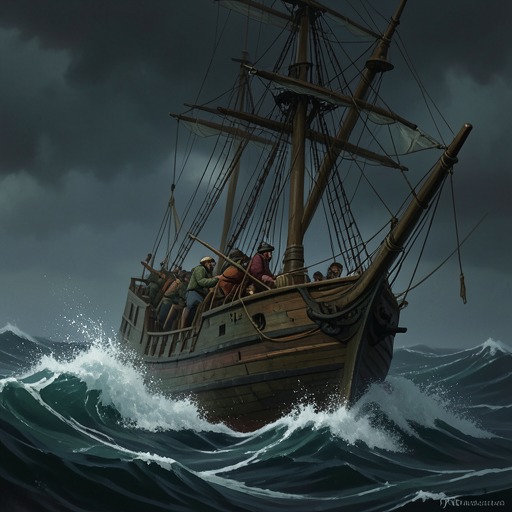
The Caine MutinyThe capsizing of the George Black and the Caine’s rescue of its survivors turns a dispute over command into an urgent test of action at sea. As the Caine struggles through the typhoon, Steve Maryk orders a search despite Philip Francis Queeg’s objections; the crew eventually brings survivors aboard, and their account explains how the other ship was lost. The episode gives practical force to the question at the center of Maryk’s assumption of command: what must a commanding officer do when danger leaves no time for authority to be settled by argument?
Causes and Command Context
The rescue takes place after Maryk has relieved Queeg and announced that he is acting under Article 184. He accepts personal responsibility for the decision and orders the other officers to follow him. Queeg contests the legality of the relief and warns that the officers will face charges of collusion in mutiny. Their dispute continues on the bridge, but the storm makes the ship’s immediate movements consequential: Maryk must direct the Caine while Queeg argues that command remains his.
The episode’s stakes extend beyond the officers’ conflict. A report from Stilwell alerts the bridge to an object close ahead. When visibility improves, the officers see a large red shape in the water and identify it as the bottom of a ship. Maryk orders the Caine to circle the wreck and directs the crew to watch for survivors. Queeg challenges the risk of searching while the Caine itself is endangered. Maryk answers that the ship cannot simply pass by, keeping the rescue obligation in view even as the dispute over command remains unresolved.
The broader wartime setting sharpens the contrast between strategic confidence and immediate peril. The narrative notes that, by early 1944, the major turning points of the war seemed to favor the Allies; elsewhere, a large armada sails from Hawaii toward Kwajalein. Yet the Caine’s officers encounter the war not as a settled historical outcome but as a storm, a wreck, and uncertain reports from the sea. The rescue is a local emergency inside a much larger campaign, and its urgency is measured by what the crew can do in the moment.
Search Through the Storm
Maryk maneuvers the Caine around the capsized vessel against strong wind and waves. As the ship rolls and is pushed sideways, he changes engine settings and calls out rudder orders, steering the Caine clear of the wreck while trying to keep it in view. The officers complete a difficult circle, but the wreck is going under, and Maryk cannot be sure whether anyone has survived. The search makes a second circuit rather than ending when the hull disappears from sight.
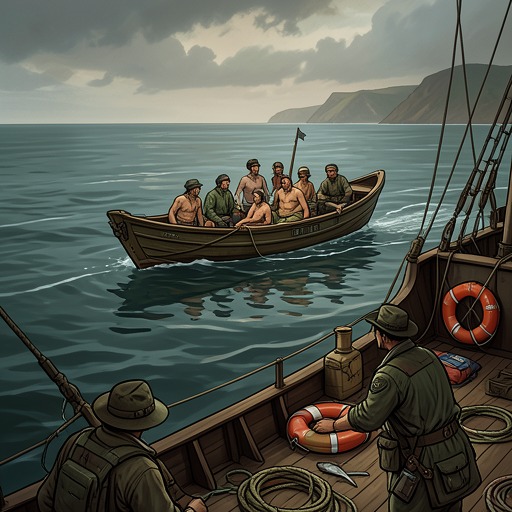
A report from the radar shack gives the crew a new lead: Bellison has spotted what may be a raft off the starboard quarter. Maryk moves the Caine toward it and prepares the deck force to assist. The object proves to be a raft carrying three men, with two more people in the water nearby. Queeg then says he had already considered ballasting and heading into the wind, but Maryk continues directing the approach and warns Stilwell not to run the survivors down. He orders the crew to throw over buoys, and the men are brought aboard.
The rescue depends on a sequence of decisions rather than a single dramatic maneuver: searching around the wreck, responding to the raft report, closing on the survivors without striking them, and getting flotation to those in the water. The Caine’s own exposure to the storm does not disappear while this work proceeds. The episode presents rescue as an added responsibility undertaken under hazardous conditions, not as an action that makes the rescuers safe.
The Survivor’s Account
One rescued sailor is brought to the bridge by Bellison. Identified as Morton, a third-class quartermaster, he is in a distressed condition and has oil smeared across his clothes. The others are taken to sick bay. His account supplies the sequence that the officers could not know while searching: the George Black had been thrown broadside to the wind, and its engines and rudder could not bring it around.
The storm then disabled the ship piece by piece. Waves tore equipment from the decks; water flooded the engine rooms, and the power failed. The George Black drifted as it rolled increasingly to starboard, then overturned. Morton’s account follows the experience of a survivor who had been submerged before reaching the surface beside the red bottom of the wreck. It converts the Caine’s uncertain sighting into a confirmed account of a ship lost in the storm—and makes the men already recovered evidence of how narrowly the disaster had spared them.
Maryk keeps the Caine circling after the first survivors are aboard, judging that the storm may be easing and continuing to watch the sea. Queeg says he is resuming command and proposes that the matter be set aside until the storm has abated. That assertion does not erase the rescue already carried out under Maryk’s direction; instead, the dispute over who commands the ship persists alongside the continuing emergency.
Consequences and Significance
The rescue reveals the practical contrast between Queeg’s claims about command and Maryk’s actions in the crisis. Queeg disputes the relief and describes Maryk’s decision as criminal, yet Maryk takes responsibility, directs the ship around the wreck, responds to the raft report, and organizes the recovery. The narrative does not make the storm itself a verdict on the legal case, but it gives the officers’ competing positions an immediate operational consequence: someone must decide what the Caine will do while lives may still be at risk.
For Willie Keith, the maneuver changes the meaning of fear. During the circling search he recognizes a distinction between fear that remains bearable and terror that incapacitates him; his reliance on Maryk’s presence marks a shift in how he experiences the crisis and the officer leading it. The scene thus joins the rescue’s public stakes to Willie’s private understanding of courage, without making the danger disappear or turning fear into a simple absence of feeling.
The book’s prefatory note cautions that the people and events aboard the Caine are imaginary and that operational details were altered. The George Black episode should therefore be read as a fictional wartime incident, not as a documented naval rescue. Within the story, however, its consequences are concrete: survivors are recovered, the fate of the wreck is reported, and the conflict over Maryk’s authority remains active after the immediate rescue.