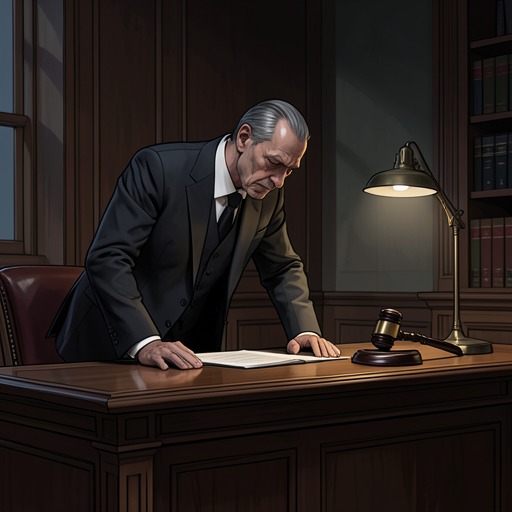
Greenwald's confrontation of Keefer
The Caine MutinyBarney Greenwald’s confrontation with Tom Keefer transforms a jubilant dinner after Steve Maryk’s acquittal into a reckoning over responsibility. In front of the officers celebrating Maryk’s release, Greenwald rejects Keefer’s triumphant account of the trial and charges him with having helped destroy Captain Queeg while keeping himself clear of the consequences. The wine Greenwald throws in Keefer’s face makes that accusation physical; the silence that follows reveals how little the verdict has settled among the men who shared the case.
From Acquittal to Celebration
The confrontation begins in the noisy relief outside the court-martial building. After an hour and ten minutes of deliberation, Maryk is acquitted. His mother clings to him, weeping and laughing, while his father stands beside her, quietly patting her shoulder. The officers of the USS Caine gather around them. Willie Keith capers, shouts, and slaps people on the back; Greenwald is jostled by well-wishers. In that crowd, the outcome seems simple: Maryk is free, and the ship’s officers can celebrate together.
Keefer takes charge of turning that relief into a party. He announces dinner at the Fairmont Hotel, says he has hired a room and will pay, and adds that he has just received a contract for his novel and a check for a thousand dollars. He calls it a double celebration: Maryk’s acquittal and his own literary success. The announcement makes Keefer appear generous and buoyant, but it also places his success beside Maryk’s uncertain future, a contrast Greenwald will soon make impossible to ignore.
The dinner’s easy high spirits are reinforced by drink and performance. New officers who have never seen Captain Queeg listen to stories about him and laugh uneasily, while the officers drink Keefer’s champagne. Harding staggers around hugging people and recalls that Greenwald once gave him his hat when he was sick. When Keefer predicts that Harding will need to use it again, Willie holds a silver bowl of celery under Harding’s mouth; Harding pretends to vomit, and the table roars with laughter. The joking treats the evening as a shared release from fear. It also shows how readily the company turns distress into entertainment while the harder questions remain unspoken.
Keefer’s Toast Becomes an Indictment
When Greenwald arrives, Keefer presents him as the evening’s conquering hero. He raises a toast that casts the lawyer as a brilliant courtroom champion and Queeg as the dragon he has slain. The officers cheer and sing “For He’s a Jolly Good Fellow.” Keefer’s praise seems to honor Greenwald, but it also makes the trial into a victory story in which Keefer can celebrate alongside the man who won Maryk’s acquittal.
Greenwald first signals that he will not accept the terms of that celebration. He says he cannot stay for dinner because it would disagree with him, then addresses Maryk directly. His account is deliberately harsher than the room’s festive version: “Steve, the thing is, this dinner is a phony. You’re guilty.” He immediately qualifies the charge, calling Maryk only half guilty and half acquitted. Greenwald predicts that the reviewing authorities will treat the verdict as a miscarriage of justice, that Maryk will receive a reprimand in his promotion jacket, and that his naval career may end with a return to fishing. The party’s central triumph, Greenwald insists, does not amount to an uncomplicated vindication.
He explains the means by which he secured the acquittal: he made Queeg and a Freudian psychiatrist look ridiculous and appealed to the Navy’s pride. In his description, the defense was ethically compromised, and its success depended on directing attention away from the question of Keefer’s own conduct. Greenwald says that Keefer wanted to run out on Maryk, and that he could only let him do so. His accusation is not simply that Keefer failed to help; it is that Keefer’s retreat shaped the trial while leaving Maryk exposed to its costs.
The Favor Behind Greenwald’s Anger
Greenwald’s speech also turns against his own role. He tells Keefer that he defended Maryk because he discovered that “the wrong guy was on trial.” To save Maryk, he says, he had to sink Queeg. That necessity does not absolve him: he is angry that he was pushed into that position and ashamed of what he did. His anger is sharpened by a debt to Queeg, whom he says deserved better treatment from him because Queeg had once protected his mother from Hermann Goering. The revelation recasts Greenwald’s attack as more than a lawyer’s judgment of the trial. The man he helped discredit had done him a personal favor, and Greenwald regards his own successful defense as a betrayal of that debt.
Greenwald then returns the toast to Keefer. He sarcastically imagines Keefer becoming captain of the USS Caine, accumulating favorable fitness reports, publishing a novel about the Navy, and getting rich, while Maryk receives the reprimand. Keefer tries to rise, but Greenwald cuts him off, saying that he is finished and that the toast is now for Keefer. The contrast is pointed: Maryk faces an institutional penalty after acquittal, while Keefer, in Greenwald’s telling, has preserved his reputation and stands to profit from the same events as a novelist.
The Wine and the Silence
Greenwald refuses Keefer’s dinner and wine, then raises his glass to him and his book. He throws the yellow wine into Keefer’s face. Some splashes onto Willie, and the action happens so quickly that officers at the far end of the table do not understand what has happened. Maryk starts to rise, but Greenwald shoves him back into his chair. He offers Keefer a chance to confront him in the lobby, acknowledging that both men are drunk and that Keefer would probably beat him in a fight.
The gesture is not a courtroom argument, and it cannot alter the verdict or the reprimand Greenwald has predicted. Its force lies in making the accusation public and impossible to fold back into the congratulatory toast. The officers glance at Keefer and mutter among themselves. Greenwald stumbles out; Keefer laughs, dismisses him as crazy drunk, and tells Willie to have the food brought in. No one meets Keefer’s eyes. The meal continues in a clinking quiet, the cake receives only scattered applause, and the party breaks up with five unopened champagne bottles left on the table.
Significance of the Confrontation
The scene reverses the ceremony Keefer has arranged. A toast meant to celebrate the acquittal and honor Greenwald becomes an indictment of the man hosting the celebration, while Greenwald’s apparent triumph as the defense lawyer is exposed as morally costly. Maryk’s acquittal remains real, but the scene distinguishes a legal outcome from a judgment about who accepted danger, who withdrew, and who profited. The officers’ silence after the wine is thrown does not resolve Greenwald’s charge; it marks the moment when the party can no longer pretend that everyone present shares the same account of what happened.