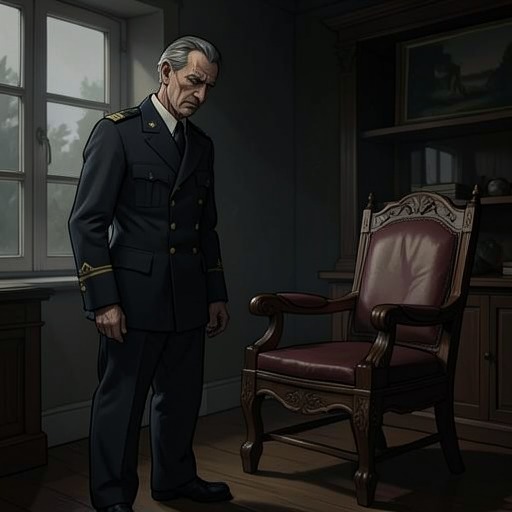
John Stilwell
The Caine MutinyJohn Stilwell is a gunner’s mate whose court-martial turns on a distinction between admitting an offense and explaining its cause. He accepts responsibility for arranging a false wire so he can see his wife, yet insists that the court consider the punishment and personal stakes that preceded it. His case tests whether a shipboard tribunal will treat guilt as a bare procedural fact or attend to the circumstances behind it; its mild sentence leaves that tension unresolved.
The Charge and the Recorder
When Willie Keith receives the news from Steve Maryk, Stilwell’s summary court-martial is scheduled for the day after tomorrow, and Willie is assigned to serve as recorder. The case has become immediate and consequential: the record must be prepared so that higher authorities cannot overturn the result on a technicality. Stilwell is therefore introduced through the machinery of discipline before he appears in person, as the accused whose fate depends partly on a correctly conducted proceeding.
Willie reads Stilwell’s confession and initially thinks the sailor is lost. But after consulting Courts and Boards, he studies the rules governing confessions and summons Stilwell to his room. There, Willie explains that Stilwell could repudiate the confession and that, without his testimony, the Red Cross letter would not establish that he had instigated his brother to send the wire. Willie’s advice offers a legal route to contest the case, not a denial that the underlying incident occurred. The distinction matters: the defense would turn on what the court could prove, while Stilwell’s own later statement turns on why he acted.
Stilwell does not follow that advice. After spending an hour in Captain Philip Francis Queeg’s cabin, he emerges with a handwritten statement affirming that his confession was voluntary and that he would repeat its facts under oath. The statement is signed in his schoolboyish hand and written in the bright blue ink of Queeg’s fountain pen. Its contents reinforce the confession; its circumstances also show that Stilwell has been back in the captain’s presence after Willie privately described a possible defense. The text does not explain what was said in the cabin, so the document establishes his formal position without clarifying why he chose to reaffirm it.
Admission and Explanation
The court proceeds through a slow, rule-bound ritual of entrances, exits, procedural disputes, and consultations of the manuals. Stilwell waits through the process in an apathetic state, then asks to make a statement after the trial has apparently been finished. He explains that Queeg had given him six months’ restriction for reading on watch, and that he arranged the false wire because he needed to see his wife or feared his marriage would break up. He does not deny the offense. Instead, he asks that the court remember the circumstances when judging it.
His account gives the case two distinct layers. The false wire is the act for which he is being tried; the restriction and the threatened rupture of his marriage are the conditions he offers to explain it. He also refers to reading a comic book at the gangway, describing the conduct in terms that make the punishment seem disproportionate to him. His explanation is not a claim of innocence: he says he is guilty while asking the court to take the reason for his conduct into account. In that combination of admission and protest, Stilwell neither simply resists authority nor presents himself as untroubled by the consequences.
Sentence and Significance
The officers find the specification proved by his plea and sentence him to the loss of six liberties. Willie is appalled. Stilwell is already confined under the six-month restriction, so the new penalty seems to Willie to have little practical force; he reads it as an effective acquittal and a direct insult to Queeg. The sentence thus means something different to the participants: formally, it is a conviction with a stated punishment; to Willie, its weakness undermines the captain’s authority and makes the trial’s outcome look almost like exoneration.
Stilwell’s part in the episode is defined by this unresolved mismatch between procedure and consequence. He has affirmed a confession, pleaded guilty, and asked the court to recognize the personal pressure behind his conduct. The resulting sentence records his guilt but does not visibly add much to the restriction already imposed. His case consequently exposes how a court can complete its formal work while leaving the significance of punishment contested: Stilwell is held responsible, but the proceedings do not erase the circumstances he asked the officers to consider.