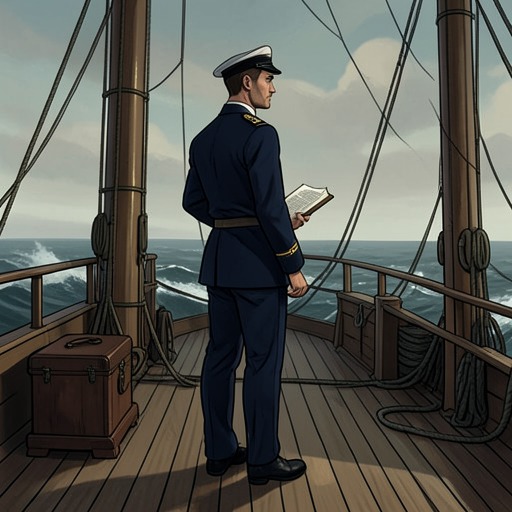
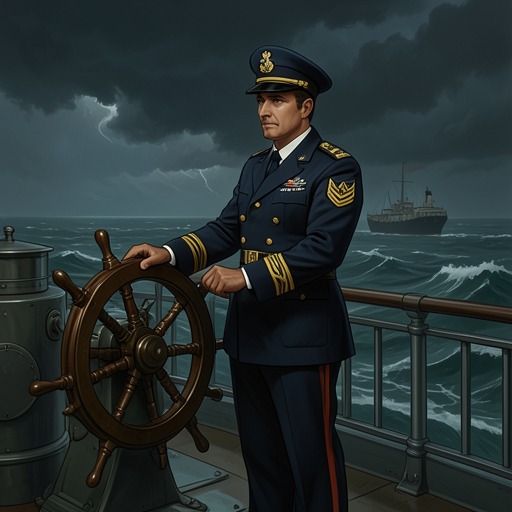
Keefer abandons the Caine
The Caine MutinyTom Keefer’s abandonment of the Caine is a crisis of command that exposes the distance between a captain’s order and the danger actually facing his ship. Wounded during a kamikaze attack, Keefer orders the crew overboard and jumps himself, while Willie Keith tries to keep the men aboard and contain the damage. The ship’s condition is serious, but Keith can see that Keefer’s decision rests on a mistaken reading of what is happening aft. The act becomes more than a moment of panic: Keefer later treats it as a defining failure, one he cannot reason away or forget.
The attack and Keefer’s order
The emergency unfolds amid explosions and fire aboard the Caine. Keefer is struck in the arm and reports that he may have been hit by a piece of a shell. With crewmen already leaping from the bridge, he tells Keith to pass the word to abandon ship. Keefer then enters the wheelhouse and tries to make the announcement over the public-address system. The system is dead, so the order does not reach the ship through the loudspeakers; the captain has to carry it out himself.
A fresh explosion intensifies the danger. Keefer comes out of the wheelhouse and says the ship will not survive much longer. Looking aft, he sees men in the water and concludes that the main deck is going up. He takes the canvas sack and urges everyone over the side. The order comes from a captain who is injured and under pressure, but its urgency also depends on his mistaken belief about where the men in the water came from.
Keith’s resistance and Keefer’s departure
Keith challenges that reading: the men in the water, he says, are from the bridge, not the aft part of the ship. As officers and sailors press toward the rail, Keith tries to make the distinction clear. Keefer does not stop to reconsider. When he reaches the bulwark, Keith grabs his shoulder and asks permission to remain aboard with volunteers to fight the fire. Keefer responds that he cannot stop Keith from committing suicide, then jumps into the water himself, still holding the sack with his uninjured arm.
The contrast between the two men is sharply drawn through their choices. Keith remains focused on what he has seen and on the possibility of controlling the fire; Keefer acts on the belief that the ship is about to be destroyed. The order has already set the crew in motion, and people continue to leap from the ship. Only Ensign Farrington remains with Keith on the bridge. When Farrington asks what is holding Keith back, Keith’s refusal to leave is met with the ensign’s answer that he will follow him. The exchange makes Keith’s decision consequential: staying aboard is not simply a private act of nerve, but a choice that leaves at least one other officer beside him.
What happens aboard the Caine
The ship does not immediately disappear beneath the crew’s retreat. With the wheel unattended, the Caine slews broadside to the wind, and the bridge begins to clear of smoke. The explosions have torn apart the deckhouse fire, while the ammunition boxes are left smoldering. Keith can still see flames aft amid heavy billows of steam. These details qualify the choice facing the men: the danger is real, but the ship is not shown as already lost. The difference between a severe emergency and an unavoidable sinking is precisely what Keefer fails to establish before ordering abandonment.
The later conversation confirms that the event has not ended with the jump. Keefer is alive and recovering, and he is able to discuss what happened with Keith. His wound and shock form part of the circumstances, but they do not erase the decision in his own account. Instead, the moment becomes the subject of later reflection, set against the survival of the ship and Keith’s choice to remain aboard.
Keefer’s memory of the act
Afterward, Keefer connects the incident to a story about a man who jumps overboard when he should not and is haunted by that single impulsive act for the rest of his life. He recognizes the parallel as applying to him. In conversation with Keith, he argues that his intelligence makes his situation worse: unlike a person who can believe his own self-protective explanations, he says, he can analyze what he did and remains imprisoned by the knowledge that he jumped. His later account gives the abandonment a continuing consequence beyond the immediate danger: Keefer regards it as an identity he cannot shed.
He also compares his response with that of his brother Roland. Both brothers, Keefer reflects, faced the same test in a kamikaze fire; Roland died saving his ship, while Keefer jumped. The comparison is Keefer’s own retrospective interpretation, not proof that the two situations were otherwise identical. It shows how the incident becomes entangled with his judgments about courage, the Navy, and himself. He wonders whether the difference in their assignments carried some hidden meaning, then Keith urges him not to turn a random accident into a design. Keefer’s attempt to interpret the event does not undo it: the jump remains, for him, a fact that analysis can clarify but cannot make disappear.