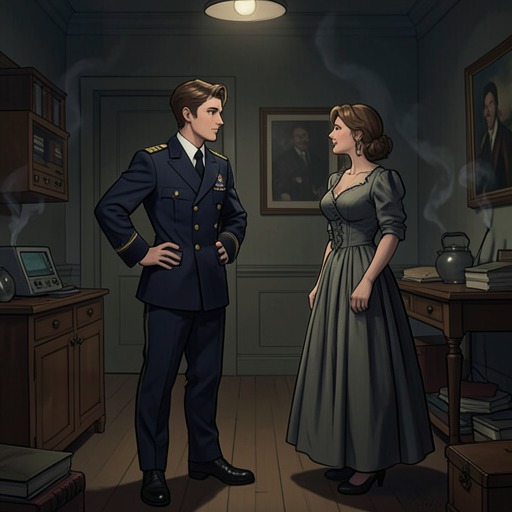
Keith and May's Yosemite Trip and Marriage Proposal
The Caine MutinyWillie Keith and May Wynn’s Yosemite trip turns a long-standing romance into a tentative marriage prospect. A night of intimacy leads Willie to propose the following morning, but the encounter does not settle what either of them wants or what marriage should mean. May accepts the possibility of a future together only after resisting an immediate answer, while later advice from Mrs. Keith makes clear how guilt, wartime separation, and social background complicate Willie’s decision.
The Yosemite Trip and Its Reversal
At Yosemite Valley, Willie and May share a quiet moment near the Ahwahnee Hotel as a firefall descends from a cliff and musicians play nearby. They kiss, then go into the hotel together. The narration initially follows Willie’s satisfied interpretation of the night: he returns to his room pleased by their closeness and remembers May as she appeared when he left her. The scene then reverses that impression by revealing that May, in her own room, is crying. Their shared experience has produced sharply different emotional aftermaths, though Willie does not yet understand the difference.
The narration places their intimacy in the context of a young couple returning to love after wartime separation and encountering peacetime conventions. Willie has not previously pressured May, partly because he feared the complications of intimacy more than he desired it. This time, the relationship changes without force: both have encountered books that question conventional moral rules, and Willie takes their arguments as confirmation that those rules are outdated. May is less certain. The distinction matters to the event’s consequence: for Willie, the night initially feels like a welcome release from restraint; for May, it leaves unresolved doubts rather than uncomplicated happiness.
The Proposal at Breakfast
A few hours later, after they have each been unable to sleep, Willie and May meet for breakfast in the hotel dining room. The bright view of the cliffs, forest, and distant snowy peaks contrasts with the private uncertainty of the night. Their conversation is initially cheerful. Willie remarks on the cost of the trip and says it was worth it, treating the expense as part of a pleasurable shared adventure. Yet the previous night returns to the conversation when he apologizes. May tells him there is nothing to apologize for, but her reassurance does not settle what he should do next.
Willie experiences the prospect of proposing as a sudden, almost physical crisis. He describes himself as a monster and asks what May would think of spending her life with him; then he says they ought to discuss marriage. His words do not arrive as a polished declaration he has planned. He has imagined proposing before, but the real exchange feels awkward and uncertain, and he is surprised that speaking the words does not immediately bind him to a decision. When May points out that he has not actually proposed, he makes the request plainly. Her response is not an instant acceptance: she says she will think about it and explains that she does not want to be tied to an offer made because he feels sheepish or sorry for her. She asks them to talk about other things rather than treating his sudden proposal as a settled agreement.
May’s Decision and the Unequal Stakes
May’s hesitation reflects both dissatisfaction with the proposal’s manner and her practical desire for Willie. She does not experience the breakfast exchange as the romantic courtship she had vaguely imagined. At the same time, she thinks she should take what he is offering because she wants him and doubts that a better chance will come. Her uncertainty is therefore not simple rejection: she asks when and where they might marry and what Willie wants to do, while also insisting that he must not marry her out of pity or a sense of masculine obligation.
That distinction exposes the central imbalance in the scene. Willie’s impulse follows his anxiety about the night and his need to decide what it means; May is concerned that his proposal may be an attempt to manage guilt rather than an expression of considered love. The trip moves them closer, but it does not erase their different positions. Willie is startled to discover that he remains free to reconsider after proposing. May, meanwhile, must judge whether to accept a hesitant offer without mistaking his remorse for commitment. Her eventual willingness to proceed is real, but it remains conditional on what the proposal means and what they will do next.
Mrs. Keith’s Counsel and the Wartime Delay
After the trip, Mrs. Keith interprets Willie’s attachment through the possibility that he feels indebted to May because of their intimacy. She tells him that affection, attraction, and obligation can become entangled, and asks him to distinguish love from a guilty sense of duty. Her counsel also reveals her social prejudices: she invokes May’s work as a nightclub singer and imagines the Italian fruit peddlers in the Bronx as possible in-laws, making family background and social standing part of her argument against a hasty marriage. Willie answers that he feels both love and obligation, a response Mrs. Keith treats as evidence that guilt may be driving him.
Her advice is also shaped by the imminent return to war. Mrs. Keith urges Willie not to marry during his visit, arguing that it would be unfair to bind May to him when he is about to leave again. Willie tells her he probably will not marry immediately, but he will not promise to give May up. The exchange leaves the proposal neither withdrawn nor finalized: the couple has moved from intimacy to an acknowledged prospect of marriage, while the decision remains exposed to delay and disagreement.
Significance of the Episode
The Yosemite episode turns a romantic excursion into a test of how private desire becomes a public commitment. Its scenic interlude and cheerful breakfast briefly suggest that the couple’s closeness has resolved the tensions surrounding their relationship. The contrast between Willie’s contented recollection and May’s distress, followed by her refusal to accept an immediate proposal on terms of guilt, unsettles that impression. What appears to Willie as a straightforward progression from intimacy to marriage is, for May, a question of whether he genuinely chooses her.
Mrs. Keith’s intervention broadens the conflict from the couple’s private feelings to the expectations surrounding marriage: class, family, personal responsibility, and the prospect of separation during wartime. The episode offers no completed wedding or final settlement. Instead, it leaves Willie committed to the possibility of marrying May but unwilling to renounce her, while May has accepted the possibility without allowing his first impulsive proposal to decide their future. The trip is therefore a turning point in their relationship, not its conclusion.