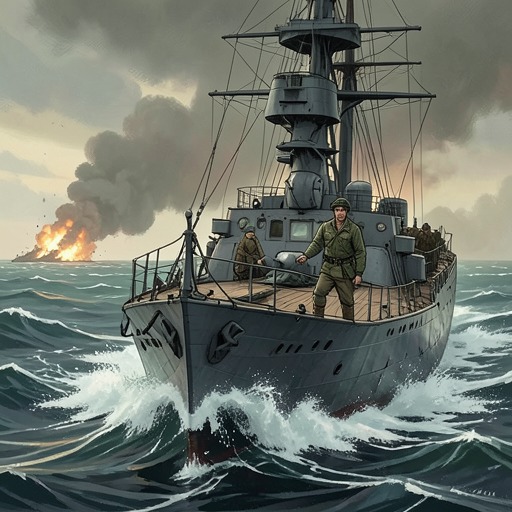
Kwajalein Atoll landing-operation area
The Caine MutinyKwajalein Atoll landing-operation area is the setting for the USS Caine’s approach to a major American assault in the Marshall Islands, and for Willie Keith’s first close exposure to a large-scale Pacific battle. The location gives the episode its double perspective: a strategically overwhelming operation, described across a vast array of ships, and a small minesweeper’s specific, precarious task of guiding attack boats toward the shore. The Caine does not arrive at the battle’s decisive point as planned; its navigational failure and subsequent position in the lagoon make Kwajalein a setting for both operational risk and the limits of Keith’s view of combat.
Strategic Setting
The novel situates the operation in a war that, from the perspective of later military histories, had already passed its great turning points. Guadalcanal, El Alamein, Midway, and Stalingrad lay in the past; Italy had surrendered, and the balance of industrial power favored the Allies. Keith’s immediate perspective is narrower and more anxious. On New Year’s Eve, he imagines the Pacific campaign ahead as a succession of dangerous islands, shore batteries, aircraft, and mines. The difference between this broad strategic picture and a junior officer’s apprehensions establishes how a location can signify both a point on a campaign map and a personal approach to danger.
Kwajalein is identified in the operation material as the largest of the atolls in the Marshall Islands, in the heart of the island group and surrounded by Japanese strongholds. The planned assault on Kwajalein Atoll and other objectives in the Marshalls was intended to establish bases for attacks farther west. The geography therefore matters as more than a destination: it is part of a sequence of operations extending the American advance across the Central Pacific.
Approach and the Caine’s Assignment
On a bright January day, a vast force of ships left Hawaiian harbors, formed into a broad circular arrangement, and set course for Kwajalein. During the approach, the formation crossed quiet seas with ships visible in every direction. Radar helped maintain the fleet’s precise arrangement while allowing it to change course or reorganize. The scale and order of the armada contrast with the particular navigation problem assigned to the USS Caine: low-lying attack boats needed assistance finding their line of departure because their own navigation would be difficult.
Keith learns that the minesweeper is to shepherd attack boats from their transport to a departure line only a thousand yards from the beach, within range of shore batteries. The mission makes the Caine’s ordinary navigational work immediately hazardous. In the approach to the line, the ship goes inside the departure point. Queeg orders a turn, and the Caine reverses course as the landing craft are left astern; a yellow dye marker spreads nearby. The intended guidance task has thus failed at the moment it matters. Kwajalein’s approach is not simply the fleet’s smooth passage toward an objective: for the Caine, it includes a specific error with consequences for its role in the landing operation.
The Lagoon and the Battle
Later that day, the Caine steams through the channel between Jacob Island and Ivan with the larger attack force. American flags fly over both islands, and the minesweeper anchors in the lagoon. Queeg orders armed guards along the ship’s sides against Japanese swimmers and dismisses the crew from battle stations. Hemmed in by transports, cargo ships, and destroyers, the Caine could not have fired toward the beach even if ordered to do so. The sailors, who had spent fourteen hours at their guns, leave their posts and go below to sleep; Keith, despite his own fatigue, goes up to watch the fighting.
The account presents the battle as strangely unlike the dramatic initiation into warfare that Keith might have expected. The American fleet’s arrival had made the result appear almost settled in advance: Japanese aircraft had been depleted in earlier fighting, and the remaining warships were too valuable to risk freely. A few thousand Japanese soldiers faced an immense concentration of ships and men. When they did not surrender, the American bombardment began. The episode thus sets the visible violence of the attack beside the prior strategic and material conditions that made resistance seem futile to the fleet.
Narrative Perspective and Historical Qualification
Kwajalein’s narrative significance lies partly in the contrast between the battle’s scale and Keith’s position within it. He is buoyant before the assault, imagining himself as a man about to risk his life, but his optimism is shaped by the fact that he will not land on a beach. His immediate danger is more likely to come from a shell, torpedo, or mine striking the ship. The veteran crew, having seen the consequences of battle, measures that risk less cheerfully. Once anchored in the lagoon, Keith watches rather than participates in the bombardment. The place therefore marks an initiation into war that is real for him but incomplete: he encounters the operation’s danger and spectacle without occupying the combatants’ same experience.
The novel also expressly cautions against treating its military geography and operations as documentary history. Its note describes the work as fiction set during World War II and says that operational times and places, ship names and missions, and naval procedures were altered. It further states that all people and events aboard the Caine are imaginary and that no ship named USS Caine existed. Kwajalein in the narrative should consequently be understood as a fictionalized setting for the novel’s account of an amphibious operation, not as a guarantee of exact historical reconstruction.