Maryk General Court-Martial
The Caine MutinyThe Maryk General Court-Martial turns a crisis aboard the USS Caine into a test of the boundary between lawful command and emergency intervention. By examining Steve Maryk’s removal of Philip Francis Queeg through formal charges, witness testimony, and psychiatric evidence, the proceeding asks not only what Maryk did but how a naval institution can judge whether the officer who holds authority was capable of exercising it.
Legal Basis and Charge
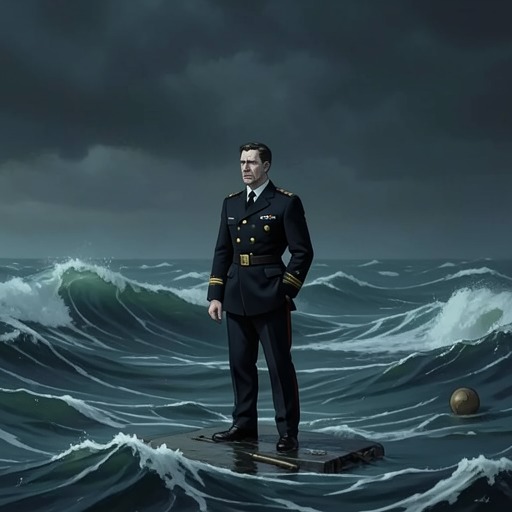
The case concerns the morning of December 18, 1944, when Maryk relieved Queeg, the USS Caine’s duly assigned commanding officer. The charge specifies that Maryk acted willfully, without proper authority or justifiable cause, while the United States was at war. Its wording makes the conflict stark: the act under review was a direct interruption of the chain of command, but the defense rested on the claim that circumstances had made intervention necessary.
The charge was not classified simply as mutiny. Captain Theodore Breakstone recognized that the affair resembled mutiny, but Maryk had invoked Article 184 of the Navy Regulations and then proceeded in a legalistic manner. Breakstone therefore considered conviction for mutiny unlikely and selected the broader charge of Conduct to the Prejudice of Good Order and Discipline, used for rare or complicated offenses. The choice captures the proceeding’s unsettled legal character: the prosecution had to address an act that challenged command, while the defense could point to a regulation governing extraordinary circumstances.
The novel places that problem against the Navy’s detailed system of military law. Its discussion of Naval Courts and Boards presents an extensive catalogue of offenses, yet that catalogue offered no charge tailored to Maryk’s unusual situation. The proceeding consequently becomes an argument over how general rules apply when command authority itself is at issue, rather than a routine inquiry into a clearly defined offense.
Courtroom and Participants
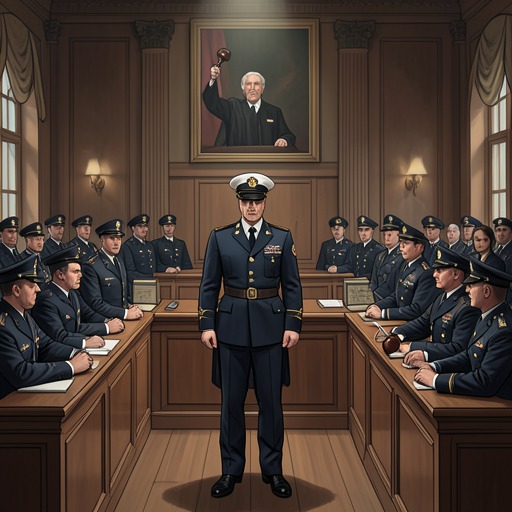
The trial convenes in a courtroom at Com Twelve on Yerba Buena Island. The room’s physical arrangement frames the accused against the institution judging him: the American flag hangs between Maryk and the windows, beyond which are sunlight, trees, and the bay. The narrative emphasizes the contrast between the open view and the confining room, making the formal setting part of Maryk’s experience of the proceeding rather than a neutral backdrop.
Seven officers sit as the court: Captain Blakely presides, with one regular lieutenant commander and five lieutenants forming the rest of the board. The group includes two reserve doctors, two regular line officers, and one reserve line officer. Blakely’s reputation as a severe disciplinarian and his distrustful expression intensify Maryk’s apprehension when he takes his place before the board. The composition also places officers with differing service backgrounds inside a single body responsible for judging the conduct of a naval officer.
Jack Challee serves as judge advocate and expects to prove the charge. The narrative gives his professional zeal a personal context: after years at sea, he had requested legal duty to spend time with his wife, and he felt some guilt that the request had been granted. He nevertheless pursues Maryk’s conviction earnestly, treating the case as his personal wartime objective. His role therefore embodies the prosecution’s institutional task, while the account also shows the individual motives and pressures carried into that task.
The Psychiatric Evidence
A central question is whether Queeg’s behavior reflected a disabling condition or traits compatible with continued command. Dr. Forrest Lundeen, chief of psychiatry at the Navy hospital and head of the medical board that examined Queeg, testifies after three weeks of continuous observation and testing. His evidence distinguishes a psychiatric description from a finding that an officer cannot perform his duties.
During cross-examination, Barney Greenwald gathers a series of traits attributed to Queeg: rigidity, feelings of persecution, unreasonable suspicion, withdrawal from reality, perfectionist anxiety, an unreal basic premise, and obsessive self-righteousness. Lundeen characterizes the symptoms as mild and well compensated. When Greenwald asks for an inclusive diagnostic term, the answer is paranoid, a word that momentarily alters the atmosphere in the courtroom without, by itself, resolving the question of fitness.
Greenwald then presses the distinction between illness and adjustment. Lundeen explains that traits associated with a condition do not automatically establish disability: the relevant issue is whether a disabling factor interferes with functioning. He also warns that a paranoid personality may appear plausible and normal on the surface, particularly in its self-justification. The testimony thus complicates any easy inference from outward manner, while also resisting the opposite shortcut of treating a diagnostic label as proof of incapacity.
Greenwald tests that standard with a hypothetical commanding officer who becomes frightened under fire and runs away, damages government property and denies it, falsifies official records, extorts money from subordinates, and imposes excessive punishments for minor offenses. Lundeen calls the question incomplete until the officer’s performance of other duties is considered; when Greenwald stipulates that those duties are performed satisfactorily, the exchange leaves the court with a functional question rather than a diagnosis alone. The conduct is presented as a hypothetical for the expert, not as an independent finding by the court that every listed act occurred.
Maryk’s Account and the Trial’s Stakes
When the defense presents its case, Maryk recounts the morning of December 18 in a version that repeats Willie Keith’s account. Greenwald asks whether the ship was in the last extremity when Maryk relieved Queeg, and Maryk answers that it was. The follow-up asks what facts support that judgment. This exchange brings the abstract dispute over regulation and psychiatric fitness back to the operational decision Maryk made aboard ship: whether the danger was immediate enough to justify taking command away from its assigned officer.
The proceeding’s significance lies in the collision of two kinds of responsibility. Naval discipline depends on a recognized commanding officer and a chain of authority; emergency action may demand that a subordinate judge whether continued obedience has become unsafe. The court’s charge records the seriousness of Maryk’s intervention, while the defense and medical testimony require the board to consider the circumstances and the commander’s capacity rather than treating rank or diagnosis as a complete answer.
The novel explicitly marks the case as fictional. Its prefatory note states that the people and events aboard the USS Caine are imaginary, that the ship itself did not exist, and that Navy records covering thirty years contained no instance of a court-martial resulting from a captain’s relief at sea under Articles 184, 185, and 186. The Maryk General Court-Martial is therefore not presented as a historical precedent; it is a constructed legal crisis through which the story examines how regulations, expert judgment, and immediate responsibility meet when command is contested.