Maryk's medical log
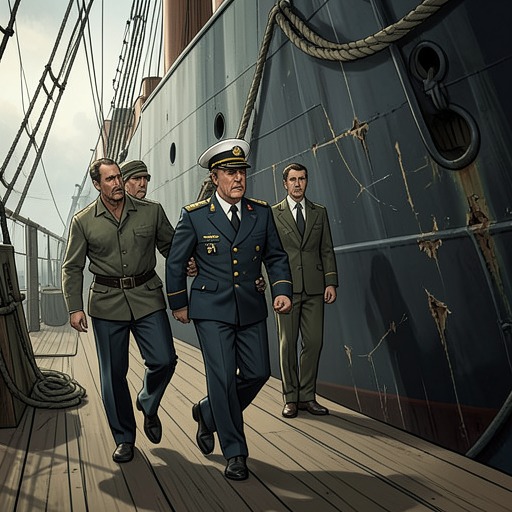
The Caine MutinyMaryk's medical log is Steve Maryk’s secret, accumulating account of Philip Francis Queeg’s eccentricities and abuses of authority aboard the USS Caine. More than a private notebook, it becomes the record Maryk turns to when he decides that Queeg may be unfit for command: a written history he hopes can speak persuasively to senior officers where he fears his own explanations will fail.
Creation, custody, and purpose
Maryk began the record under the label of a medical log on his commanding officer. He kept it in his desk safe, aware that Queeg possessed a record of the safe’s combination. One night, Maryk quietly opened the lock and reset its dials. He gave Willie Keith a sealed envelope containing the new combination and told him to open it only if Maryk died or disappeared. The log’s secrecy was therefore practical as well as personal: Maryk took steps to protect both the contents and access to them.
The document grew over a period of months. During the USS Caine’s repetitive escort assignments, Maryk continued to add incidents whenever Queeg emerged from his cabin and, in Maryk’s view, committed another minor outrage. The log thus accumulated against a backdrop of monotonous watches, paperwork, and fatigue. Its scale matters: by the time Maryk takes it out of the safe, it is not a brief complaint about one disagreement but a voluminous record formed across an extended period of shipboard life.
Its title suggests medical authority, but its contents are an officer’s written record of observed conduct, not a psychiatrist’s examination. Maryk’s eventual reliance on it rests partly on this distinction. He believes the entries establish a pattern; he does not believe that he can make the case effectively by himself. The log is both a store of incidents and a substitute for the explanation he feels unable to deliver.
Incidents and point of view
The record’s material ranges from restrictions and punishments to Queeg’s demands for investigations and written reports. Maryk noted that Queeg cut off water and coffee, and suspended movies for the entire crew for six months after the operator failed to notify him that a showing was beginning. In another episode, Queeg kept the officers in session for forty-eight hours while they tried to identify the mess boy who had burned out a Silex. They never identified the person responsible; Queeg then announced a twenty-point reduction in everyone’s fitness rating. The log’s cumulative force comes from such particulars: the duration of a punishment, the disproportion between a small incident and its consequence, and the way an individual demand bears on the ship’s routine.
A dated entry concerning Saipan makes the record’s evidentiary limits explicit. Maryk wrote that he had not witnessed the incident firsthand; instead, an officer of the deck reported that a shore battery fired on a destroyer investigating an air crash. According to that report, Queeg reversed course and left without firing, although the battery was within range and the USS Caine’s guns were manned. By preserving the source of the account in the entry itself, Maryk distinguishes what he saw from what another officer told him. The log is not presented as uniformly eyewitness testimony, and its wording records that difference.
That entry also shows the document’s reach beyond private discipline. It preserves an account of a decision under fire, setting the question of Queeg’s conduct in an operational situation alongside the many smaller incidents aboard ship. The log gathers different kinds of material, but the excerpted Saipan entry does not claim more than its source can support: Maryk records what was reported to him, rather than claiming to have seen the event himself.
Reading the record and deciding to act
At a later turning point, Maryk reread the entire log in his room after the crew had been occupied with redistributing thousands of keys. He brought the folder out of the safe, read from its first page to its last, and then asked Tom Keefer to come in. Maryk handed Keefer the document and had him read it through. Keefer recognized incidents he had forgotten and judged the accumulated record to make a strong case that Queeg was paranoid. That diagnosis is Keefer’s assessment of the log, not a conclusion established by the act of reading it.
Maryk’s purpose was more immediate than securing Keefer’s opinion. He announced that he was ready to go to the senior command on the beach and report Queeg under Article 184 of the Navy Regulations, and asked Keefer to accompany him. Maryk wanted Keefer beside him because Keefer knew psychiatry and, Maryk believed, could help present the material intelligibly to outsiders. He feared that, left to explain it alone, he would make a poor case; he saw the written record as containing what needed to be said, but believed its effect depended in part on how someone presented it.
The choice of Keefer brought a complication into this appeal to expertise. Keefer had been personally angered by Queeg’s prevention of a visit to his brother, while Maryk insisted that this grievance was beside the question of Queeg’s condition. The scene places the log between a proposed institutional case and the officers’ private feelings: its entries are offered as a record of conduct, yet those who interpret and carry it forward have their own histories with the captain. The evidence supports Maryk’s hope that the document can make his case; it does not establish that the log, by itself, secures Queeg’s removal.
Documentary force and limits
The novel later puts the question of Queeg’s mental condition and fitness for command into a formal medical and legal setting. Dr. Forrest Lundeen testified that Queeg had been observed and tested for three weeks, and described the reported symptoms as mild and well compensated. Under questioning, Lundeen stressed that a personality label did not alone resolve whether a person was disabled for a particular duty; the relevant issue was the effect on performance. This later distinction clarifies the stakes surrounding Maryk’s record without turning the log into a clinical diagnosis: documenting troubling acts and demonstrating incapacity for command are related, but not identical, tasks.
The log’s narrative significance lies in that gap. It gives Maryk a concrete means of ordering incidents that otherwise remain dispersed across the ship’s daily life, and it allows him to approach a superior authority with a record rather than an unsupported accusation. At the same time, the Saipan entry acknowledges reliance on another officer’s report, and the eventual medical testimony distinguishes personality symptoms from functional disability. The object is therefore neither an impartial verdict nor merely a private grievance: it is Maryk’s protected, accumulating attempt to turn remembered conduct into evidence strong enough to justify action.