Navy Rule Requiring One Commanding Officer per Ship
The Caine MutinyThe Navy Rule Requiring One Commanding Officer per Ship establishes the appointed captain’s authority as the governing principle aboard a naval vessel, sharply limiting a subordinate’s power to take command. In the story, that principle becomes decisive when Steve Maryk relieves Philip Francis Queeg during a typhoon: the Navy’s later review treats the intervention as improper even though USS Caine was in danger, turning a crisis decision into a test of discipline, judgment, and responsibility.
Definition and Legal Basis
The rule is expressed in the Navy’s insistence that a ship has only one commanding officer, appointed by the government. According to the official comments on Maryk’s case, a second-in-command exceeds his authority if he removes that officer irregularly without referring the matter to the highest available authority. The comments invoke Articles 184, 185, and 186 as narrowly drawn exceptions, emphasizing that their existence does not displace the normal chain of command.
The doctrine therefore distinguishes between a captain’s authority and an executive officer’s responsibility to act. A subordinate may not treat disagreement, unpopularity, or even a grave situation as a general license to assume command. Any exception is presented as rare and bounded by rules, with the officer who invokes it accountable for the decision.
Command and Daily Discipline Aboard USS Caine
The rule’s force is set against the uneven reality of life aboard USS Caine. When Queeg first addresses his officers, he declares that the ship will follow his way and that its work will be conducted by the book. His formulation makes clear that he regards the captain’s office not merely as a place in the hierarchy but as the source of the ship’s operating standards.
Yet the crew’s response to his regulations shows that formal authority does not automatically produce uniform practice. After Queeg cancels liberty over a cigarette butt, the deck is kept clean while the order is in force and becomes dirty again after the ship sails. Sailors adapt their behavior to a limited circle of the captain’s observation; beyond it, the ship’s older habits persist. The episode does not cancel the command rule, but it reveals the distance between an order’s formal reach and its practical observance.
The ship’s routines also depend on decisions made within established roles. During a watch, Willie Keith relays a request from the forward fireroom, and Maryk, serving as officer of the deck, grants permission after checking the flag and considering the wind. This ordinary exchange presents authority as a working structure of delegated judgment: orders and permissions pass through designated officers rather than requiring the captain to decide every operational detail himself.
Emergency Relief and Its Consequences
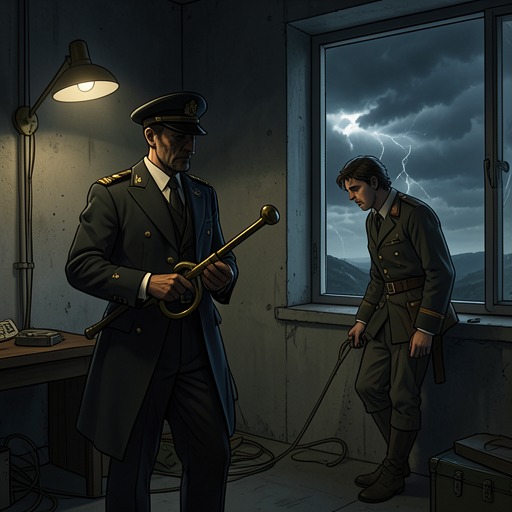
The sharpest test comes in the typhoon, when USS Caine is struck by a large wave, takes water on the bridge, and fails to answer to its engines. Maryk declares that he has taken command under Article 184, accepts responsibility for the action, and orders the ship ballasted and put on a course. The rule is no longer an abstract assurance of hierarchy: it governs whether the executive officer’s response to immediate danger is recognized as a lawful exception or condemned as an unauthorized removal.
The emergency continues after Maryk takes command. When a wreck appears ahead, he orders a hard turn and full reverse; once USS Caine is clear, he directs the crew to circle the capsized vessel twice and watch for survivors. These decisions show the practical burden carried by the officer who assumes command: his authority is asserted in the same crisis in which he must navigate the ship and respond to another vessel’s peril. The rule’s legal question and the demands of the scene are thus inseparable, though the later review judges the transfer of command by its procedural legitimacy.
Official Review and Narrative Significance
The Navy’s subsequent judgment gives the one-commanding-officer doctrine its most severe consequence. The Bureau characterizes the irregular relief of Queeg as improper performance of duty and reprimands Willie Keith for his part in it. The review also records that the medical board recommended restoring Queeg to duty and found no evidence of mental illness. The official position therefore rejects the premise that an unconfirmed diagnosis could settle the issue of command fitness.
The convening authority argues that danger intensifies rather than lessens an officer’s responsibility to preserve naval discipline. It treats the Articles’ exceptions as exceedingly rare and insists that a second-in-command cannot remove the appointed commander without first referring the matter upward when that course is available. Higher authorities concur. Although Maryk’s acquittal is disapproved, the order notes that he cannot be tried again; Willie understands that the ruling nevertheless means the end of Maryk’s naval career, while his own promotion record will carry the reprimand.
The rule’s narrative significance lies in this collision between an institution’s need for a single, identifiable source of command and the possibility that adherence to procedure may be costly in a moment of danger. The Navy’s decision does not simply settle whether Queeg’s conduct was acceptable or whether Maryk’s action was effective. It establishes that the chain of command, and the limits it places on emergency intervention, remains binding even when the ship is in peril.