Pearl Harbor
The Caine MutinyPearl Harbor is a recurring naval base in the Caine’s wartime story, linking the ship’s departure, changing assignments, and the practical business of life in the fleet. It is also a place remembered later through testimony: officers describe liquor purchased there and recount disputes over shipboard discipline. The novel makes Pearl Harbor part of the machinery of war, while its prefatory note cautions that the ship, its people, and its events are imaginary and that military details have been distorted.
Base and departure
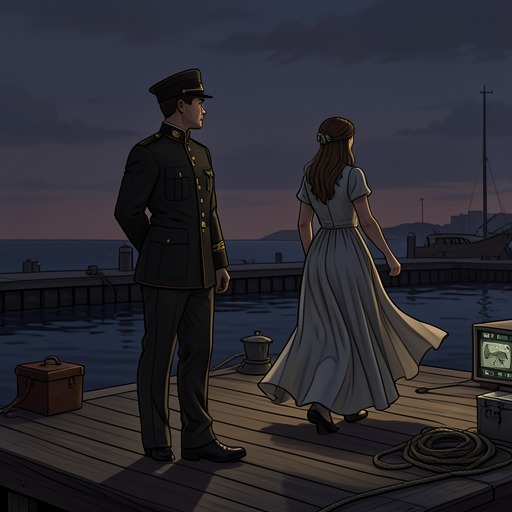
The Caine leaves Pearl Harbor at dawn in a rain squall. On the bridge, Steve Maryk reports that the ship is ready to get under way while Willie Keith, serving as junior officer of the deck, struggles to follow the rapid reports and orders. Captain de Vriess moves through the departure preparations with practiced ease. For Willie, this is an early measure of the difference between merely wearing a uniform and possessing the knowledge to command a ship: the harbor departure is both a military procedure and a lesson in seamanship.
Pearl Harbor also appears as a place where ships wait, berth, and meet one another between operations. After a minesweeping exercise, the Caine and the Moulton lie paired in one buoy berth. Once the gangplank is laid between them, Willie obtains permission to cross over and visit Keggs. The two ships are structurally identical, yet the Moulton’s clean gray decks, fresh ladder cording, and orderly crew sharply contrast with the Caine’s rust, loose and cracked life-line coverings, and untidy appearance. The comparison makes the berth more than a temporary stopping place: it lets Willie see how differently two ships can be maintained within the same naval service.
Assignments, equipment, and routine
Pearl Harbor is a point from which the Caine’s work can be redirected by orders from far above the ship. After a wardroom party to mark the officers’ departure from Pearl, Willie is woken near dawn to decode an action message. It cancels the Caine’s departure for Pago Pago, assigns the Moulton to convoy duty in its place, and keeps the Caine at Pearl Harbor for target towing, with towing gear to be obtained from the target repair base. The abrupt switch unsettles Burt Gorton, but the decoded message offers no explanation. The episode shows how a ship’s immediate future could change through a brief signal, leaving its crew to carry out an assignment rather than determine its rationale.
The target-towing duty connects Pearl Harbor to the book’s broader contrast between combat and routine naval labor. The Caine’s work is not simply a passage from one battle to another: it includes towing equipment and targets, just as other assignments involve escorting or sweeping. The setting therefore marks an operational change in the ship’s task, not an end to service. Later, a large Allied force sails from Hawaiian harbors toward Kwajalein, placing the Caine’s Pacific service within the scale of fleet operations without identifying Pearl Harbor as the departure point for that particular armada.
Pearl also figures in the less formal transactions of wartime service. During the court-martial, Philip Francis Queeg testifies that he bought up his officers’ wine-mess rations at Pearl Harbor and transported the resulting thirty-one bottles of whisky to the United States aboard the Caine. He says the crate was sealed and given locked stowage, but that he confused it with a crate of medicinal brandy. The episode makes the harbor part of the later inquiry into the captain’s decisions: a purchase made there becomes evidence considered alongside the disputed loss of the crate at sea.
Memory, testimony, and the limits of the setting
Pearl Harbor’s meaning shifts between immediate experience and retrospective account. In the ship’s wartime chronology, it is a place of departure, berthing, and reassignment. In the courtroom, it is recalled through specific details about supplies and conduct. Queeg’s testimony also disputes Willie’s account of his enforcement of uniform regulations, claiming that shirttail discipline had been a source of conflict after Queeg took command. These recollections reveal how ordinary practices associated with a ship’s service could later be drawn into arguments about responsibility and credibility.
The novel’s historical note sets a firm limit on what these scenes establish about the real Pearl Harbor or the actual Navy. It identifies the work as fiction in the setting of World War II, states that all events and people aboard the Caine are imaginary, and says that times, places, ship missions, and communication procedures have been altered. It further states that no ship named the Caine exists or existed. Pearl Harbor thus grounds the story in a recognizable wartime naval geography, but the novel explicitly warns readers not to treat the Caine’s assignments or the controversies recalled in court as a record of actual events there.