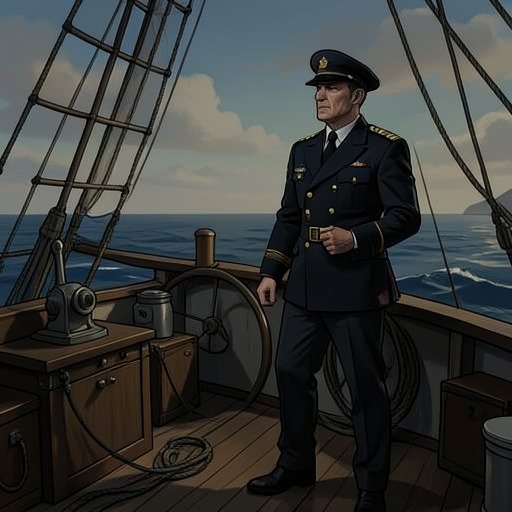
Queeg’s paranoid personality
The Caine MutinyQueeg’s paranoid personality is the psychological condition examined at Steve Maryk’s court-martial and a central issue in deciding whether Queeg could function as commanding officer under extreme stress. The testimony does not make diagnosis and incapacity interchangeable: witnesses described a pattern of suspiciousness, rigidity, anxiety, and self-justification, but disputed whether that pattern disabled Queeg for command. The distinction matters because Maryk’s defense rested on the claim that Queeg’s condition had compromised his judgment during the typhoon, not simply that he was difficult or ill.
Behavior and Command Aboard the USS Caine
Queeg’s behavior aboard the USS Caine is presented through both conspicuous rules and the crew’s adaptations to them. After finding a cigarette butt in a forecastle scupper, he canceled all liberty for the crew. The deck force then kept the main deck swept, but when the ship sailed for Kwajalein the order was shelved and the deck became dirty again except during sweeping. A sailor continued to clean the small patch between Queeg’s cabin, the bridge ladder, and the wardroom hatchway. The episode shows a rule enforced most carefully where Queeg was likely to see its observance, rather than a lasting transformation of shipboard practice.
The crew’s informal response is described as a “circle of compliance”: a zone shaped by Queeg’s habits and movements, within which new orders were followed while much of the old ship continued beyond his immediate attention. When an unexpected inspection or encounter brought some neglected matter to his notice, his disapproval could become a new shipboard rule. The crew observed such edicts within his range, while disregarding them elsewhere; the account stresses that this was not a consciously organized conspiracy. This pattern makes his authority visible as both effective and limited: he could impose rules, but could not make their observance uniform throughout the ship.
The surrounding routine offers context for that command style without, by itself, proving a diagnosis. In the wardroom, Queeg repeatedly rolled steel balls in his fingers and spoke only occasionally about the progress of work requests. Willie Keith’s days alternated among bridge watches, coding, correcting publications, hurried meals, and sleep repeatedly interrupted after only a few hours. Elsewhere, shipboard life is rendered as a grinding cycle of watches and paperwork under heat, rain, and glare. Against that shared strain, Queeg’s persistent focus on work requests and the narrowly observed rules appears as one particular way command operated aboard an overburdened ship, not as clinical evidence on its own.
Psychiatric Testimony and Diagnostic Limits
Dr. Forrest Lundeen, chief of psychiatry at the Navy hospital and head of the medical board that had examined Queeg, described the broad problem as feelings of inferiority generated by an unfavorable childhood and aggravated by adult experiences. He connected Queeg’s identity as a naval officer to his personal security: because that identity was his essential source of stability, Queeg was excessively zealous in protecting his standing. Lundeen offered this as an explanation for the harshness and ill temper he had described.
Lundeen also testified to a tendency for Queeg to revise reality in his own mind so that he emerged blameless, accompanied by a tendency to blame others. During cross-examination, Barney Greenwald drew together symptoms attributed to Queeg’s behavior: rigidity of personality, feelings of persecution, unreasonable suspicion, withdrawal from reality, perfectionist anxiety, an unreal basic premise, and an obsessive sense of self-righteousness. Lundeen accepted that the pattern could be called a paranoid personality, while maintaining that the label did not by itself establish a disabling affliction.
The courtroom’s central question was therefore functional rather than merely diagnostic. Greenwald asked whether a paranoid personality could leave a man capable of subordinate duties yet make him unfit for command, and Lundeen located the decisive point in a loss of control over oneself and the reality around oneself. Asked through a hypothetical about an officer bewildered or frightened under fire, running away, damaging government property and denying it, falsifying records, extorting money, or imposing excessive punishment for small offenses, Lundeen did not declare that such conduct necessarily proved disability. He called the officer undesirable, but said the Navy might still use such a man if war had depleted the supply of qualified commanders, accepting that choice as another war risk. His answer exposed the gap between identifying troubling conduct and establishing that a particular officer could not command.
Captain Blakely pressed a related question: whether a mild condition could cause a temporary loss of efficiency, confusion, or erroneous judgment when ordinary command stresses were multiplied by an extreme emergency. That question brought the medical dispute directly to Maryk’s decision during the typhoon. Lundeen preferred the description “an obsessive personality with paranoid features,” a formulation that retained the behavioral pattern without treating the diagnosis alone as proof of incapacity.
The Typhoon and the Dispute over Fitness
The storm supplied the practical test the courtroom could not resolve by naming a personality type. The ship struggled to hold its heading; the helmsman reported that it was falling off to port, and the vessel careened and sideslipped over the swells. Steve Maryk urged that the ship use its engines and head into the wind, while Queeg remained the commanding officer. Maryk then ordered the helmsman to hold steady, directed Willie Keith to note the time, and told Queeg he was temporarily relieving him under Article 184 of the Navy Regulations because he was a sick man. The court-martial later revisited that morning, with Greenwald asking whether the ship had been in the last extremity when Maryk acted.
These circumstances make the distinction between an enduring personality pattern and a temporary failure under extreme pressure consequential. Maryk’s action was not justified merely by a claim that Queeg was suspicious or rigid; the defense needed to connect his condition to the immediate demands of command in the storm. Conversely, the existence of a psychiatric condition did not automatically prove that he had lost command capacity at that moment. The testimony left the court to assess the threshold for intervention in an emergency, where the captain’s conduct and the danger to the ship mattered alongside the diagnosis.
Competing Interpretations at Trial
Dr. Bird offered a different account of psychological disturbance. He described a deep-seated problem buried in the unconscious that could drive strange behavior and maintain constant tension without the person knowing why. A person might compensate through willpower, daydreams, or other conscious devices, Bird said, but in his view could not adjust without psychoanalysis bringing the disturbance into awareness. He nevertheless testified that Queeg was not disabled by the disturbance. His explanation thus added a theory of hidden psychological pressure while preserving the same unresolved division between illness and occupational fitness.
In closing, Greenwald contrasted the defense’s reluctant, apologetic manner with Jack Challee’s passionate prosecution. He insisted that the defense was not calling Queeg a coward; its case rested on the assumption that a man who had risen to command a United States naval ship could not be a coward, and that questionable conduct under fire instead required examination as possible mental incompetence. Greenwald reviewed the damaging evidence against Queeg, emphasized that both psychiatrists had admitted in one form or another that he was sick, and asked the court—whose members knew the sea—to decide whether that sickness was severe enough to incapacitate him. He also pointed to Queeg’s evasiveness, incoherence, changing accounts, and inability to stop speaking in court as further evidence of illness. The argument shifted attention away from Maryk and back to the captain whose fitness the trial was testing.
Queeg’s paranoid personality therefore remains both an explanation and a limit on explanation. It helps account for his protection of his officer identity, his tendency to blame others, and a command culture in which rules could multiply around his attention without taking hold across the whole ship. But the trial’s medical evidence refuses a simple equation between those traits and unfitness. Its sharper question is whether Queeg could maintain judgment and control in an extreme emergency—and whether Maryk was justified in acting before that question could be answered by anything other than the danger unfolding aboard the ship.