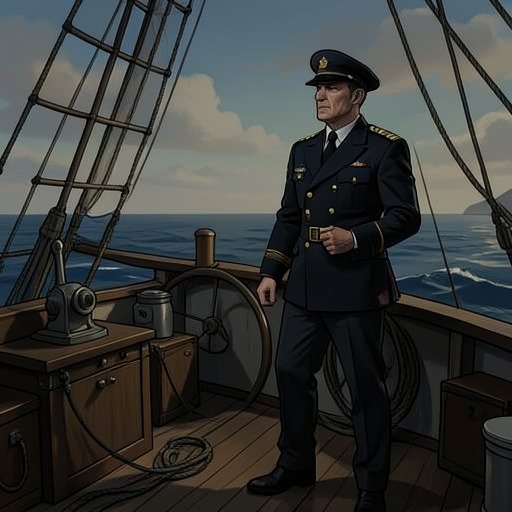
Relief of Commander Queeg aboard the USS Caine
The Caine MutinyThe relief of Commander Queeg aboard the USS Caine is the crisis at the center of the court-martial narrative: in a typhoon, executive officer Steve Maryk took command from Philip Francis Queeg because he judged that the ship and its crew faced immediate danger. Maryk’s account makes the decision neither a simple act of insubordination nor an abstract legal question. It rests on an urgent practical judgment—whether a subordinate could, and had to, act when the captain could no longer keep the vessel under control—and on the evidence he later gave to defend that judgment.
Background and mounting pressure
The crisis arose amid a long, grinding deployment. After reaching Funafuti, the USS Caine was drawn into the Seventh Fleet’s escort work, shuttling repeatedly among South Pacific ports and operating with slow landing craft. Its days blurred into watches, reports, audits, heat, and rain squalls. That routine did not itself establish that Queeg was incapable of command, but it formed the setting in which Maryk’s secret log accumulated incidents and the wardroom grew exhausted by the captain’s demands and hostility.
The crew’s experience of Queeg’s rules was uneven. After a cigarette butt was found in a forecastle scupper, he canceled liberty for the entire crew; for a time the deck force kept the main deck swept, but once the ship sailed the order was observed chiefly when someone was watching. The resulting “circle of compliance” described an informal division between the areas and moments under the captain’s direct attention and the rest of the ship, where older habits continued. The account also records the conflict around gunner’s mate John Stilwell and the crew’s wary responses to Queeg’s dislike of him. These details establish a strained command climate, not by themselves the grounds for Maryk’s action in the typhoon.
The larger war supplied a sharp counterpoint to the Caine’s monotonous service. By early 1944, major turning points had passed and Allied industrial strength was increasing; in January, a vast fleet sailed from Hawaii toward Kwajalein. Yet the Caine’s own work could remain repetitive and peripheral to the strategic spectacle. That distance between the war’s immense operations and a small ship’s daily burdens helps frame the later emergency: the decisive test of command came not in a set-piece battle but aboard an aging minesweeper in a storm.
The ship loses control
At Maryk’s court-martial, he recounted the morning of December 18 and described why he considered the ship to be in what the defense called the last extremity. According to his testimony, the Caine could not hold its course and broached three times in an hour. It rolled so steeply that the inclinometer could not register the movement, while solid water came aboard in the wheelhouse. These were not merely discomforts of rough weather in his account; they were signs that the vessel was no longer responding safely to the conditions around it.
The ship’s systems compounded the danger. Maryk testified that the generators were cutting out, the lights and gyro repeatedly failed, and the vessel did not answer emergency rudder and engine settings. Sea return jammed the radar, leaving the ship lost and out of control as he described it. His case therefore joined failures of navigation, power, and response to the physical difficulty of holding course. The accumulation matters: Maryk presented the emergency not as a single alarming roll, but as a succession of failures that together convinced him the ship could not be managed by the existing command.
Maryk said that he pointed out these conditions to Queeg repeatedly over the course of an hour and begged him to ballast the ship and head into the wind. The testimony makes the interval before the relief important. Maryk portrayed himself as warning the captain and urging specific corrective action before taking command, rather than acting at the first sign of danger. The evidence presented here records Maryk’s account of those warnings; it does not independently establish Queeg’s response to each one.
The relief and its justification
Maryk acknowledged that he relieved Queeg willfully and knew what he was doing. He denied acting without authority, identifying Articles 184, 185, and 186 as the basis for his action, and denied acting without justifiable cause. His stated justification was that Queeg had suffered a mental breakdown while the ship was in danger. That formulation placed the central dispute in two connected parts: whether the emergency was severe enough to warrant intervention, and whether the captain’s condition made intervention necessary.
The court-martial testimony supplied a practical measure of Maryk’s fitness as well as his explanation of the relief. Asked how he could substantiate his account, he pointed to what happened afterward: after taking command, he rescued five survivors from the George Black at the height of the typhoon. He argued that carrying out the rescue under those conditions was inconsistent with the claim that he had acted in panic. The rescue did not erase the legal question of authority, but in his defense it connected the decision to subsequent conduct under pressure.
The narrative also preserves an earlier pattern of strain aboard the ship without treating it as a substitute for the storm evidence. Over the months, Queeg had become more irascible and secluded; he imposed restrictions on water, coffee, and movies, demanded investigations and written reports, and once kept officers in session for forty-eight hours over a burned-out Silex. Officers were left with only a few broken hours of sleep, while Maryk continued adding to his private log. Those circumstances help explain why the relief became the culmination of a widening command conflict, but Maryk’s courtroom defense centered on the immediate loss of control and danger at sea.
Retrospective meaning
The event is reconstructed in the courtroom through testimony rather than left as an unexplained transfer of authority. Maryk repeats his account of the storm, specifies the failures he saw, describes his appeals to Queeg, and names the regulations on which he relied. The legal proceeding thus turns a compressed emergency decision into a sequence that can be examined: danger, warning, judgment, relief, and the actions that followed. The distinction between Maryk’s observations and his conclusions remains essential. The ship’s conditions are reported through his testimony, while his claim that Queeg had undergone a mental breakdown is his stated justification for taking command.
The book’s prefatory note further qualifies the event’s historical status. It identifies the Caine and the people aboard as fictional, says that operational details were altered, and notes that the author knew of no historical instance of a court-martial resulting from a captain’s relief at sea under the cited regulations. The episode therefore uses a fictional ship and a constructed crisis to examine a real institutional tension: naval discipline depends on a chain of command, yet the regulations Maryk invokes contemplate action when a commander’s conduct and the ship’s peril make ordinary obedience untenable. The storm makes that tension immediate; the trial gives it a lasting form.